
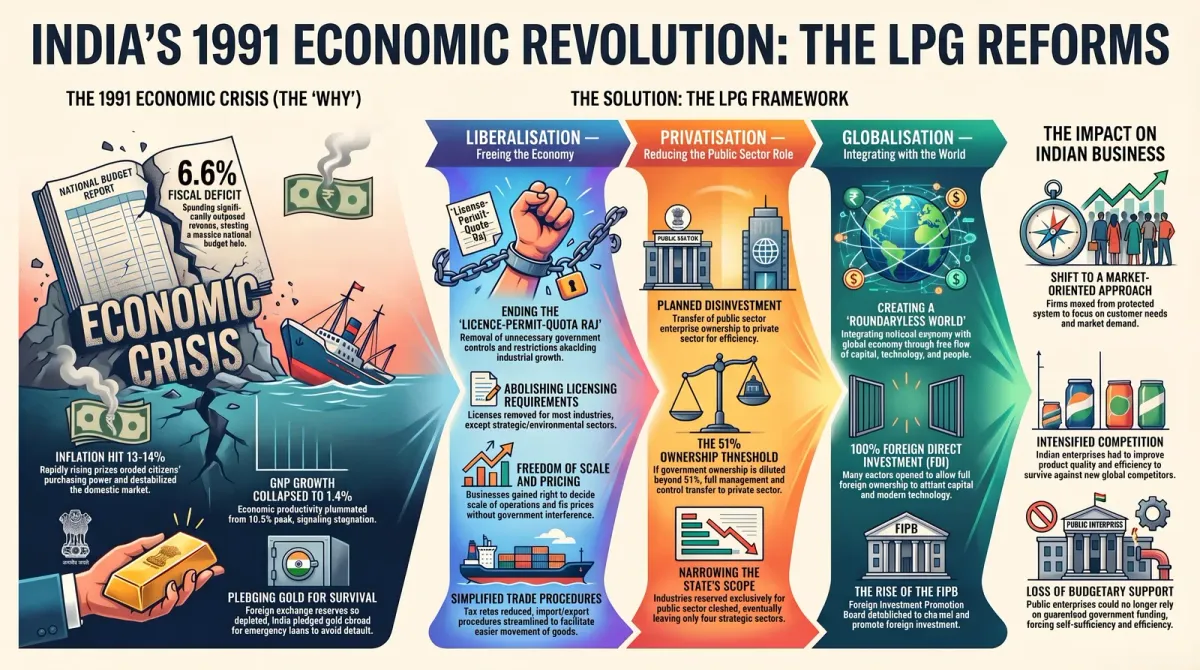
July 1991 marked a turning point in Indian economic history. Faced with a severe foreign exchange crisis, the Government of India announced a New Industrial Policy that fundamentally rewired how Indian business operated. This policy is remembered through three words that every Class 12 Business Studies student must know inside out: Liberalisation, Privatisation, and Globalisation, commonly abbreviated as LPG. This post breaks down what each of these terms means, the specific measures taken under each, and why they matter for understanding today’s business environment.
Why the Reforms Were Necessary
By the time these reforms were announced, India’s economic situation had become critical. The fiscal deficit had ballooned to unsustainable levels, GNP growth had collapsed, inflation was soaring, foreign trade was shrinking, the rupee had depreciated sharply, and foreign exchange reserves had fallen to a level barely sufficient to cover a few weeks of imports. The country was on the verge of defaulting on its international financial obligations, and the government even had to pledge gold reserves abroad to secure emergency loans. This was the backdrop against which the New Industrial Policy of July 1991 was introduced, seeking to liberate industry from the shackles of licensing, drastically reduce the role of the public sector, and encourage foreign private participation in India’s industrial development.
Liberalisation: Freeing Industry from Controls
Liberalisation refers to freeing the Indian economy from unnecessary government controls and restrictions, effectively signalling the end of the licence-permit-quota raj. It took shape across several fronts:
-
Abolishing licensing requirements in most industries, except for a short list retained for strategic or environmental reasons.
-
Freedom in deciding the scale of business activities, removing restrictions on expansion or contraction of operations.
-
Removal of restrictions on the movement of goods and services across the country.
-
Freedom in fixing prices of goods and services.
-
Reduction in tax rates and lifting of unnecessary controls over the economy.
-
Simplified procedures for imports and exports.
-
Easier access to foreign capital and technology for Indian businesses.
Privatisation: Reducing the Role of the Public Sector
Privatisation aimed at giving a greater role to the private sector in nation-building, reversing the development strategy India had pursued for decades. Through the New Industrial Policy of 1991, the government adopted a policy of planned disinvestment — transferring public sector enterprises to the private sector, which results in a dilution of government ownership. If government ownership is diluted beyond 51%, it results in a full transfer of ownership and management to the private sector. Loss-making and sick public sector enterprises were also referred to the Board of Industrial and Financial Reconstruction for resolution.
As part of these reforms, the government also reduced the number of industries under compulsory licensing to just six, dereserved many industries that were previously earmarked exclusively for the public sector (limiting its role to only four industries of strategic importance), and carried out disinvestment across numerous public sector industrial enterprises.
Globalisation: Integrating with the World Economy
Globalisation means the integration of the various economies of the world into a single, cohesive global economy. Until 1991, the Government of India had strictly regulated imports through licensing, tariff restrictions, and quantitative restrictions. The new reforms aimed at trade liberalisation focused on import liberalisation, export promotion through a rationalised tariff structure, and reforms to foreign exchange policy so that India would no longer remain isolated from the rest of the world.
Globalisation increases the level of interaction and interdependence among nations, with physical geography and political boundaries no longer acting as barriers for a business enterprise to serve customers in distant markets. A truly globalised economy implies a boundaryless world featuring free flow of goods and services, free flow of capital, free flow of information and technology, free movement of people across borders, common mechanisms for dispute settlement, and a global governance perspective.
To support this shift, several concrete measures were introduced: the share of foreign equity participation was increased, and in many activities, 100% Foreign Direct Investment (FDI) was permitted. Automatic permission was granted for technology agreements with foreign companies, and the Foreign Investment Promotion Board (FIPB) was set up specifically to promote and channelise foreign investment into India.
The Combined Impact on Business and Industry
Together, these three reforms transformed the competitive landscape for Indian enterprises. Businesses suddenly faced increasing competition, more demanding customers, and a rapidly changing technological environment. This created a necessity for change across Indian industry — firms needed to invest in developing human resources, adopt a genuinely market-oriented approach, and cope with the loss of guaranteed budgetary support that many public sector enterprises had previously relied on. In response, Indian enterprises developed a wide range of new strategies to meet the challenge of open competition, from improving product quality and efficiency to expanding into new markets themselves.
The Mindset Shift the Reforms Demanded
While the LPG reforms opened up the Indian economy, they also required a fundamental mindset shift for both businesses and managers — from operating within a protected, licence-driven system to competing openly in domestic and global markets. This shift is precisely why the “dynamic nature” and “uncertainty” features of business environment, covered earlier in this chapter, are so relevant even decades later.
Related Reading
-
Economic Environment in India: From Independence to the 1991 Crisis
-
Dimensions of Business Environment: Economic, Social, Technological, Political and Legal
-
India’s 1991 LPG Reforms Explained: Liberalization, Privatization and Globalization
Ready to Master Business Studies Chapter 3?
Strengthen your understanding of the LPG reforms with AI-powered practice questions on ChampionsPrep — just ₹10 per session, tailored for CBSE and Maharashtra Board Class 12 Commerce students.
Test Your Knowledge

Liberalisation, Privatisation and Globalisation (LPG) — The 1991 Economic Reforms
Frequently Asked Questions
What do the letters L, P, and G stand for in the 1991 reforms? +
LPG stands for Liberalisation, Privatisation, and Globalisation — the three pillars of the New Industrial Policy announced by the Government of India in July 1991.
What is meant by liberalisation in the Indian economic context? +
Liberalisation means freeing Indian industry from unnecessary government controls and restrictions, such as abolishing licensing requirements and removing restrictions on business expansion, pricing, and imports.
What does disinvestment mean under privatisation? +
Disinvestment means transferring ownership of public sector enterprises to the private sector; if government ownership dilutes below 51%, it results in a full transfer of ownership and management to private hands.
What is globalisation as explained in the 1991 reforms? +
Globalisation is the integration of India's economy with the rest of the world through trade liberalisation, easier foreign investment, and increased interaction and interdependence among nations.
Why were the LPG reforms introduced in 1991? +
They were introduced because India faced a severe economic crisis in 1991, including a high fiscal deficit, plunging foreign exchange reserves, soaring inflation, and the risk of defaulting on international obligations.
Keep practising Business Studies
AI-powered feedback and structured revision for Business Studies — free to start, at your own pace.
AI-powered practice — free to start