
To understand modern Indian business, you first need to understand where it came from. Before liberalisation transformed the country’s economic landscape, India followed a very different economic path for over four decades. This post covers the economic environment in India from Independence through to the eve of the 1991 crisis — essential background for understanding why the reforms discussed later in Chapter 3 were introduced in the first place.
What Constitutes the Economic Environment in India?
The economic environment in India consists of various macro-level factors related to the means of production and distribution of wealth that impact business and industry. These include the stage of economic development, the economic structure (India follows a mixed economy recognising both public and private sectors), government economic policies covering industry, money, and fiscal matters, economic planning through five-year plans and annual budgets, economic indices like national income and GNP growth, and infrastructural factors such as financial institutions, banks, and transport and communication facilities.
Business enterprises in India take this seriously — almost every annual company report presented by chairpersons devotes considerable attention to the general economic environment prevailing in the country and assesses its likely impact on the company’s own performance.
India’s Economic Environment at the Time of Independence
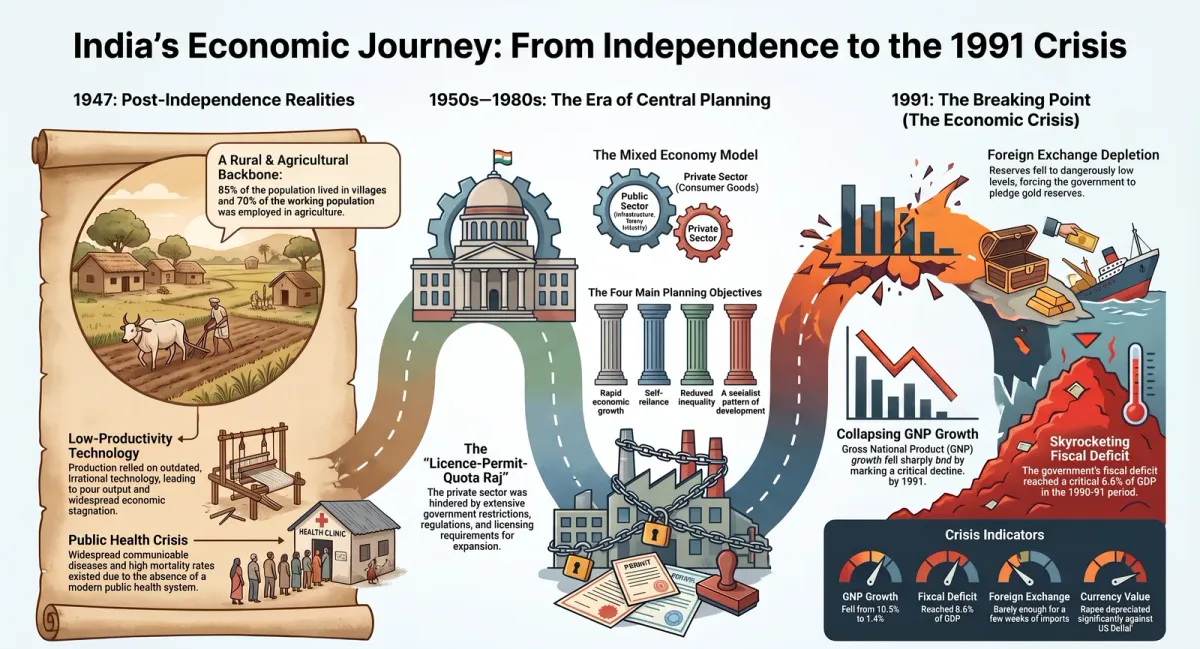
At the time of Independence, India’s economic environment looked drastically different from today. The economy was mainly agricultural and rural in character, with roughly 70% of the working population employed in agriculture and about 85% of the population living in villages. Production was carried out using low-productivity, often irrational technology, and communicable diseases were widespread, with high mortality rates due to the absence of a good public health system.
The Government’s Response: Central Planning
To solve these pressing economic problems, the government took several major steps, including state control over certain industries, central planning, and a reduced role for the private sector. India’s development plans, structured through successive five-year plans, were built around four main objectives:
-
Initiate rapid economic growth to raise the standard of living and reduce unemployment and poverty.
-
Become self-reliant and build a strong industrial base with emphasis on heavy and basic industries.
-
Reduce inequalities of income and wealth across the population.
-
Adopt a socialist pattern of development, based on equality and preventing the exploitation of man by man.
In line with this planning approach, the government took the lead role in developing infrastructure industries through the public sector, while the private sector was broadly given responsibility for consumer goods industries. At the same time, the government imposed extensive restrictions, regulations, and controls on how private sector enterprises could operate — a system that later came to be known as the “licence-permit-quota raj.”
Mixed Results Over Four Decades
India’s experience with this model of economic planning delivered genuinely mixed results. On one hand, it helped build a domestic industrial base and infrastructure that would not otherwise have existed so quickly. On the other hand, the heavy web of licensing requirements, restrictions on business expansion, and limited foreign participation gradually slowed down the efficiency and competitiveness of Indian industry compared to economies that were opening up faster.
By 1991, these underlying weaknesses came to a head. The Indian economy faced a serious foreign exchange crisis, a high government fiscal deficit, and a rising trend in prices, despite the country having enjoyed bumper agricultural crops that year. The scale of the crisis was severe: the fiscal deficit had ballooned to unsustainable levels, GNP growth had fallen sharply, foreign trade was shrinking, the rupee had depreciated significantly against the US dollar, and foreign exchange reserves had fallen so low they were barely enough to cover a few weeks of imports. The situation grew so critical that the government had to pledge gold reserves to international institutions to secure emergency loans and avoid defaulting on its financial obligations.
Why This History Matters for Understanding Business Environment
This period is not just historical trivia — it is a textbook demonstration of nearly every feature of business environment covered earlier in this chapter. The dynamic nature of the environment, its uncertainty, and its complexity are all visible in how a stable-seeming economic system built over decades could unravel within a few years due to a combination of fiscal, monetary, and trade pressures. It also sets up the crucial turning point that the next part of this chapter explores: the sweeping economic reforms of July 1991, built around liberalisation, privatisation, and globalisation, which fundamentally reshaped India’s economic environment and, with it, the operating landscape for every Indian business.
Related Reading
Ready to Master Business Studies Chapter 3?
Build a strong grasp of India’s economic history and reforms with AI-powered practice questions on ChampionsPrep — just ₹10 per session, designed for CBSE and Maharashtra Board Class 12 Commerce students.
Test Your Knowledge

Economic Environment in India: From Independence to the 1991 Crisis
Frequently Asked Questions
What did India's economic environment look like at Independence? +
It was mainly agricultural and rural, with about 70% of the working population in agriculture, 85% of people living in villages, low-productivity technology, and widespread communicable diseases due to a weak public health system.
What were the main objectives of India's early development plans? +
The objectives were to initiate rapid economic growth, achieve self-reliance with a strong industrial base, reduce income and wealth inequalities, and adopt a socialist pattern of development.
What is meant by the licence-permit-quota raj? +
It refers to the extensive system of government licensing, permits, and quotas that regulated and restricted the operations of private sector enterprises in India before the 1991 reforms.
What triggered the economic crisis of 1991? +
A combination of a high fiscal deficit, heavy internal debt, falling GNP growth, soaring inflation, shrinking foreign trade, rupee depreciation, and critically low foreign exchange reserves triggered the 1991 crisis.
Why is understanding pre-1991 India important for Business Studies students? +
Because it explains the economic conditions that led to the liberalisation, privatisation, and globalisation reforms, which are essential for understanding the business environment India operates in today.
Keep practising Business Studies
AI-powered feedback and structured revision for Business Studies — free to start, at your own pace.
AI-powered practice — free to start