
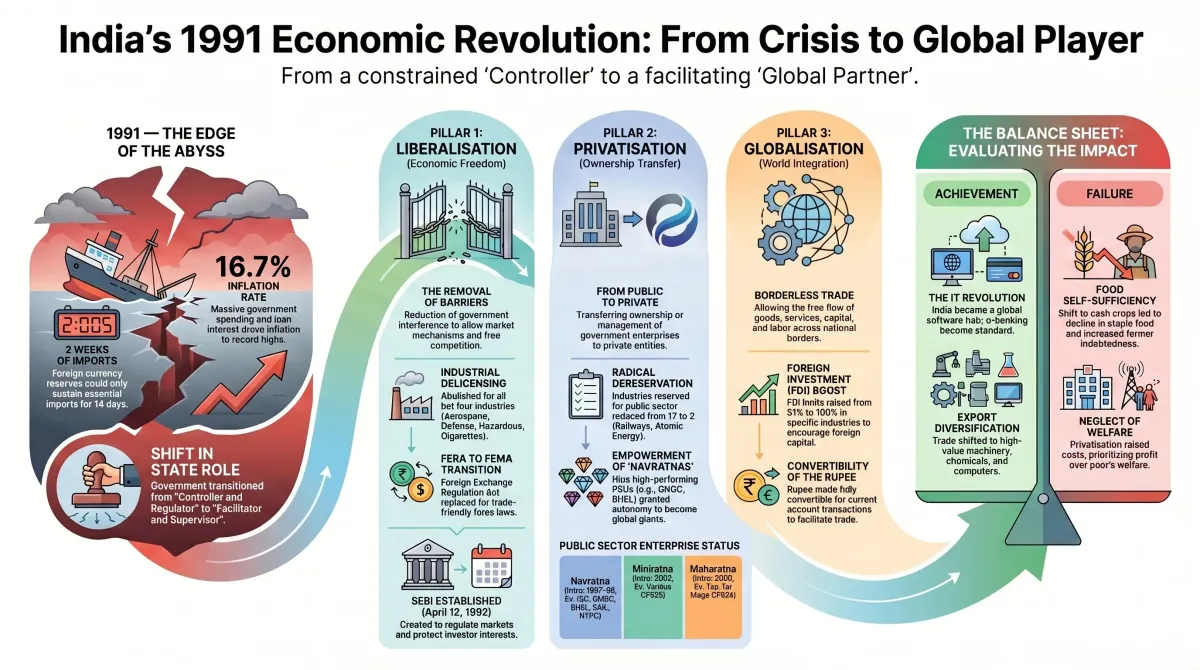
In June 1991, India was weeks away from defaulting on its international obligations. Foreign currency reserves had dropped to a level that could barely cover two weeks of imports. Inflation was at 16.7%. The government was spending far more than it earned — on defence, subsidies, and loan interest payments. India had to pledge its gold reserves to the Bank of England just to avoid a sovereign default.
Out of this crisis came the New Economic Policy (NEP) of 1991 — the most transformative economic reform in independent India’s history. Its three pillars — Liberalisation, Privatisation, and Globalisation (LPG) — fundamentally changed how the Indian economy operates. Chapter 9 of the Maharashtra State Board Class 11 Economics textbook explains what each pillar means, what specific measures were taken, and how they worked out.
The 1991 Crisis — What Went Wrong?
The process of reform had started tentatively in 1985, but the real catalyst was the 1991 foreign exchange crisis. India’s earlier “socialistic pattern of society” — heavy government control, industrial licensing, import restrictions — had created an economy that was protected but uncompetitive.
The crisis forced a fundamental role change for the Indian state: from controller and regulator to facilitator, coordinator, and supervisor. The government stopped trying to run the economy and started trying to create conditions for the economy to run itself.
Objectives of the 1991 Policy
-
Integrate India into the global economy
-
Bring down inflation
-
Correct the balance of payments crisis
-
Achieve higher economic growth
-
Build foreign exchange reserves
-
Achieve economic stabilisation and reduce the fiscal deficit
-
Establish international trade relationships with free flow of goods
-
Increase private sector participation
Key Features of the NEP
-
Delicensing: Government licences were required for almost everything before 1991. The NEP abolished licensing for most industries. Today, only 4 industries require compulsory licensing: electronic aerospace/defence equipment, industrial explosives, hazardous chemicals/drugs/pharmaceuticals, and cigarettes.
-
Abolition of MRTP Act: The Monopolies and Restrictive Trade Practices Act forced large companies to get government approval for expansion or mergers. Abolishing it freed businesses to grow.
-
Small sector encouragement: Investment limit for small-scale units raised from ₹1 crore to ₹5 crore.
-
FDI liberalisation: Foreign Direct Investment was permitted in priority industries — initially up to 51%, later raised to 74%, then 100% for specific sectors.
-
Reduced public sector reservation: Industries reserved exclusively for government went from 17 to 8, and eventually to just 2 — railways and atomic energy (from 2014).
-
Trade liberalisation: Import licensing abolished. Capital goods, raw materials, and intermediate goods made freely importable. SEZs and Agro Export Zones established.
-
Insurance reform: The IRDA Act, 1999 ended the government’s monopoly in insurance, allowing private companies to enter.
-
Financial sector reform: New private and foreign banks permitted to operate alongside existing public sector and co-operative banks.
The Three Pillars of LPG
A) Liberalisation — Economic Freedom
Meaning: Reducing or removing government barriers to free competition and market-driven decision making. Producers, consumers, and factor owners are free to make economic decisions in their own interest — the philosophy Adam Smith advocated in The Wealth of Nations.
Key measures:
-
Flexible interest rates — banks set rates based on market forces, not government diktat
-
Industrial freedom — no government-imposed production capacity limits
-
MRTP abolition — companies with ₹100+ crore assets freed from expansion restrictions
-
FERA → FEMA — the restrictive Foreign Exchange Regulation Act replaced by the trade-friendly Foreign Exchange Management Act
-
Infrastructure investment opened — domestic and foreign investors permitted in railways, roads, power
-
Foreign technology encouraged in priority industries
-
SEBI established (12th April 1992) — Securities and Exchange Board of India created to regulate stock markets and protect investors
B) Privatisation — Private Sector Takes Over
Meaning: Transferring ownership, management, or control from the public sector to the private sector. The government recognised that many public sector units were inefficient, loss-making, and draining the exchequer.
Key measures:
-
Disinvestment: Government sold shares in sick public sector companies — Maruti, ITDC Hotels, IPCL, VSNL
-
Dereservation: Industries reserved for government reduced from 17 to 2 (railways, atomic energy)
-
BIFR (Board of Industrial and Financial Reconstruction): Determined the fate of sick public units — 188 cases referred by end of 1996
-
National Renewal Board (NRB): Compensated workers retrenched or voluntarily retiring from closed loss-making units
-
Navratna Status (1997-98): Nine PSUs given full financial and managerial autonomy based on performance — IOC, ONGC, HPCL, BPCL, IPCL, VSNL, BHEL, SAIL, NTPC
-
Miniratna and Maharatna categories: Further classification empowering large CPSEs to operate as global competitors
C) Globalisation — Joining the World Economy
Meaning: Creating a global economy with free flow of goods, services, capital, labour, and technology across borders. This was the ultimate aim of the NEP — making India an integrated part of the world economy rather than a closed, self-sufficient one.
Key measures:
-
Removal of trade barriers — quantitative restrictions on imports/exports abolished; tariffs and import duties reduced
-
Foreign capital encouraged across multiple sectors
-
Rupee convertibility — made fully convertible for current account transactions
-
Foreign collaborations — landmark deals like Maruti-Suzuki, Hero-Honda, and Tata Steel’s acquisition of Corus Group (a UK-Dutch steelmaker) demonstrated India’s global integration
-
Long-term trade policy — liberalised import/export framework with SEZ incentives
-
Export promotion through EXIM policy incentives
Achievements and Failures
What Worked
-
IT sector revolution — India became a global software hub; IT became a major GDP contributor
-
Better financial services — private and foreign banks brought credit cards, e-banking, and competition
-
Education access — easier access to international education, scholarships, and education loans
-
Export diversification — India moved beyond traditional exports to machinery, chemicals, and software
-
Agricultural diversification — farmers shifted to horticulture, floriculture, and medicinal plants
-
Scarcity reduction — liberal imports addressed shortages and helped moderate inflation
What Didn’t
-
Food self-sufficiency weakened — economy oriented toward globally profitable goods at the expense of staple crop production
-
Domestic markets flooded — cheaper imports hurt Indian manufacturers who couldn’t compete on price
-
Farmer inequality — only wealthy farmers growing exportable crops benefited; poor farmers faced deeper indebtedness
-
Unequal competition — Indian entrepreneurs often couldn’t compete with well-resourced MNCs
-
Welfare erosion — privatisation of health, education, and communication raised costs and prioritised profit
-
Job losses — industries closing due to MNC competition displaced workers without adequate retraining
Exam Intelligence
How this chapter is typically tested:
| Question Type | Likely Topics | Marks |
|---|---|---|
| MCQ / Objective | Number of licensed industries (4), Navratna PSUs, SEBI year, FERA→FEMA | 1 each |
| Define / Short note | Liberalisation, privatisation, globalisation, disinvestment, Navratna | 2–3 |
| Distinguish between | Liberalisation vs Privatisation; FERA vs FEMA | 3–4 |
| Assertion-Reasoning | Linking measures to their LPG pillar | 3–4 |
| Long answer | Measures of liberalisation/privatisation/globalisation; Achievements and failures | 5–6 |
High-frequency questions:
-
“Explain the measures of liberalisation/privatisation/globalisation” — one of these appears every year
-
“What are the achievements and failures of the NEP?” — standard long answer
-
“What are Navratna companies?” — classic short note
-
“Explain the features of the Economic Policy of 1991” — comprehensive long answer
Common mistakes to avoid:
-
Confusing liberalisation measures with globalisation measures — liberalisation is about domestic freedom; globalisation is about international integration
-
Getting the Navratna list wrong — memorise all 9 (IOC, ONGC, HPCL, BPCL, IPCL, VSNL, BHEL, SAIL, NTPC)
-
Writing “4 industries need licensing” without naming them — the examiner wants the names
Frequently Asked Questions
What does LPG stand for? +
Liberalisation, Privatisation, and Globalisation — the three pillars of India's New Economic Policy adopted in 1991.
Why did India adopt the NEP in 1991? +
A severe foreign exchange crisis (reserves covering only two weeks of imports), inflation at 16.7%, and unsustainable fiscal deficits from excessive government spending on subsidies and defence.
What is the difference between liberalisation and privatisation? +
Liberalisation reduces government controls and barriers, giving economic freedom to producers and consumers. Privatisation transfers ownership or management from the public sector to the private sector. One removes rules; the other changes ownership.
What are Navratna companies? +
Nine PSUs given full financial and managerial autonomy during 1997-98 based on performance: IOC, ONGC, HPCL, BPCL, IPCL, VSNL, BHEL, SAIL, and NTPC.
How many industries currently require compulsory licensing? +
Only 4: electronic aerospace and defence equipment, industrial explosives, hazardous chemicals/drugs/pharmaceuticals, and cigarettes.
Is this chapter important for board exams? +
Very. It's one of the most heavily tested chapters, featuring assertion-reasoning questions, LPG measure classifications, and evaluation-type (achievements/failures) long answers across Maharashtra Board, CBSE, and CUET.
Keep practising Economics
AI-powered feedback and structured revision for Economics — free to start, at your own pace.
AI-powered practice — free to start