
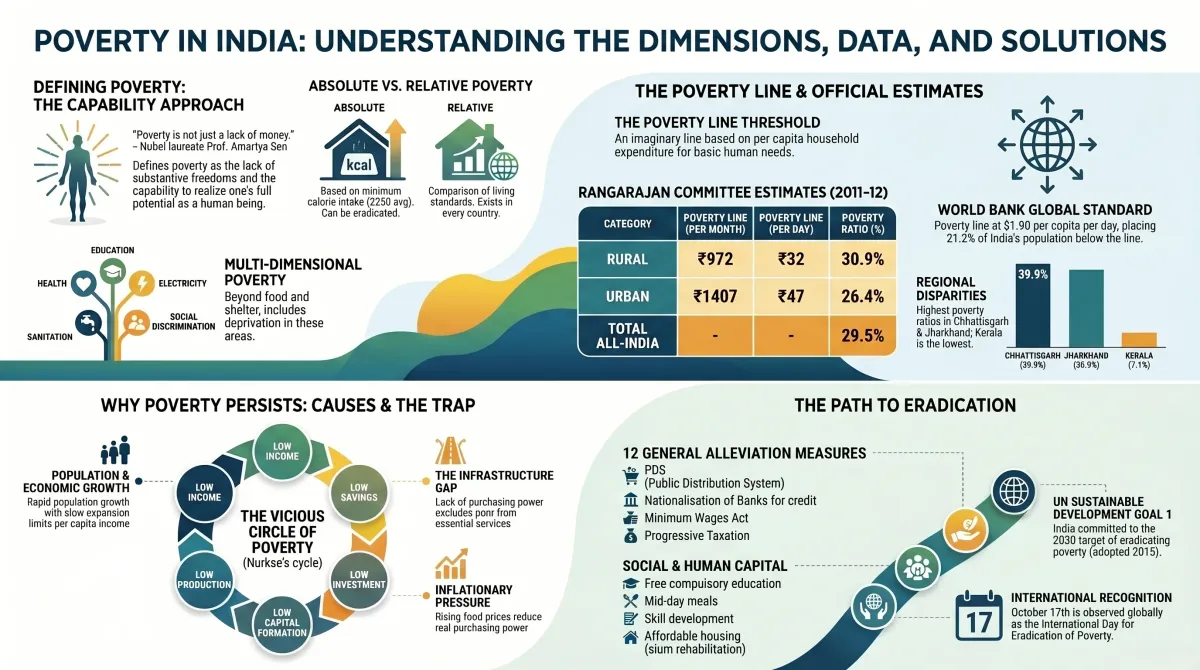
What does it mean to be poor? If your answer is “not having enough money,” you’re thinking like an economist from 50 years ago. Modern economics defines poverty far more broadly — it’s about being denied the capability to live a full human life. Chapter 8 of the Maharashtra State Board Class 11 Economics textbook examines poverty from multiple angles: what it means, how we measure it, what causes it, and what India is doing about it.
Multi-Dimensional Poverty — Beyond Just Money
The old definition of poverty was simple: not having enough for food, clothing, and shelter. Modern economics has expanded this into multi-dimensional poverty — deprivation across material dimensions (food, clothing, shelter, health, education, road connectivity, electricity, sanitation) AND non-material dimensions (social discrimination, lack of political voice).
Prof. Amartya Sen — Indian economist, Bharat Ratna recipient, and Nobel Memorial Prize in Economic Science winner (1998) — redefined poverty in a way that changed global policy. For Sen, poverty isn’t just a lack of money — it’s a lack of capability to realise one’s full potential. Capabilities mean economic, social, and political freedom. If you can’t satisfy hunger, access healthcare, get education, or exercise civil liberties, you are poor — regardless of how much cash you technically hold.
In Poverty and Famines: An Essay on Entitlement and Deprivation (1981), Sen showed that famines happen not because food doesn’t exist, but because certain groups lose their ability to access it — through declining wages, unemployment, rising food prices, or broken distribution systems. His core argument: social reforms (education, public health) must come before or alongside economic reforms for growth to actually reduce poverty.
Absolute vs Relative Poverty
This is one of the cleanest “distinguish between” questions in the entire syllabus:
Absolute Poverty is measured by a fixed standard — typically minimum calorie intake. The Planning Commission set this at 2400 calories per day (rural) and 2100 calories per day (urban), averaging 2250 calories. If your income can’t buy this minimum food requirement, you’re absolutely poor. Absolute poverty is primarily found in developing countries and can be eradicated through effective policy.
Relative Poverty is measured by comparison — how does your income, wealth, and consumption compare to others around you? Even in wealthy countries, the bottom 10% of earners are “relatively poor” compared to the top 10%. Relative poverty exists everywhere in the world and can never be completely eradicated, only reduced. As long as inequality exists, relative poverty exists.
Exam anchor: Absolute = fixed standard, can be eradicated. Relative = comparative, can only be reduced. These two distinctions answer 90% of what the examiner wants.
The Poverty Line
The Poverty Line is an imaginary dividing line between the poor and the non-poor, determined by per capita household expenditure. The NITI Aayog Task Force on Eliminating Poverty defines it as the threshold expenditure necessary to purchase a basket of goods considered essential for basic human needs.
Objectives
-
Identify who is Above Poverty Line (APL) and Below Poverty Line (BPL)
-
Track poverty over time and compare across regions
-
Estimate the budget needed for poverty alleviation programmes
World Bank Definition
The World Bank sets the international poverty line at $1.90 per capita per day (2011 PPP prices). By this measure, 21.2% of India’s population was below the poverty line.
Updated context: The World Bank revised its poverty line to $2.15/day (2017 PPP) in September 2022. Your textbook uses the $1.90 figure — use that in exams unless a question specifically asks about the updated line.
The Rangarajan Committee (2014)
In 2012, an Expert Group under Dr. C. Rangarajan was constituted to review India’s poverty line methodology. It submitted its report in 2014 with these estimates for 2011-12:
| Monthly (per capita) | Daily (per capita) | Poverty Ratio | |
|---|---|---|---|
| Rural | ₹972 | ₹32 | 30.9% |
| Urban | ₹1,407 | ₹47 | 26.4% |
| All-India | — | — | 29.5% |
States with highest poverty: Chhattisgarh (39.9%), Jharkhand (36.9%), Bihar (33.7%), Odisha (32.6%) States with lowest poverty: Kerala (7.1%), Andhra Pradesh (9.2%)
Memory hack: Rural = ₹972 ≈ “under a thousand.” Urban = ₹1,407 ≈ “about fourteen hundred.” Total = 29.5% ≈ “roughly three in ten Indians.” These three numbers cover most data questions from this chapter.
Types of Poverty
Rural Poverty: Concentrated among small and marginal farmers, agricultural labourers, contractual workers, and the landless. Driven by low agricultural productivity, drought, poor infrastructure, illiteracy, lack of alternative employment, and rural indebtedness.
Urban Poverty: Affects migrant communities, slum dwellers, and informal sector workers. Caused by uncontrolled migration, lack of affordable housing, illiteracy, slow industrial growth, and inadequate infrastructure. Urban poverty drives the growth of slums.
Causes of Poverty in India
-
Population explosion — resources spread thinner across a rapidly growing population
-
Slow economic growth — particularly in agriculture and labour-intensive industries
-
Unemployment and underemployment — the most direct cause of low household income
-
Economic inequalities — vast gaps in income, assets, landholdings, and credit access
-
Infrastructure inaccessibility — the poor can’t access energy, transport, health, or education
-
Inflation — rising food prices hit the poor hardest because food is their largest expense
-
Regional imbalance — states like Bihar, Odisha, Jharkhand, and Chhattisgarh lag far behind
-
Vicious Circle of Poverty — the most important theoretical concept in this chapter
The Vicious Circle of Poverty (Prof. Ragnar Nurkse)
This is a self-reinforcing trap: low national income → low savings → low investment → low capital formation → low production → less employment → low national income again. The cycle feeds itself. Breaking it requires a deliberate external intervention — foreign aid, massive public investment, or structural reform — because the system has no internal mechanism to escape.
- Other factors: Natural disasters, caste/religious/gender discrimination, administrative inefficiency, corruption, and leakages in the Public Distribution System.
Measures to Eradicate Poverty
Twelve measures — this is a standard “list any 6” long answer question:
-
Population control — Family Welfare Programme and population policies
-
Agricultural support — cheap credit and Minimum Support Prices
-
Rural employment — roads, irrigation, and electrification projects
-
Rural industrialisation — small-scale and cottage industries
-
Minimum wages — Minimum Wages Act, 1948 (revised periodically)
-
Public Distribution System — subsidised food through ration shops
-
Bank nationalisation (1969, 1980) — financial inclusion through low-interest credit
-
Progressive taxation — reducing inequality through higher tax rates on higher incomes
-
Education — free primary education, girls’ education, mid-day meals
-
Affordable housing — slum rehabilitation and housing schemes
-
Healthcare — primary health centres and subsidised government hospitals
-
Skill development — vocational training and self-employment promotion
UN Sustainable Development Goals
Adopted in September 2015, the SDGs comprise 17 goals and 169 targets to be achieved by 2030. India is committed to SDG 1: End poverty in all its forms everywhere as a signatory nation.
17th October is observed as the International Day for Eradication of Poverty.
Exam Intelligence
How this chapter is typically tested:
| Question Type | Likely Topics | Marks |
|---|---|---|
| MCQ / Objective | Rangarajan figures, World Bank line, Sen's Nobel year, SDG target year | 1 each |
| Define / Short note | Absolute poverty, relative poverty, poverty line, vicious circle | 2–3 |
| Distinguish between | Absolute vs Relative poverty; Rural vs Urban poverty | 3–4 |
| Explain | Amartya Sen's view on poverty; Vicious Circle of Poverty | 4–5 |
| Long answer | Causes of poverty (any 6); Measures to eradicate poverty (any 6) | 5–6 |
High-frequency questions:
-
“Distinguish between absolute and relative poverty” — appears nearly every exam
-
“Explain the Vicious Circle of Poverty” — standard long answer, often with a diagram
-
“Explain any 6 measures to eradicate poverty” — very frequent
-
“What are the views of Amartya Sen on poverty?” — common 4-5 mark question
-
“What is the Rangarajan Committee’s poverty line?” — MCQ or short note
Common mistakes to avoid:
-
Writing “poverty can be eradicated” without specifying which type — absolute can, relative cannot
-
Forgetting the Rangarajan Committee year (2014 report) and confusing it with other committees
-
Describing the Vicious Circle without showing it as a circular flow — draw the diagram, don’t just write paragraphs
Frequently Asked Questions
What is the difference between absolute and relative poverty? +
Absolute poverty is measured against a fixed minimum standard (calorie intake) and can be eradicated. Relative poverty is measured by comparing living standards across groups, exists in every country, and can only be reduced.
What is Amartya Sen's view on poverty? +
Sen argued poverty is not just lack of money but lack of capability to realise one's full potential — spanning economic, social, and political freedom. He won the Nobel Prize in Economic Science in 1998 for this work.
What did the Rangarajan Committee recommend? +
The Rangarajan Committee (2014) set the poverty line at ₹972/month for rural areas and ₹1,407/month for urban areas, giving an all-India poverty ratio of 29.5% for 2011-12.
What is the Vicious Circle of Poverty? +
A concept by Prof. Ragnar Nurkse describing a self-reinforcing trap: low national income → low savings → low investment → low capital formation → low production → less employment → low national income again. It requires external intervention to break.
What is the World Bank's poverty line? +
$1.90 per capita per day at 2011 PPP prices (updated to $2.15 at 2017 PPP in 2022). By the textbook measure, 21.2% of India's population was below this line.
Is the Poverty chapter important for board exams? +
Yes. Absolute vs relative poverty, Amartya Sen's views, Rangarajan Committee figures, causes of poverty, and alleviation measures are heavily tested — including in assertion-reasoning format.
Keep practising Economics
AI-powered feedback and structured revision for Economics — free to start, at your own pace.
AI-powered practice — free to start