
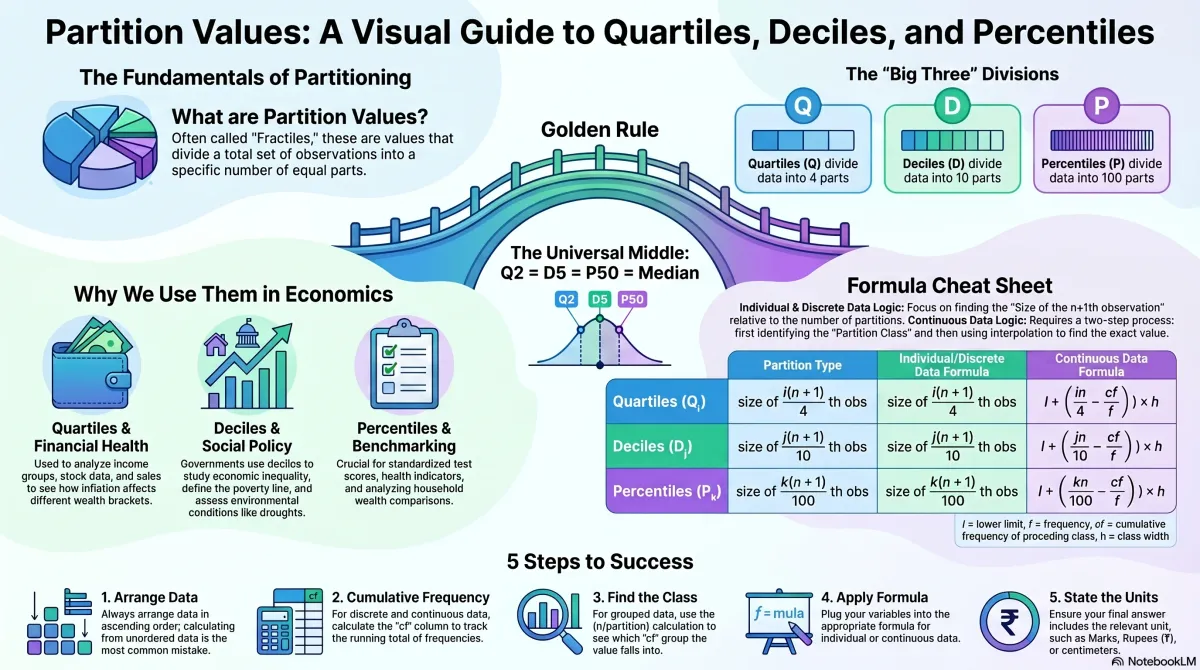
Averages lie. If Mukesh Ambani walks into a room of 50 people earning ₹30,000 a month, the “average” income in that room shoots past ₹1 crore — but nobody in the room actually got richer. This is exactly why we need Partition Values — tools that tell you what’s happening across the entire spread of data, not just the centre. Chapter 3 of the Maharashtra State Board Class 11 Economics textbook introduces Quartiles, Deciles, and Percentiles — and this is the one chapter where practice matters more than theory.
What Are Partition Values?
You already know one partition value from Class X — the Median, which splits data into two equal halves. Partition values extend this idea further:
-
Quartiles (Q): Divide data into 4 equal parts — Q1, Q2, Q3
-
Deciles (D): Divide data into 10 equal parts — D1 through D9
-
Percentiles (P): Divide data into 100 equal parts — P1 through P99
The relationship that ties them together: Q2 = D5 = P50 = Median. The second quartile, fifth decile, and 50th percentile are all the same value — the middle of the dataset.
Why Do Partition Values Matter?
In economics, these aren’t abstract statistics — they drive real policy:
-
Quartiles are used to study income inequality, stock performance, and survey data. When economists say “the bottom 25% of earners,” they mean everyone below Q1.
-
Deciles help governments set poverty lines, measure drought severity, and evaluate portfolio returns.
-
Percentiles are used in test scores (your board exam percentile!), health indicators, and household wealth analysis.
The Formula Pattern
Here’s the good news: all three partition values use the same formula structure. Learn the pattern once, and you can calculate any of them.
For Individual / Ungrouped Discrete Data
| Partition Value | Formula |
|---|---|
| Qᵢ (i = 1, 2, 3) | Size of i(n+1)/4th observation |
| Dⱼ (j = 1 to 9) | Size of j(n+1)/10th observation |
| Pₖ (k = 1 to 99) | Size of k(n+1)/100th observation |
For Continuous (Grouped) Data
| Partition Value | Step 1: Find the class | Step 2: Interpolate |
|---|---|---|
| Qᵢ | in/4 th observation | l + ((in/4 − cf) / f) × h |
| Dⱼ | jn/10 th observation | l + ((jn/10 − cf) / f) × h |
| Pₖ | kn/100 th observation | l + ((kn/100 − cf) / f) × h |
Where: l = lower limit of the relevant class, f = frequency of that class, cf = cumulative frequency of the class before it, h = class width.
The pattern: The only thing that changes across quartiles, deciles, and percentiles is the denominator — 4, 10, or 100. Everything else is identical. If you can calculate Q1, you can calculate D7 or P65 by changing one number in the formula.
Worked Examples — Quartiles
Individual Data
Problem: Find Q1 and Q3 for marks: 40, 85, 84, 83, 82, 69, 68, 65, 64, 55, 45
Step 1: Arrange in ascending order (never skip this!): 40, 45, 55, 64, 65, 68, 69, 82, 83, 84, 85 → n = 11
Step 2: Apply formula:
-
Q1 = size of 1(11+1)/4 = 3rd observation = 55
-
Q3 = size of 3(11+1)/4 = 9th observation = 83
Continuous Data
Problem: Rainfall data — classes 20-30, 30-40, 40-50, 50-60 with frequencies 7, 20, 17, 6 (n = 50)
Build the cumulative frequency table first:
| Class | Frequency | Cumulative Frequency |
|---|---|---|
| 20–30 | 7 | 7 |
| 30–40 | 20 | 27 |
| 40–50 | 17 | 44 |
| 50–60 | 6 | 50 |
For Q1: n/4 = 12.5 → falls in the class where cf first reaches or exceeds 12.5 → class 30–40 (cf = 27)
-
l = 30, f = 20, cf of previous class = 7, h = 10
-
Q1 = 30 + ((12.5 − 7) / 20) × 10 = 30 + 2.75 = 32.75
For Q3: 3n/4 = 37.5 → falls in class 40–50 (cf = 44)
-
l = 40, f = 17, cf of previous class = 27, h = 10
-
Q3 = 40 + ((37.5 − 27) / 17) × 10 = 40 + 6.18 = 46.18
Worked Examples — Deciles
Individual Data
Problem: Find D4 and D8 from: 10, 15, 7, 8, 12, 13, 14, 11, 9
Ascending order: 7, 8, 9, 10, 11, 12, 13, 14, 15 → n = 9
-
D4 = size of 4(9+1)/10 = 4th observation = 10
-
D8 = size of 8(9+1)/10 = 8th observation = 14
Continuous Data
Problem: Marks of 100 students — classes 0-10, 10-20, 20-30, 30-40, 40-50 with frequencies 10, 10, 40, 20, 20
| Class | Frequency | Cumulative Frequency |
|---|---|---|
| 0–10 | 10 | 10 |
| 10–20 | 10 | 20 |
| 20–30 | 40 | 60 |
| 30–40 | 20 | 80 |
| 40–50 | 20 | 100 |
For D5: 5(100)/10 = 50 → class 20–30 (cf = 60)
- D5 = 20 + ((50 − 20) / 40) × 10 = 20 + 7.5 = 27.5 marks
For D7: 7(100)/10 = 70 → class 30–40 (cf = 80)
- D7 = 30 + ((70 − 60) / 20) × 10 = 30 + 5 = 35 marks
Worked Examples — Percentiles
Individual Data
Problem: Find P40 for: 10, 15, 8, 16, 19, 11, 12, 14, 9
Ascending: 8, 9, 10, 11, 12, 14, 15, 16, 19 → n = 9
P40 = size of 40(9+1)/100 = 4th observation = 11
Continuous Data
Problem: Marks data — classes 0-5, 5-10, 10-15, 15-20, 20-25 with frequencies 3, 7, 20, 12, 8 (n = 50)
| Class | Frequency | Cumulative Frequency |
|---|---|---|
| 0–5 | 3 | 3 |
| 5–10 | 7 | 10 |
| 10–15 | 20 | 30 |
| 15–20 | 12 | 42 |
| 20–25 | 8 | 50 |
For P65: 65(50)/100 = 32.5 → class 15–20 (cf = 42)
- P65 = 15 + ((32.5 − 30) / 12) × 5 = 15 + 1.04 = 16.04
Step-by-Step Approach for Any Problem
-
Arrange data in ascending order — this is mandatory. Partition values are meaningless on unordered data.
-
For discrete data, list frequencies and calculate cumulative frequency.
-
For continuous data, build the cumulative frequency table and identify the relevant class.
-
Apply the formula — same structure every time, just change the denominator (4, 10, or 100).
-
State your answer with units (marks, ₹, cm, etc.).
Exam Intelligence
How this chapter is typically tested:
| Question Type | Likely Topics | Marks |
|---|---|---|
| MCQ / Objective | Q2 = D5 = P50 relationship, number of quartiles/deciles/percentiles | 1 each |
| Short note | Meaning and need for partition values | 2–3 |
| Numerical | Calculate Q1/Q3 from individual or continuous data | 4–5 |
| Numerical | Calculate specific deciles or percentiles from continuous data | 4–5 |
High-frequency questions:
-
“Calculate Q1 and Q3 from the given data” — appears almost every exam (individual AND continuous)
-
“What is the relationship between Q2, D5, and P50?” — classic MCQ or 1-mark question
-
“Calculate D4/D7/P65 from grouped data” — standard numerical
-
“Why are partition values needed?” — short answer
Where students lose marks:
-
Forgetting to arrange data in ascending order — the #1 error. Some students start calculating on unsorted data and get nonsensical answers.
-
Using the wrong formula — discrete data uses (n+1) in the formula; continuous data uses just (n). Mixing these up is fatal.
-
Misidentifying the class — in continuous data, the “relevant class” is where the cumulative frequency first equals or exceeds the calculated position. Students sometimes pick the wrong class, especially when two classes have similar frequencies.
-
Not showing the cumulative frequency table — even if you get the right answer, not showing your cf table can cost process marks.
Related Reading on ChampionsPrep
Frequently Asked Questions
What is the relationship between Q2, D5, and P50? +
They're all identical — each equals the Median. Q2 divides data at the 50% mark from quartiles, D5 from deciles, and P50 from percentiles. Same value, three names.
How many quartiles, deciles, and percentiles are there? +
3 quartiles (Q1, Q2, Q3) dividing data into 4 parts. 9 deciles (D1–D9) dividing data into 10 parts. 99 percentiles (P1–P99) dividing data into 100 parts.
Why must data be arranged in ascending order? +
Partition values depend on the position (rank) of observations. Without ordering, "the 3rd observation" is meaningless — it changes depending on how you happen to list the data.
How are quartiles used in economic analysis? +
Income quartiles compare how different income groups are affected by wage changes and inflation — making them essential tools for measuring inequality and evaluating policy impact.
What's the key formula difference between individual and continuous data? +
Individual data uses (n+1) to find the position. Continuous data uses just (n) to identify the class, then interpolates within that class using the standard formula. Mixing up (n+1) and (n) is a common exam error.
Are partition values heavily tested in board exams? +
Yes — and almost always as numerical problems worth 4–5 marks. You'll typically get one quartile problem and one decile or percentile problem. Showing the cumulative frequency table and identifying the correct class are essential for full marks.
Keep practising Economics
AI-powered feedback and structured revision for Economics — free to start, at your own pace.
AI-powered practice — free to start