
India produces millions of graduates every year — and millions of them can’t find jobs that match their skills. Meanwhile, farms are overcrowded with workers who add nothing to output, and factories replace human hands with machines. Unemployment isn’t one problem — it’s many different problems wearing the same name. Chapter 7 of the Maharashtra State Board Class 11 Economics textbook breaks down these different types, explains what causes each one, and surveys the government schemes designed to address them.
The key to this chapter: don’t memorise types of unemployment as a list. Understand why each type exists, and you’ll be able to identify them in any scenario the examiner throws at you.
Meaning of Unemployment
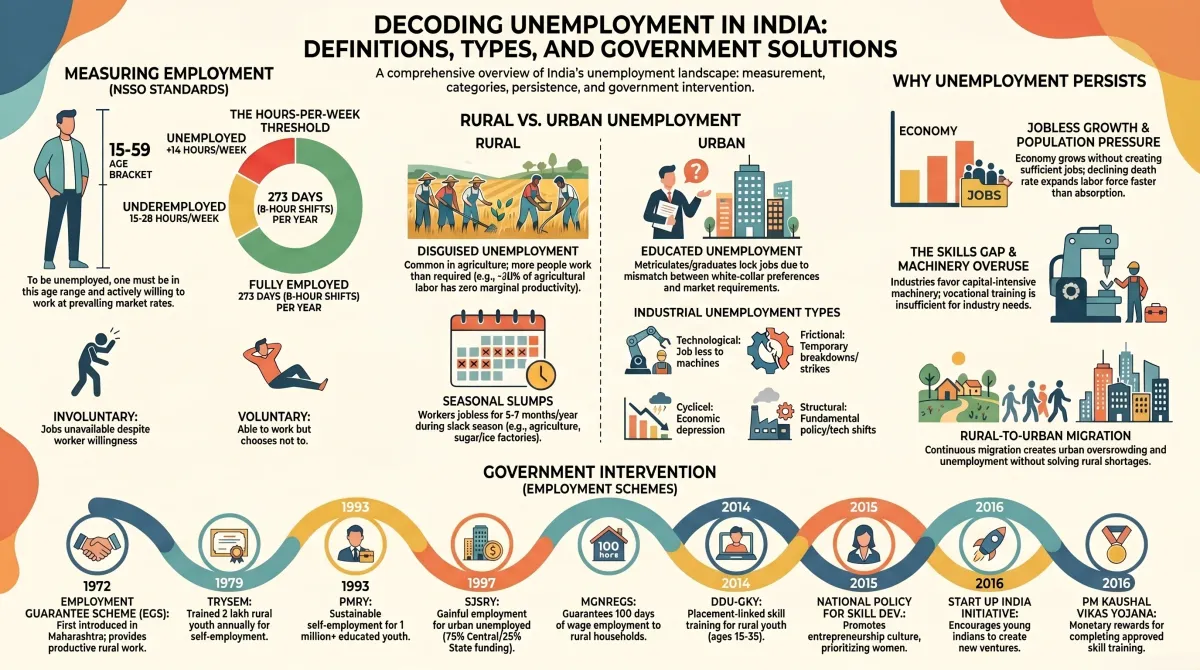
Unemployment is when people in the age group of 15 to 59 years who are able and willing to work at the prevailing wage rate cannot find jobs.
The NSSO (National Sample Survey Organisation) provides specific thresholds:
-
Working less than 14 hours per week = unemployed
-
Working 15–28 hours per week = underemployed
-
Working 8 hours per day, 273 days per year = fully employed
Important distinctions: involuntary unemployment means you want work but can’t find it. Voluntary unemployment means you could work but choose not to. Underemployment means you have a job but your capacity is being wasted — a postgraduate working as a peon, for example.
Types of Unemployment
A) Rural Unemployment
1. Seasonal Unemployment
Agriculture depends on the monsoon and has distinct busy and slack seasons. Farm labourers may work intensively during sowing and harvesting but remain idle for 5–7 months during the off-season. This also affects workers in tourism, sugar factories, ice factories, and fisheries — any industry tied to seasonal demand.
2. Disguised Unemployment
This is the most important concept in this chapter — and the most frequently tested. Disguised unemployment (also called invisible unemployment) occurs when more workers are engaged in a task than the task actually requires. The surplus workers have zero marginal productivity — remove them, and output stays exactly the same.
Example that makes it click: A farm needs 5 workers to harvest 10 quintals of crop. But because the family has 16 members and no alternative jobs exist, all 16 work on the harvest. Output is still 10 quintals. The extra 11 workers are disguisedly unemployed — they’re technically “working” but contributing nothing to production.
This happens because of the joint family system (everyone shares the family farm), overdependence on agriculture, and absence of alternative rural employment. An estimated 20% of India’s agricultural labour force is disguisedly unemployed.
B) Urban Unemployment
1. Educated Unemployment
When people with degrees — matriculates, graduates, post-graduates — are willing to work but can’t find jobs. The causes are structural: education systems that don’t teach employable skills, a mismatch between what jobs exist and what graduates expect, and a cultural preference for white-collar jobs that leads educated youth to reject available blue-collar work.
2. Industrial Unemployment
Unemployment among skilled and unskilled workers in the industrial sector. It takes four forms:
Technological unemployment: New technology (automation, AI, robotics) requires fewer workers. Existing workers get displaced because they lack the skills the new technology demands. This is increasingly relevant — and will only grow.
Frictional unemployment: Temporary disruptions — machinery breakdown, power failure, raw material shortage, worker strikes. Short-lived and self-correcting.
Cyclical unemployment: Caused by economic downturns. During a recession, demand falls → businesses cut production → workers lose jobs. When the economy recovers, these jobs return. It follows the trade cycle.
Structural unemployment: The deepest and most persistent form. Arises when the economy’s structure fundamentally changes — a policy shift, industry relocation, or technology disruption that makes entire skill sets obsolete. Horse-cart drivers displaced by auto-rickshaws. Manual typists replaced by computers. These workers can’t simply wait for recovery — they need entirely new skills.
Causes of Unemployment in India
-
Jobless growth: India’s economy has grown, but not in ways that generate proportional employment. GDP goes up while job creation lags behind.
-
Labour force expansion: Declining death rates without corresponding birth rate decline have swelled the working-age population faster than the economy can absorb.
-
Capital-intensive production: Excessive use of machinery substitutes human labour even in a labour-abundant economy.
-
Skills gap: Vocational training doesn’t match industry needs, creating a paradox: unemployed workers alongside unfilled positions.
-
White-collar preference: Educated youth prefer to remain unemployed rather than accept manual or self-employment they consider beneath their qualifications.
-
Seasonal agriculture: Farm work is available for only part of the year.
-
Slow development: Inadequate industrial expansion, poor irrigation, and weak infrastructure have limited rural employment.
-
Rural-urban migration: People move to cities hoping for jobs, adding to urban unemployment without proportionally reducing rural unemployment.
Government Employment Schemes
This is a memorisation-heavy section. The examiner expects you to know the scheme name, year, and one key feature.
| # | Scheme | Year | Key Feature |
|---|---|---|---|
| 1 | Employment Guarantee Scheme (EGS) | 1972 | First in Maharashtra; productive rural employment |
| 2 | TRYSEM | 1979 | Trained 2 lakh rural youth/year for self-employment |
| 3 | Jawahar Rozgar Yojana (JRY) | 1989 | Wage employment in 120 backward districts |
| 4 | SJSRY | 1997 | Urban unemployed; Centre 75%, State 25% |
| 5 | SGSY | 1999 | Only self-employment scheme for rural poor |
| 6 | PMRY | 1993 | Self-employment for 1 million+ educated youth |
| 7 | MGNREGS | 2005/2009 | 100 days guaranteed wage employment per rural household |
| 8 | DDU-GKY | 2014 | Placement-linked skill training, ages 15–35 |
| 9 | Skill Development Policy | 2015 | Promotes entrepreneurship, prioritises women |
| 10 | Start Up India | Jan 2016 | Encourages new ventures by young Indians |
| 11 | PMKVY | 2016–20 | Monetary rewards for completing skill training; ₹12,000 crore budget |
MGNREGS is the most important scheme in this list. Originally launched as NREGA in 2005, renamed after Mahatma Gandhi in 2009. It guarantees at least 100 days of wage employment per year to at least one adult member of every rural household willing to do unskilled manual work. This guarantee mechanism is what makes it unique.
Exam Intelligence
How this chapter is typically tested:
| Question Type | Likely Topics | Marks |
|---|---|---|
| MCQ / Objective | MGNREGS guarantee days, EGS state, scheme years | 1 each |
| Define / Short note | Disguised unemployment, structural unemployment, underemployment | 2–3 |
| Distinguish between | Seasonal vs Disguised; Cyclical vs Structural; Voluntary vs Involuntary | 3–4 |
| Explain with example | Types of unemployment (any 4); Causes of unemployment (any 4) | 4–5 |
| Long answer | Government employment schemes (any 6 with details) | 5–6 |
High-frequency questions:
-
“Explain disguised unemployment with an example” — the single most-asked question from this chapter
-
“Explain any 4 types of unemployment” — standard long answer
-
“Explain any 5 government employment schemes” — frequently asked
-
“What are the causes of unemployment in India?” — common long answer
Common mistakes to avoid:
-
Confusing disguised with seasonal unemployment — disguised has zero marginal productivity; seasonal is about time of year
-
Writing “MGNREGA” when the textbook uses “MGNREGS” (Scheme vs Act — both are used, but match your textbook’s convention)
-
Forgetting that EGS started in Maharashtra (1972) — this is a favourite MCQ, especially in Maharashtra Board exams
Frequently Asked Questions
What is disguised unemployment? +
When more workers are employed than a task requires, and the surplus workers have zero marginal productivity. Removing them doesn't reduce output. Most prevalent in Indian agriculture due to the joint family system and lack of alternative employment.
What does MGNREGS guarantee? +
At least 100 days of wage employment per financial year to at least one adult member of every rural household willing to do unskilled manual work.
What is cyclical unemployment? +
Unemployment caused by economic downturns — during a recession, demand, profits, investment, and production all fall, leading to layoffs. Workers return when the economy recovers.
When was the Employment Guarantee Scheme first introduced? +
EGS was first introduced in Maharashtra on 28th March 1972 to provide productive employment to rural populations. Its success led to national-level adoption.
What is structural unemployment? +
Long-term unemployment caused by fundamental changes in economic structure — technology disruption, policy shifts, or industry relocation that makes existing skills obsolete. Unlike cyclical unemployment, it doesn't self-correct.
Is the unemployment chapter important for board exams? +
Yes. Types of unemployment (especially disguised), causes, and government schemes with years and key features are high-frequency question topics across Maharashtra Board, CBSE, and CUET Economics.
Keep practising Economics
AI-powered feedback and structured revision for Economics — free to start, at your own pace.
AI-powered practice — free to start