
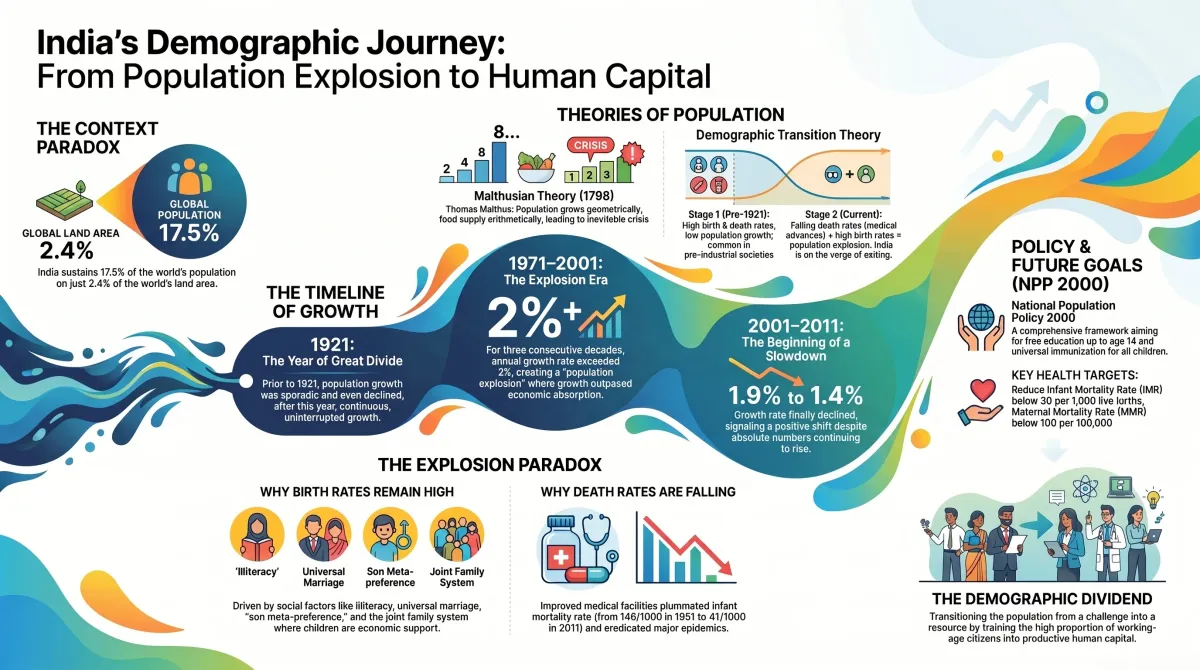
India has 17.5% of the world’s population but only 2.4% of its land. As of the 2011 Census, India’s population stood at 121.02 crore — second only to China. Every major economic challenge India faces — employment, food security, infrastructure, urbanisation — traces back to this demographic reality. Chapter 6 of the Maharashtra State Board Class 11 Economics textbook analyses population trends, the theories that explain them, what caused India’s population explosion, and the policy responses designed to address it.
Updated context: India’s total fertility rate (TFR) fell to 2.0 as per the National Family Health Survey-5 (2019-21), which is below the replacement level of 2.1. The textbook was written when TFR was still above replacement level. For your exams, use the textbook figures — but knowing this update helps with current affairs questions.
Trends in Population Growth Since 1911
India conducts a population census every 10 years. Here’s how the numbers moved:
-
1911–1921 (Marginal Decline): Population fell from 25.2 crore to 25.1 crore. Epidemics — influenza, cholera, plague, malaria — killed more people than were being born. Annual growth rate: −0.03%.
-
1921 — The Year of Great Divide: The Census Commissioner designated 1921 as the “Year of Great Divide” because after this point, population grew continuously without any decadal decline. This is one of the most frequently tested facts from this chapter.
-
1931–1941: Annual growth rate stabilised at 1.0–1.3% — steady but not explosive.
-
1951 onwards (Rapid Increase): Independence brought better medical facilities, which reduced death rates. But birth rates stayed high. Population grew from 36.1 crore (1951) to 54.8 crore (1971).
-
1971–2001 (Population Explosion): Annual growth rates exceeded 2% for three consecutive decades — the textbook definition of a population explosion.
-
2001–2011 (Slowdown): Growth rate declined from 1.9% to 1.4%. A positive trend, though absolute numbers continue to climb because the base is so large.
Theories of Population Growth
1. Malthusian Theory
Thomas Robert Malthus laid this out in An Essay on the Principle of Population (1798). His argument was devastatingly simple: population grows in geometric progression (2, 4, 8, 16, 32…) while food supply grows in arithmetic progression (1, 2, 3, 4, 5…). Eventually, population outstrips food supply, leading to crisis.
Malthus identified two types of checks that correct this imbalance:
-
Preventive checks: Deliberate human decisions — late marriage, moral restraint. Malthus considered these more dependable.
-
Positive/Natural checks: Forces outside human control — famines, epidemics, natural disasters — that reduce excess population.
2. Theory of Demographic Transition
As described in the Maharashtra Board textbook, this theory was discussed by A.J. Coale and E.M. Hoover in Population Growth and Economic Development in Low-Income Countries (1958). It argues that every country passes through three stages as it develops:
Stage 1 — Low Growth (Pre-industrial): Both birth rate and death rate are high. They roughly cancel out, so population grows slowly. India was in this stage before 1921.
Stage 2 — High Growth: Death rate falls rapidly (better medicine, sanitation, food) but birth rate stays high (social norms haven’t caught up). Population explodes. India was in this stage from 1921 through the early 2000s.
Stage 3 — Low/Stable Growth: Industrialisation and urbanisation spread education and awareness. Both birth and death rates decline. Population stabilises. Developed countries are here. India is now transitioning into this stage.
Note: The Demographic Transition Theory is more broadly attributed to Warren Thompson (1929) and Frank Notestein (1945) in academic literature. Coale and Hoover applied the framework specifically to economic development in low-income countries. Your textbook credits Coale and Hoover — use that attribution in exams.
Population Explosion in India
Population explosion occurs when population grows faster than the economy’s capacity to absorb it. India’s explosion resulted from a specific combination: birth rates remained high while death rates fell sharply.
Why Birth Rates Stayed High
-
Illiteracy: High illiteracy, especially among women, sustained traditional attitudes toward marriage and family size.
-
Universal marriage: Marriage is a social and religious obligation. Even in educated communities, nearly everyone marries.
-
Low marriage age: Legal minimum (18 for women, 21 for men) is low by international standards. Earlier marriage means a longer fertile period.
-
Preference for sons: Families continue having children until they reach a desired number of sons — a phenomenon called “son meta-preference.”
-
Joint family system: In joint families, no individual bears the full financial cost of raising children. More children means more labour for family farms.
-
Agricultural dependence: Indian agriculture relies on manual labour. Larger families meant more workers.
-
Poverty: Poor families view more children as greater potential economic support in old age.
-
Lack of awareness: Many communities lacked knowledge of family planning methods.
Why Death Rates Fell
-
Medical advances eradicated epidemics — plague, cholera, smallpox — that previously killed millions.
-
Maternal mortality declined with improved maternity care.
-
Infant mortality rate dropped from 146 per 1000 (1951) to 47 per 1000 (2011).
-
Rising literacy enabled better health decisions.
-
Nutritious food programmes, including mid-day meals in schools.
-
Disaster management improved through the National Disaster Management Authority (NDMA), established 2005.
Measures to Check Population Explosion
A) Economic Measures
Industrial expansion, employment creation, poverty removal, and equitable income distribution all reduce incentives for large families. When families are economically secure, they have fewer children.
B) Social Measures
Spreading education, improving women’s status, and raising minimum marriage age are the most effective long-term interventions.
C) Population Policy of India
-
Family Planning Programme (1952): India became the first country in the world to launch a national family planning programme.
-
Family Welfare Programme (1979): Renamed and broadened to integrate family planning with maternal and child health and nutrition services.
-
National Population Policy 2000 (NPP 2000): The comprehensive policy with targets including free and compulsory education up to age 14, reducing infant mortality below 30 per 1000, reducing maternal mortality below 100 per 100,000, universal immunisation, delayed marriage for girls (not before 18, preferably after 20), and achieving stable population by 2045.
Population as Human Resource
Population isn’t just a problem — it’s also India’s greatest asset. The UNDP introduced the concept of Human Development in 1990, recognising that healthy, educated people are resources, not burdens.
India’s demographic dividend — the high proportion of working-age population relative to dependents — is a competitive advantage that many developed countries (with ageing populations) no longer have. The challenge is converting this large young population into productive human capital through education, healthcare, and skill development. If India succeeds, the dividend pays off. If it doesn’t, the same youth become an unemployment crisis.
Exam Intelligence
How this chapter is typically tested:
| Question Type | Likely Topics | Marks |
|---|---|---|
| MCQ / Objective | Year of Great Divide, census interval, NPP 2000 year, TFR target | 1 each |
| Define / Short note | Population explosion, demographic dividend, Malthusian checks | 2–3 |
| Distinguish between | Preventive vs Positive checks; Birth rate causes vs Death rate causes | 3–4 |
| Explain | Three stages of Demographic Transition Theory with India's position | 4–5 |
| Long answer | Causes of population explosion (high birth + low death); NPP 2000 features | 5–6 |
High-frequency questions:
-
“Explain the three stages of Demographic Transition Theory” — almost certain to appear
-
“What are the causes of high birth rate in India?” — standard long answer (expect 5+ causes)
-
“What is the Year of Great Divide?” — frequent MCQ or short note
-
“Explain the features of NPP 2000” — common long answer
-
“Distinguish between preventive and positive checks” — classic distinguisher
Common mistakes to avoid:
-
Confusing “Year of Great Divide” (1921) with India’s independence (1947) — students mix these up under exam pressure
-
Listing causes of high birth rate when asked for causes of population explosion — you need BOTH high birth rate causes AND low death rate causes for full marks
-
Forgetting that India was the first country to launch a family planning programme (1952) — this specific fact is a favourite MCQ
Frequently Asked Questions
What is the Year of Great Divide in India's population history? +
1921 is called the Year of Great Divide because population growth was negative during 1911–1921 but turned positive and continuous from 1921 onwards. The Census Commissioner designated it as this landmark year.
What is population explosion? +
A situation where population grows faster than the economy's capacity to absorb it. India experienced this between 1971 and 2001 when annual growth rates exceeded 2%.
What is demographic dividend? +
The economic advantage that comes from having a high proportion of working-age population relative to dependents. India currently has this advantage — the challenge is converting it into productive human capital.
When was India's Family Planning Programme launched? +
In 1952, making India the first country in the world to have a national family planning programme.
What are the two checks in Malthusian theory? +
Preventive checks (deliberate human decisions like late marriage and moral restraint) and positive/natural checks (famines, epidemics, natural disasters). Malthus considered preventive checks more dependable.
Is the Population chapter important for board exams? +
Yes. Population trends, Demographic Transition Theory, causes of population explosion, NPP 2000, and the concept of demographic dividend are all high-frequency exam topics across Maharashtra Board, CBSE, and CUET.
Keep practising Economics
AI-powered feedback and structured revision for Economics — free to start, at your own pace.
AI-powered practice — free to start