
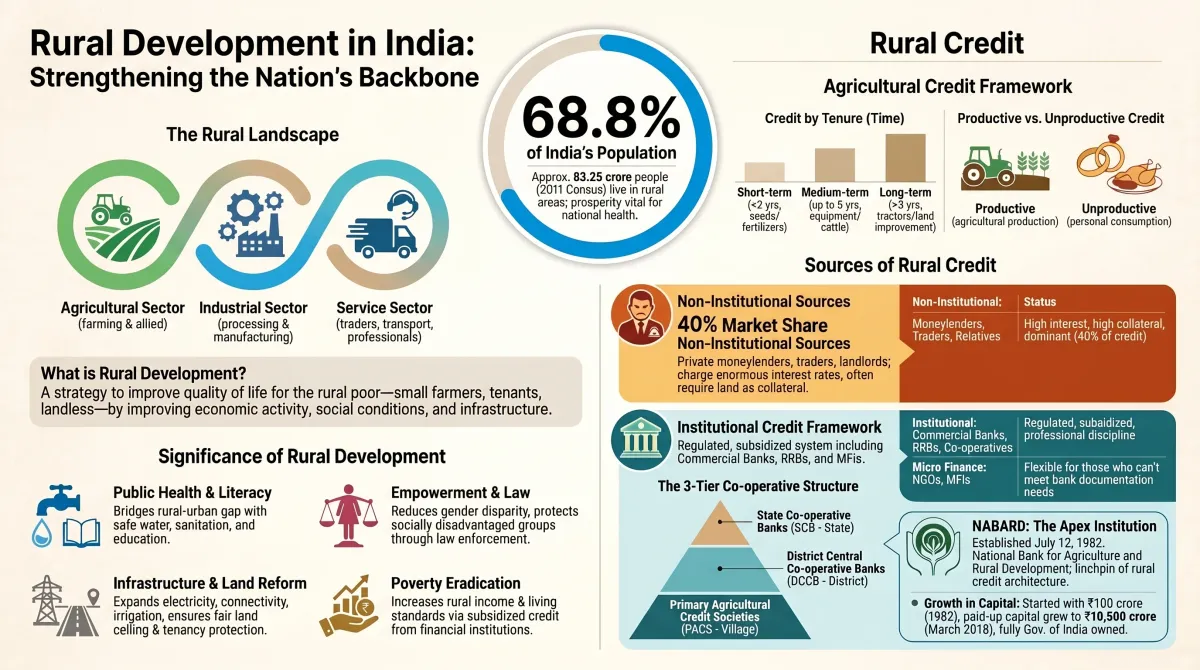
Mahatma Gandhi said India lives in its villages — and the numbers back him up. Around 68.8% of India’s population (83.25 crore people as per the 2011 Census) lives in rural areas. Their economic health determines the nation’s overall prosperity. Chapter 5 of the Maharashtra State Board Class 11 Economics textbook examines what rural development means, why it matters, and — most importantly for exams — the entire credit architecture that funds it.
If you understand who lends money to farmers and why, you understand this chapter.
Rural Occupational Structure
Rural India’s workforce is spread across three sectors:
-
Agricultural Sector: Farming (small, marginal, and large farmers) plus allied activities — plantation, forestry, fisheries, dairy, and horticulture
-
Industrial Sector: Processing and manufacturing — small-scale, cottage, and rural industries
-
Service Sector: Traders, transport operators, professionals, and technical workers serving rural businesses and consumers
Why Rural Development Matters — Eight Reasons
-
Public health and sanitation — safe drinking water, hygiene, affordable healthcare
-
Literacy — bridging the rural-urban education gap at all levels
-
Women’s empowerment — reducing gender disparity, encouraging community participation
-
Law and order — protecting the rights of socially disadvantaged groups
-
Land reforms — effective implementation of land ceiling, rent regulation, tenancy protection
-
Infrastructure — electricity, roads, irrigation
-
Credit availability — growing co-operative societies and rural banks that provide subsidised loans
-
Poverty eradication — increasing income and living standards
Agricultural Credit — The Core of This Chapter
Agricultural credit is a prerequisite for agricultural growth. Most rural families don’t have enough savings to fund farming on their own — they need loans for seeds, fertilizers, equipment, and land improvement. Understanding the credit system is the key to scoring well on this chapter.
Classification by Tenure
-
Short-term credit (up to 2 years): For seeds, fertilizers, HYV seeds, and seasonal expenses. Think of these as the “running costs” of farming.
-
Medium-term credit (up to 5 years): For land improvement, cattle purchase, agricultural equipment, canal digging. These improve the farm’s productive capacity.
-
Long-term credit (over 5 years): For tractors, permanent land improvements, major infrastructure. These are capital investments.
Classification by Purpose
-
Productive credit: Directly related to agricultural output — seeds, tractors, land. Economically justified.
-
Unproductive credit: For personal consumption unrelated to production — marriages, ceremonies. Economically questionable but socially widespread.
Exam tip: When given a loan scenario, classify it in both dimensions — tenure AND purpose. “A farmer takes a 3-year loan to buy two cows” = medium-term + productive. This two-dimensional thinking scores higher than a single classification.
Sources of Agricultural Credit
1. Non-Institutional Sources (~40% of rural credit)
These are the traditional, unregulated sources. They charge high interest rates and often trap farmers in debt cycles.
-
Money lenders: The dominant non-institutional source. They charge enormous interest rates and often mortgage cultivators’ land as collateral. When the farmer can’t repay, the money lender takes the land.
-
Traders and landlords: Commission agents and landlords provide credit tied to purchase commitments — the farmer must sell produce to them at their price.
-
Relatives and friends: Informal loans with varying terms — sometimes interest-free, but unreliable.
Despite decades of institutional expansion, non-institutional sources still account for roughly 40% of rural credit. Why? Because moneylenders are fast, require no paperwork, and don’t ask why you need the money. Banks are slow, require documentation, and have rigid eligibility criteria.
2. Institutional Sources
These are regulated, subsidised, and designed to protect farmers from exploitation. Government policy has progressively pushed toward institutionalising rural credit — but the shift is incomplete.
i) NABARD — The Apex Institution
NABARD (National Bank for Agriculture and Rural Development) is the apex banking institution for agricultural and rural development finance in India. Established on 12th July 1982 with initial paid-up capital of ₹100 crore (50:50 contribution from the Government of India and RBI). Today, NABARD is fully owned by the Government of India with paid-up capital of ₹10,580 crore (as of March 2018).
NABARD provides credit for agriculture, small-scale industries, cottage and village industries, and handicrafts. It sits at the top of the entire rural credit architecture.
ii) Rural Co-operative Credit Institutions
The co-operative credit system has two parallel structures:
Short-term credit (three-tier):
-
Village level: Primary Agricultural Credit Societies (PACS) — the grassroots institution where farmers actually borrow
-
District level: District Central Co-operative Banks (DCCB) — fund and supervise PACS
-
State level: State Co-operative Banks (SCB) — coordinate the district banks
Long-term credit (two-tier):
-
Village level: Primary Co-operative Agriculture and Rural Development Banks
-
State level: State Co-operative Agriculture and Rural Development Banks
iii) Commercial Banks
After nationalisation in 1969 and 1980, commercial banks expanded massively into rural areas, providing agricultural loans through their rural and semi-urban branches.
iv) Regional Rural Banks (RRBs)
Established under the RRB Act, 1976, specifically to serve the rural poor. RRBs are designed to combine the rural orientation of co-operatives with the professional discipline of commercial banks — offering formal credit at rates lower than private moneylenders.
v) Micro Finance Institutions (MFIs)
NGO-based alternative credit providers operating since the mid-1970s. MFIs reach farmers who can’t access banks due to rigid documentation requirements, inflexible loan products, high transaction costs, and the sheer distance to the nearest bank branch.
Exam Intelligence
How this chapter is typically tested:
| Question Type | Likely Topics | Marks |
|---|---|---|
| MCQ / Objective | NABARD establishment year, three-tier structure names, credit tenure thresholds | 1 each |
| Define / Short note | Rural development, productive vs unproductive credit, NABARD, RRBs | 2–3 |
| Distinguish between | Short-term vs Long-term credit; Institutional vs Non-institutional sources | 3–4 |
| Diagram / Chart | Three-tier short-term co-operative credit structure | 3–4 |
| Long answer | Sources of agricultural credit (institutional); Significance of rural development | 5–6 |
High-frequency questions:
-
“Explain the institutional sources of agricultural credit” — appears regularly; expects NABARD, co-operatives, CBs, RRBs, MFIs
-
“Explain the three-tier structure of short-term co-operative credit” — often asked as a diagram question
-
“What is NABARD? When was it established?” — standard short note
-
“Classify agricultural credit by tenure” — frequent short answer
Common mistakes to avoid:
-
Confusing NABARD’s establishment year (1982) with bank nationalisation (1969/1980)
-
Mixing up the two-tier (long-term) and three-tier (short-term) structures — short-term has three tiers, long-term has two
-
Forgetting to mention MFIs in institutional sources — students often stop at RRBs
Frequently Asked Questions
What is rural development? +
A strategy to improve the economic and social life of the rural poor — including small farmers, tenants, and the landless — through agriculture, industries, education, and services.
When was NABARD established? +
NABARD was established on 12th July 1982, initially with ₹100 crore paid-up capital equally from the Government of India and RBI. It is now fully owned by the Government of India with capital of ₹10,580 crore.
What is the difference between productive and unproductive agricultural credit? +
Productive credit finances agricultural production — seeds, fertilizers, equipment. Unproductive credit finances personal consumption unrelated to farming — marriages, ceremonies. Both exist widely in rural India.
What are Regional Rural Banks (RRBs)? +
Banks established under the RRB Act 1976 specifically to serve the rural poor, combining co-operative societies' rural orientation with commercial banks' professional discipline.
Why do small farmers still rely on non-institutional sources? +
Despite institutional expansion, banks remain slow, documentation-heavy, and inflexible. Moneylenders are fast, require no paperwork, and impose no conditions on loan purpose — making them the easier (though far more expensive) option.
Is this chapter important for board exams? +
Yes. The three-tier credit structure, NABARD, classification of agricultural credit, and the significance of rural development are standard exam topics in Maharashtra Board, CBSE, and CUET Economics.
Keep practising Economics
AI-powered feedback and structured revision for Economics — free to start, at your own pace.
AI-powered practice — free to start