
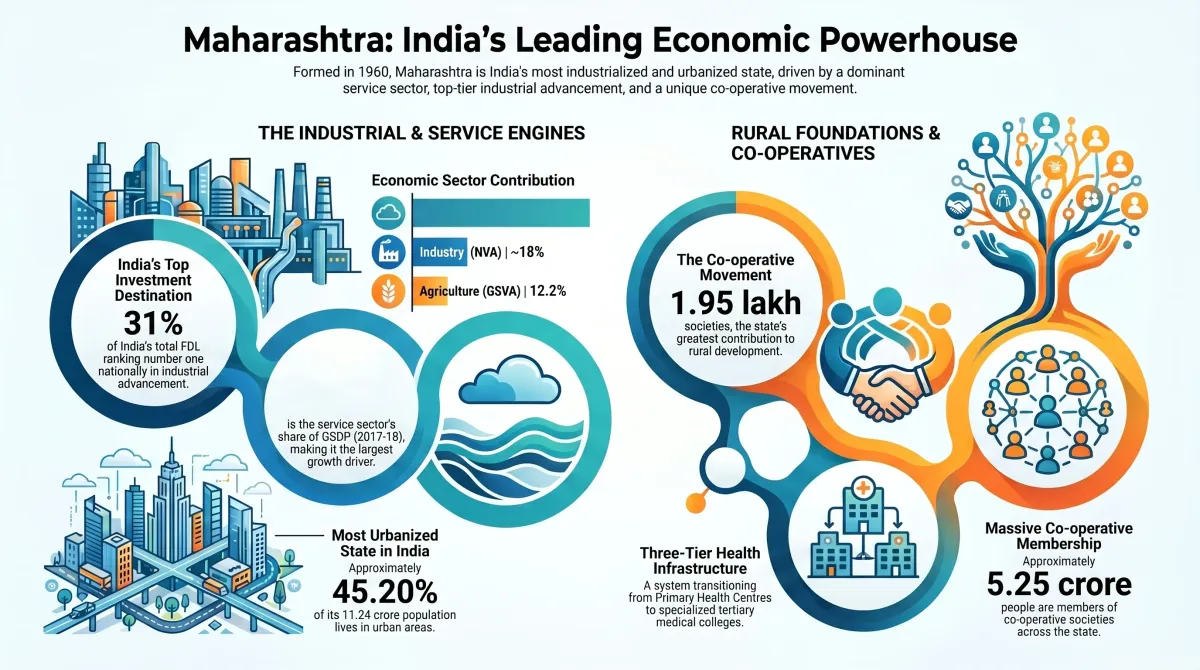
Maharashtra isn’t just a state — it’s an economy the size of many countries. Formed on 1st May 1960, it has built India’s most diversified state economy, leading the country in industrial output, FDI inflows, and urbanisation. Chapter 4 of the Maharashtra State Board Class 11 Economics textbook gives you a sector-by-sector breakdown of what makes this economy tick — agriculture, industry, services, infrastructure, and the co-operative movement that is Maharashtra’s unique contribution to the country.
This chapter is data-heavy. The key to scoring well isn’t memorising every number — it’s knowing which numbers matter and how the sectors connect.
Key Features of Maharashtra’s Economy
These headline facts define Maharashtra’s economic standing:
-
Second largest state by population — 11.24 crore (2011 Census)
-
Third largest by area — approximately 3.08 lakh sq. km
-
Most urbanised state in India — 45.20% urban population
-
Sex ratio: 929 females per 1000 males (2011)
-
Literacy rate: 82.3% (2011)
-
Highest GSDP and State Per Capita Income among all Indian states (Economic Survey of Maharashtra 2016-17)
-
Top investment destination in India
-
Administered through 36 districts under 6 revenue divisions: Mumbai, Pune, Nashik, Chhatrapati Sambhajinagar (formerly Aurangabad), Amravati, and Nagpur
Syllabus note: Your textbook uses the pre-2023 names “Aurangabad” and “Amaravati” for the revenue divisions. The official names are now Chhatrapati Sambhajinagar and Amravati respectively. Know both — examiners may use either.
A) Agricultural Sector
Agriculture remains important to Maharashtra’s economy, but its share is declining as services and industry grow. As per the Economic Survey of Maharashtra 2017-18, agriculture’s share in Gross State Value Added (GSVA) fell from 15.3% in 2001-02 to 12.2% in 2016-17.
Problems in Agriculture
The sector faces a familiar set of challenges: shrinking average landholdings, growing numbers of small and marginal farmers, soil degradation from excessive chemical use, agricultural indebtedness (a persistent crisis in Maharashtra), poor irrigation coverage, lack of capital, inconsistent implementation of rural development schemes, and climate change impacts including erratic monsoons.
Government Measures
Responses include distribution of quality seeds at subsidised rates, expanded fertilizer and pesticide availability, irrigation development and electrification of agricultural pumps, financial assistance programmes, establishment of Agriculture Produce Marketing Committees (APMC), agro export zones, horticultural training centres, and mass media campaigns to make farming more profitable.
B) Industrial Sector
Maharashtra is India’s most industrially advanced state. As per the Annual Survey of Industries (ASI) 2016-17, it ranks number one nationally in industrial output. Industry’s share in Net Value Added (NVA) is about 18%, and the state is consistently the first choice of domestic and foreign investors.
Foreign Direct Investment (FDI)
This is one of the most exam-relevant data points: from April 2000 to September 2017, Maharashtra received FDI inflows of ₹6,11,760 crore — representing 31% of total FDI at the all-India level. No other state comes close.
Problems
Industrial challenges include bureaucratic delays in government clearances, insufficient skill development programmes, outdated technology in legacy industries, infrastructure gaps, lack of motivation and support for new entrepreneurs, and persistent regional imbalance between western Maharashtra and the Vidarbha-Marathwada regions.
Government Measures
-
Single Window Cell — one-stop clearance for investors
-
MAITRI (Maharashtra Industry, Trade and Investment Facilitation Cell) — online portal with consolidated investment information
-
Export awards and rent subsidies for small-scale industries
-
Special Economic Zones (SEZ) for industrial clustering
-
MSICDP (Maharashtra State Industrial Cluster Development Programme) for small, medium, and micro enterprises
C) Service Sector
The service sector is Maharashtra’s largest and fastest-growing segment. Its contribution to GSDP reached 54.5% in 2017-18 — more than agriculture and industry combined. This single number tells you where Maharashtra’s economy is headed.
Core growth areas: Fintech, IT/ITES, start-ups, cloud computing, electric vehicles, defence manufacturing, tourism, and private universities.
Infrastructure — Economic and Social
Economic Infrastructure:
-
Electricity: Expanding generation capacity and rural electrification
-
Roads: 3.37 lakh km under the Road Development Plan (2001-2021)
-
Metro Rail operations in Mumbai and Nagpur
-
Maritime: Maharashtra Port Development Policy and Sagarmala programme
-
Telecom: 5.45 crore internet subscribers — highest among all states (2017)
Social Infrastructure — Education: Maharashtra has 1,04,971 primary schools enrolling 159.86 lakh students (2016-17) under the Right to Education Act. The state has 22 state universities, 21 autonomous universities, a central university, 4 private universities, and 5 institutes of national importance. Maharashtra was the first state to receive a RUSA grant for innovation and technology transfer hubs.
Social Infrastructure — Health: Three-tier system: Primary tier (PHCs and Community Health Centres) → Secondary tier (sub-district and district hospitals) → Tertiary tier (medical colleges and super-speciality hospitals). As of March 2017: 1,814 PHCs and 360 CHCs statewide.
Tourism
The Maharashtra Tourism Policy 2016 targets making the state a leading tourist destination by 2025, attracting ₹30,000 crore in investment and creating one million additional jobs. MTDC (Maharashtra Tourism Development Corporation) is the implementing agency. Mumbai’s entertainment industry — Bollywood — is a significant employment generator.
D) Co-operative Movement
The co-operative movement is described as Maharashtra’s greatest contribution to the country. What started with agricultural credit has expanded into sugar co-operatives, dairy societies, agro processing, marketing, fisheries, textiles, housing, and consumer stores.
The numbers are striking: as of March 2017, there were approximately 1.95 lakh co-operative societies in Maharashtra with about 5.25 crore members — nearly half the state’s population.
Exam Intelligence
How this chapter is typically tested:
| Question Type | Likely Topics | Marks |
|---|---|---|
| MCQ / Objective | GSDP sector shares, FDI percentage, formation date, revenue divisions | 1 each |
| Short note | MAITRI, SEZ, MTDC, Three-tier health system, Co-operative movement | 2–3 |
| Give reasons | Why Maharashtra attracts maximum FDI; Why agriculture's share is declining | 3–4 |
| Long answer | Problems and measures in agriculture/industry; Service sector contribution | 5–6 |
High-frequency questions:
-
“Explain the key features of Maharashtra’s economy” — standard long answer
-
“What is the contribution of the service sector to Maharashtra’s economy?” — frequently asked
-
“Explain the three-tier health system” — popular short note
-
“What is the significance of the co-operative movement in Maharashtra?” — almost guaranteed
Common mistakes to avoid:
-
Mixing up GSDP shares — Agriculture: 12.2%, Industry: ~18%, Services: 54.5%. Learn these three numbers.
-
Confusing MAITRI (investment facilitation) with MTDC (tourism) — both are Maharashtra-specific acronyms
-
Forgetting the FDI figure — ₹6,11,760 crore and 31% of national total are high-value data points
Frequently Asked Questions
What is Maharashtra's share in national FDI? +
From April 2000 to September 2017, Maharashtra received ₹6,11,760 crore in FDI — 31% of total FDI inflows at the all-India level, making it India's top investment destination.
What is MAITRI? +
MAITRI stands for Maharashtra Industry, Trade and Investment Facilitation Cell. It provides online consolidated information about the investment process in Maharashtra — a digital single window for investors.
What is the share of the service sector in Maharashtra's GSDP? +
The service sector contributed 54.5% to Maharashtra's Gross State Domestic Product in 2017-18 — more than agriculture and industry combined.
What is the three-tier health system in Maharashtra? +
Primary tier: PHCs and Community Health Centres. Secondary tier: Sub-district and district hospitals. Tertiary tier: Medical colleges and super-speciality hospitals in major cities.
When did Maharashtra come into existence? +
Maharashtra was formed on 1st May 1960 and is administered through 36 districts under 6 revenue divisions.
Why is the co-operative movement significant in Maharashtra? +
With nearly 1.95 lakh co-operative societies and 5.25 crore members, Maharashtra's co-operative movement spans agriculture, dairy, sugar, housing, and consumer sectors — making it the state's most distinctive contribution to India's economic development model.
Keep practising Economics
AI-powered feedback and structured revision for Economics — free to start, at your own pace.
AI-powered practice — free to start