
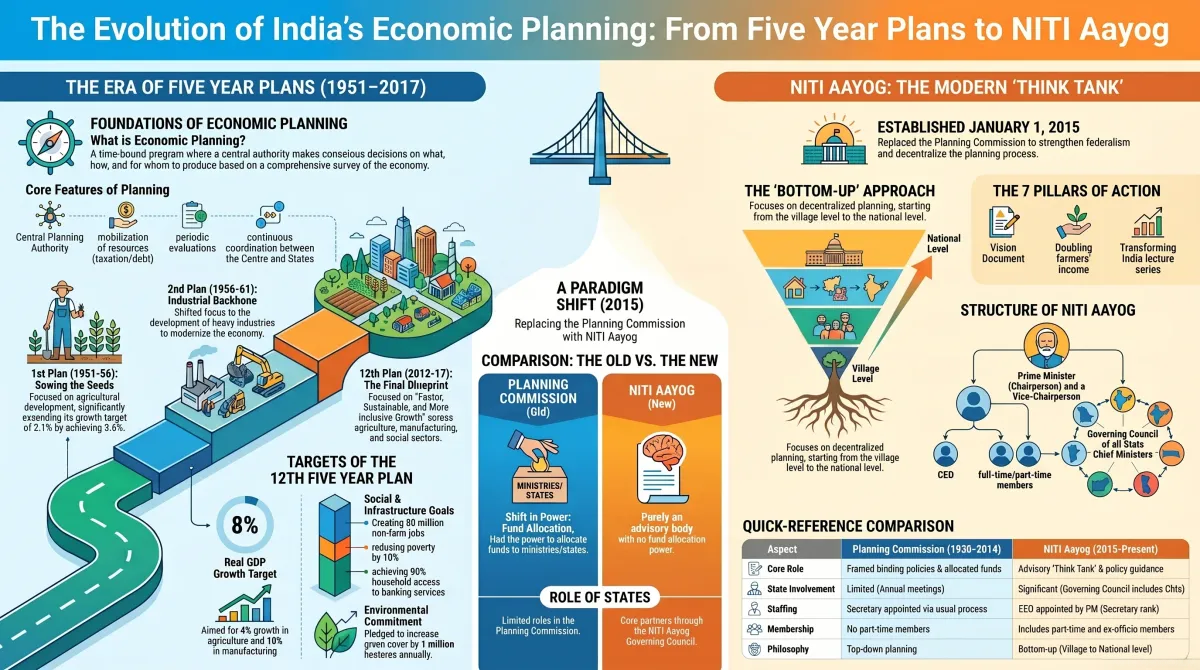
For 65 years, India’s economic future was charted through Five Year Plans — a model borrowed from the Soviet Union and adapted to India’s mixed economy. In 2015, that model was scrapped and replaced with NITI Aayog, marking a fundamental shift from centralised planning to cooperative federalism. Chapter 10 of the Maharashtra State Board Class 11 Economics textbook traces this entire journey — from the establishment of the Planning Commission in 1950 to how India plans its development today.
This chapter is a favourite for “distinguish between” and table-based questions. If you know the Five Year Plan objectives and the Planning Commission vs NITI Aayog comparison, you’re covered for most of what the examiner can ask.
What Is Economic Planning?
Economic planning is a time-bound programme to achieve specific objectives using available resources, directed by a central planning authority.
Two definitions the textbook highlights:
-
Dr. H.D. Dickinson: Economic planning is the making of major economic decisions — what and how much to produce, how and when to produce it, and to whom to allocate it — by a central authority based on a comprehensive survey of the economy.
-
Mrs. Barbara Wooten: Planning is a conscious and deliberate choice of economic priorities by a public authority.
The core idea: instead of leaving everything to the market, the government sets priorities, allocates resources, and measures progress.
Features of Economic Planning
Ten features define how planning works in India:
-
Central Planning Authority — the Planning Commission (1950-2015), now NITI Aayog
-
Comprehensive Survey — of human and natural resources before setting targets
-
Pre-determined Objectives — realistic and flexible goals
-
Priorities and Targets — sectors ranked by development importance; targets are concrete steps
-
Resource Mobilisation — through taxation, savings, deficit financing, public debt, external aid
-
Plan Period — typically five years in India
-
Periodic Evaluation — mid-term appraisals to adjust course
-
Continuous Process — planning is ongoing, not one-off
-
Centre-State Coordination — essential in a federal system
-
Flexibility — the plan adapts during implementation as conditions change
The Five Year Plans — Complete Timeline
The Planning Commission was established on 15th March 1950, with the Prime Minister as Ex-Officio Chairman.
| Plan | Period | Main Objective | Target Growth (%) | Achieved (%) |
|---|---|---|---|---|
| 1st | 1951–56 | Agriculture development | 2.1 | 3.6 |
| 2nd | 1956–61 | Heavy industries (Mahalanobis model) | 4.5 | 4.1 |
| 3rd | 1961–66 | Agriculture and industry | 5.6 | 2.7 |
| Annual Plans | 1966–69 | Plan holiday due to wars and drought | — | — |
| 4th | 1969–74 | Growth with stability | 5.7 | 3.3 |
| 5th | 1974–79 | Removal of poverty | 4.4 | 4.8 |
| Rolling Plans | 1978–80 | Janata Party government | — | — |
| 6th | 1980–85 | Improvement in quality of life | 5.2 | 5.7 |
| 7th | 1985–90 | Social welfare and poverty eradication | 5.0 | 6.0 |
| Plan Holiday | 1990–92 | Political instability | — | — |
| 8th | 1992–97 | Dynamism to economy (post-LPG) | 5.6 | 6.8 |
| 9th | 1997–2002 | Social justice and equality | 7.0 | 5.6 |
| 10th | 2002–07 | Reduction of poverty | 8.2 | 7.8 |
| 11th | 2007–12 | Faster and more inclusive growth | 8.1 | 7.9 |
| 12th | 2012–17 | Faster, sustainable, more inclusive growth | 8.0 | N.A. |
Pattern to notice: The first three plans focused on building the base (agriculture → industry → both). From the 5th Plan onward, the focus shifted to poverty, welfare, and inclusion. The 8th Plan onward reflected the post-1991 liberalisation environment. Knowing this arc is more useful than memorising individual growth rates.
The 12th Five Year Plan (2012-2017)
The last Five Year Plan focused on sustainable and inclusive growth. Key targets:
-
Growth: 8% real GDP; agriculture at 4.0%; manufacturing at 10%
-
Poverty: Reduce head-count poverty ratio by 10 percentage points; create 50 million new non-farm jobs
-
Education: Mean years of schooling to 7 years; eliminate gender and social gaps in enrolment
-
Health: Reduce total fertility rate to 2.1%; halve child undernutrition (ages 0-3)
-
Infrastructure: Investment at 9% of GDP; all-weather roads to all villages; rural tele-density to 70%
-
Environment: Increase green cover by 1 million hectares annually
-
Financial inclusion: Banking access for 90% of households; direct cash transfers via Aadhaar-linked accounts
The 12th Plan ended on 31st March 2017. There was no 13th Plan — NITI Aayog had already replaced the Planning Commission.
NITI Aayog — India’s New Planning Framework
NITI Aayog (National Institution for Transforming India) was established on 1st January 2015, replacing the Planning Commission. The fundamental shift: from a body that allocated funds and framed binding policies to a policy think tank that advises, coordinates, and supports states.
Structure
| Role | Who |
|---|---|
| Chairperson | Prime Minister of India |
| Vice-Chairperson | Appointed by the PM |
| Full-time Members | 5 |
| Part-time Members | 2 |
| Ex-Officio Members | Up to 4 Union Ministers |
| CEO | Appointed by PM (Secretary rank) |
| Governing Council | All Chief Ministers + UT Governors |
| Regional Councils | For multi-state issues |
Functions
-
Shared National Agenda — develops priorities with active state involvement
-
States’ partner at the Centre — coordinates, consults, and builds state capacity
-
Decentralised planning — bottom-up approach from village to national level
-
Knowledge and innovation hub — research centre on governance best practices
-
Monitoring and evaluation — tracks implementation through performance metrics
-
Cooperative and competitive federalism — platform for states to participate in national policy
-
Conflict resolution and technology upgradation — inter-state consultancy and support
Planning Commission vs NITI Aayog — The Key Comparison
This comparison table is one of the most predictable exam questions from this chapter:
| Aspect | Planning Commission | NITI Aayog |
|---|---|---|
| Established | 15th March 1950 | 1st January 2015 |
| Fund allocation | Yes — allocated funds to ministries and states | No — advisory only |
| Policy-framing power | Yes — framed binding policies | No — think tank; recommends, doesn't bind |
| Role of states | Limited (NDC and annual meetings) | Central — Governing Council includes all CMs |
| Part-time members | None | Yes |
| CEO | Member Secretary (normal appointment) | CEO appointed by PM (Secretary rank) |
| Nature | Top-down planner and fund allocator | Bottom-up advisor and coordinator |
The one-line summary: The Planning Commission told states what to do and gave them money to do it. NITI Aayog advises states on what to do and has no money to give. The power shift is from directive to consultative.
Exam Intelligence
How this chapter is typically tested:
| Question Type | Likely Topics | Marks |
|---|---|---|
| MCQ / Objective | Planning Commission year, NITI Aayog year, PM's role, plan periods | 1 each |
| Short note | NITI Aayog, any specific Five Year Plan, features of planning | 2–3 |
| Distinguish between | Planning Commission vs NITI Aayog (the highest-value question in this chapter) | 4–5 |
| Table-based | Five Year Plans with objectives and periods | 4–5 |
| Long answer | Features of economic planning; Functions of NITI Aayog; 12th Plan targets | 5–6 |
High-frequency questions:
-
“Distinguish between Planning Commission and NITI Aayog” — appears almost every year
-
“State the objectives of any 5 Five Year Plans” — standard table question
-
“Explain the features of economic planning” — common long answer
-
“Explain the functions of NITI Aayog” — frequently asked
-
“What were the targets of the 12th Five Year Plan?” — data-based question
Common mistakes to avoid:
-
Confusing the Planning Commission’s establishment date (1950) with the First Five Year Plan’s start (1951) — they’re different events
-
Writing that NITI Aayog “allocates funds” — it explicitly does NOT. This is the biggest functional difference from the Planning Commission
-
Mixing up Five Year Plan numbers with their periods — the annual plans and plan holidays create gaps that confuse students
Frequently Asked Questions
When was the Planning Commission established? +
On 15th March 1950, with the Prime Minister of India as its Ex-Officio Chairman. It functioned for 65 years before being replaced by NITI Aayog.
When was NITI Aayog established and why? +
On 1st January 2015, to replace the Planning Commission. The shift was from a fund-allocating, policy-framing body to an advisory think tank that strengthens cooperative federalism and expands states' roles in development planning.
What was the main objective of the 12th Five Year Plan? +
"Faster, sustainable, and more inclusive growth" — with an 8% real GDP growth target and targets spanning agriculture, education, health, infrastructure, and financial inclusion.
What is the biggest difference between Planning Commission and NITI Aayog? +
The Planning Commission allocated funds to states and framed binding policies. NITI Aayog is purely advisory — it recommends, coordinates, and monitors, but has no power to allocate funds or impose policies.
Who heads NITI Aayog? +
The Prime Minister as Chairperson. The Vice-Chairperson and CEO are appointed by the PM.
Is this chapter important for board exams? +
Yes. The Planning Commission vs NITI Aayog comparison, Five Year Plan objectives, and NITI Aayog functions are standard, high-frequency topics across Maharashtra Board, CBSE, and CUET Economics.
Keep practising Economics
AI-powered feedback and structured revision for Economics — free to start, at your own pace.
AI-powered practice — free to start