
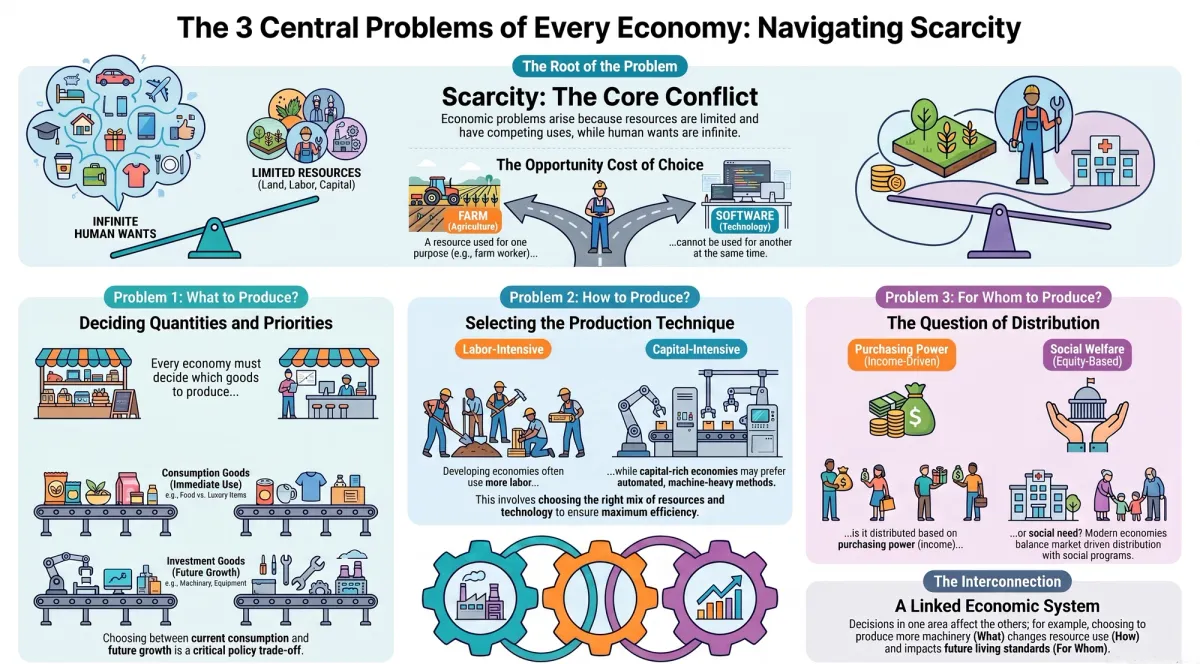
Every society that has ever existed — from ancient civilizations to modern industrial nations, from capitalist democracies to socialist states — faces the same three inescapable economic questions. They arise directly from the fact of scarcity: when you cannot have everything, you must decide what you will have, how you will get it, and who will receive it.
These are the three central problems of every economy. They are universal, unavoidable, and the foundation of all economic policy.
Why Every Economy Faces These Three Problems
Resources — land, labor, capital, technology — are limited. But the potential uses for those resources are virtually unlimited. This forces every society to make collective choices about resource allocation.
No amount of wealth, technology, or political will eliminates these problems. They take different forms in different societies, but they are always present. The difference between economic systems is not whether they face these problems, but how they solve them.
Problem 1: What to Produce?
The Question
Given that resources are limited, which goods and services should be produced, and in what quantities?
This is a question of priorities. Every unit of resource used to produce one thing is unavailable for producing something else. Society must collectively decide where its productive capacity is directed.
The Trade-Offs
Consumer goods vs Capital goods: Consumer goods satisfy immediate needs (food, clothing, entertainment). Capital goods build future productive capacity (machinery, infrastructure, factories). Allocating more to consumer goods improves current living standards but slows future growth. Allocating more to capital goods sacrifices present consumption for future prosperity.
Guns vs Butter: The classic economic metaphor. A nation that allocates more resources to defense (guns) has fewer resources for civilian welfare (butter). In wartime, the trade-off skews toward defense. In peacetime, it shifts toward welfare and consumption.
Essential goods vs Luxury goods: Should productive capacity be directed toward basic necessities accessible to all, or higher-value goods that fewer can afford? The answer shapes the character of a society.
Real-World Indian Example
When the Indian government allocates its annual budget, it must decide: How much to spend on rural employment schemes vs urban infrastructure? How much on primary healthcare vs advanced research hospitals? How much on agricultural subsidies vs industrial development? Every allocation decision is an answer to “what to produce” — and every answer involves trade-offs.
Problem 2: How to Produce?
The Question
Once society decides what to produce, it must decide which production technique to use — specifically, the combination of inputs (labor, capital, technology) that will be employed.
The Core Choice: Labor-Intensive vs Capital-Intensive
Labor-intensive production uses more workers relative to machines. It is often less efficient per unit but creates more employment.
Capital-intensive production uses more machines relative to workers. It is often more efficient per unit but creates less direct employment.
Why This Is Especially Significant in India
India faces this dilemma with particular sharpness. The country has:
-
A large, relatively low-cost labor force that needs employment
-
A development objective that includes reducing unemployment and raising rural incomes
-
Simultaneously, a need to compete globally, which often requires modern, efficient (capital-intensive) production methods
Example: In agriculture, should Indian farmers use traditional labor-intensive methods (supporting rural employment) or shift to mechanized harvesting (more efficient but displacing agricultural workers)?
Example: In manufacturing, should a textile factory employ more workers at looms (labor-intensive) or invest in automated weaving machines (capital-intensive)? The economic answer depends on factor costs; the policy answer must also consider employment and social stability.
There is no universally correct answer. The optimal production method depends on:
-
Relative costs of labor and capital in that economy
-
Available technology
-
Social priorities (employment vs efficiency)
-
Stage of economic development
Problem 3: For Whom to Produce?
The Question
After deciding what to produce and how to produce it, society must decide how the output is distributed among its members. Who gets to consume what has been produced?
This is fundamentally a question about income distribution and equity.
The Distribution Choices
Market-based distribution: Output goes to those who can pay for it, which means those with higher incomes consume more. This creates incentives for productivity and innovation but can result in stark inequality.
Need-based distribution: Output is allocated based on what people need, regardless of their income. This promotes equity but may reduce incentives for productive effort.
Equal distribution: Everyone receives an equal share. Rarely implemented in full because it ignores differences in contribution and need.
Real-World Implications
-
Should basic goods like food, healthcare, and education be available to all citizens regardless of income, or should they be allocated by purchasing power?
-
How progressive should the tax system be? Should the wealthy pay proportionally more to fund services for all?
-
Should the government subsidize essential goods to make them accessible to low-income households?
Indian Example: India maintains a Public Distribution System (PDS) that provides subsidized food grains to millions of low-income households. This is a policy answer to “for whom to produce” — explicitly directing a portion of food production toward those with less purchasing power. Simultaneously, luxury goods markets exist where distribution is entirely market-determined.
How the Three Problems Are Interconnected
The three central problems cannot be solved in isolation — each affects the others:
| Decision | Affects |
|---|---|
| What to produce (more capital goods) | How to produce shifts toward investment-heavy methods; For whom future output is larger but present consumption is lower |
| How to produce (labor-intensive) | For whom more workers earn wages, improving income distribution |
| For whom (subsidize basic goods) | What to produce more basic goods needed; How to produce them affordably becomes critical |
Understanding these interactions is what separates simplistic policy analysis from sophisticated economic thinking.
The Three Problems Across Economic Systems
Different economic systems answer these three questions very differently — which is explored in depth in the companion post on economic systems. In brief:
| Economic System | What to Produce | How to Produce | For Whom |
|---|---|---|---|
| Market Economy | Whatever is most profitable | Most cost-efficient method | Those who can pay |
| Command Economy | Whatever the state plans | Whatever the state directs | According to state-determined plan |
| Mixed Economy | Market + state guidance | Market + state regulation | Market + redistribution policies |
Key Takeaway
The three central economic problems — what, how, and for whom — emerge inevitably from scarcity. They are not problems that can be permanently “solved.” They are ongoing decisions that every society must continuously revisit as resources, technology, priorities, and circumstances change.
For students: being able to apply these three questions to real economic situations — not just define them — is what turns a textbook answer into an insightful one.
Related Posts:
-
Introduction to Economics: Scarcity, Choice & Opportunity Cost Explained
-
Production Possibility Curve (PPC): Features, MRT & Shifts Explained
-
Economic Systems: Market Economy, Command Economy & Mixed Economy Compared
Keep practising Economics
AI-powered feedback and structured revision for Economics — free to start, at your own pace.
AI-powered practice — free to start