
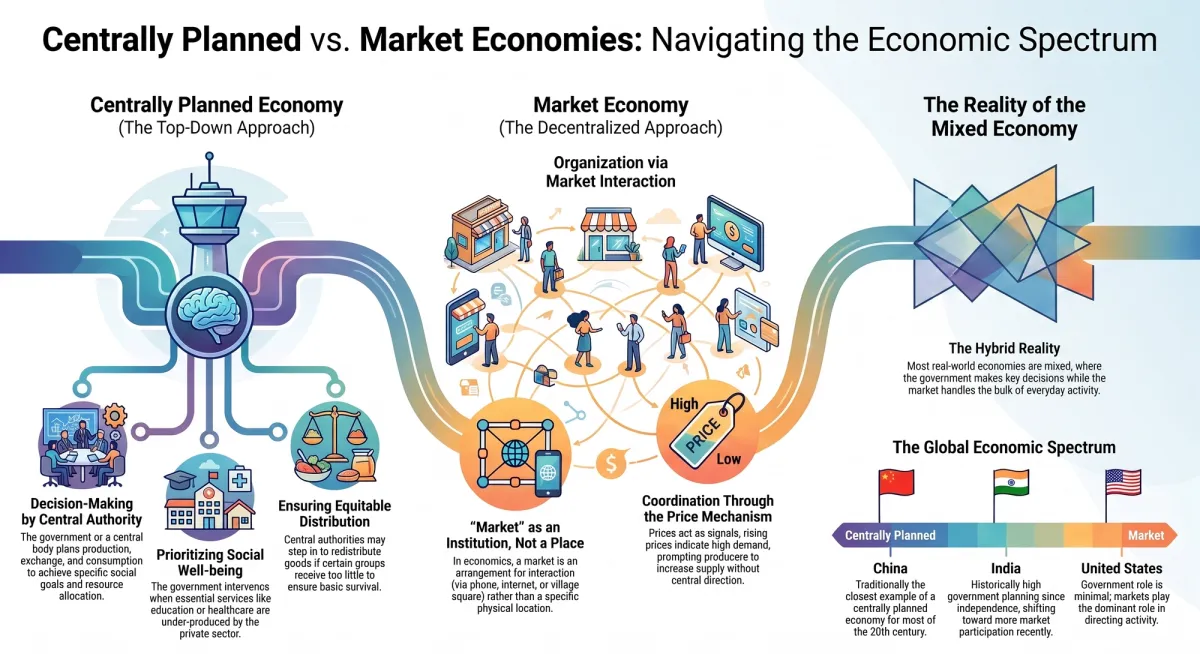
Every economy must answer the same three fundamental questions: what to produce, how to produce, and for whom to produce. But different societies have arrived at very different answers — and the institutional arrangements they use to answer them define their economic system.
Understanding economic systems is not just an academic exercise. It explains why India looks different from the United States, which looks different from China, which looked very different from the Soviet Union. The economic system a society chooses shapes the incentives people face, the distribution of wealth, the role of government, and the long-run trajectory of development.
What Is an Economic System?
An economic system is the set of institutions, mechanisms, and rules through which a society organizes the production, distribution, and consumption of goods and services.
At the core of every economic system is a decision about who controls resources and how resource allocation decisions are made. The answers to these questions produce the three major economic systems.
1. Market Economy (Capitalism)
Core Principle
Resources are privately owned, and allocation decisions are made through the price mechanism — the interaction of supply and demand in free markets.
Adam Smith described this as the “invisible hand”: when individuals pursue their own self-interest in competitive markets, they are guided — as if by an invisible hand — to produce outcomes that benefit society as a whole.
How It Answers the Three Central Problems
What to produce? Whatever is profitable. Firms produce goods and services that consumers are willing to pay for. If demand for a product rises, prices rise, profits rise, and producers expand supply. If demand falls, unprofitable products are discontinued.
How to produce? Whatever is most cost-efficient. Competition forces firms to minimize costs or lose customers to rivals. This drives adoption of efficient technologies and production methods.
For whom to produce? For those who can pay. Output is distributed according to purchasing power, which in turn reflects income, which reflects the value of the resources (labor, capital, land) one owns and supplies to the market.
Key Features
-
Private ownership of resources and firms
-
Prices determined by supply and demand (not by government decree)
-
Profit motive drives production decisions
-
Minimal government intervention — markets self-regulate
-
Competition among producers and consumers
Advantages
-
Efficiency: Competition incentivizes cost minimization and innovation
-
Consumer choice: Diverse products emerge to serve diverse preferences
-
Incentives: Profit motive encourages entrepreneurship and risk-taking
-
Decentralization: Millions of independent decisions aggregate into market outcomes without central coordination
Disadvantages
-
Inequality: Distribution by purchasing power can produce extreme income and wealth gaps
-
Market failures: Public goods, externalities, and information problems cause markets to allocate resources inefficiently in some areas
-
Short-termism: Profit focus can neglect long-term social or environmental considerations
-
Instability: Business cycles, financial crises, and unemployment are inherent features
Examples
United States, United Kingdom, Singapore, Hong Kong — though even these “market economies” involve significant government involvement in healthcare, education, and regulation.
2. Command Economy (Socialism / Centrally Planned Economy)
Core Principle
Resources are owned by the state, and allocation decisions are made by central government planners rather than market forces. The government decides what to produce, how to produce it, and how to distribute the output.
How It Answers the Three Central Problems
What to produce? Whatever the state plans. Central planners set production targets for all major goods and services based on their assessment of social need and national priorities.
How to produce? However the state directs. Production methods are specified by planning authorities, often prioritizing social objectives (like employment) alongside efficiency.
For whom to produce? According to the state’s distribution plan. The government allocates output based on its conception of social need or equity — which may be equal shares, or allocation according to contribution, or prioritized distribution to specific groups.
Key Features
-
State ownership of major means of production
-
Central planning replaces market mechanism
-
Production targets set by government
-
Prices may be fixed by the state
-
Limited private enterprise
Advantages
-
Equity: Can ensure basic needs are met for all citizens
-
Directed development: Can rapidly mobilize resources toward national priorities (e.g., industrialization, defense)
-
No unemployment (in theory): State can assign everyone productive work
-
Reduced inequality: Distribution is not solely determined by market income
Disadvantages
-
Inefficiency: Without price signals, planners lack the information needed to allocate resources optimally — leading to surpluses of unwanted goods and shortages of needed ones
-
Lack of innovation: Without competition and profit motive, incentives for innovation weaken
-
Bureaucracy: Central planning requires enormous administrative apparatus
-
Consumer neglect: Production targets may not reflect actual consumer preferences
-
Loss of freedom: State control over resources can extend into personal and political life
Historical Examples
Soviet Union (USSR), Maoist China, Cuba, North Korea. The Soviet model achieved rapid industrialization in the early 20th century but ultimately collapsed under the weight of inefficiency and lack of adaptability.
3. Mixed Economy
Core Principle
Both market forces and government intervention play roles in resource allocation. The private sector operates within a framework set by government, which also directly produces some goods and services and redistributes income.
How It Answers the Three Central Problems
What to produce? A combination: the market determines most goods, while the government produces public goods (defense, roads, street lighting) and regulates or subsidizes merit goods (education, healthcare).
How to produce? Primarily by the most cost-efficient market method, but subject to government regulations on labor standards, environmental protection, and safety.
For whom to produce? Primarily by market-determined purchasing power, but with government redistribution through taxes, subsidies, and welfare programs to reduce inequality and ensure basic needs are met.
Key Features
-
Both private and public sector coexist
-
Markets are the primary allocation mechanism, but government intervenes to correct market failures
-
Government provides public goods and social safety nets
-
Progressive taxation and redistribution reduce (but don’t eliminate) inequality
-
Regulatory framework governs private sector activity
Why Most Modern Economies Are Mixed
Pure market economies and pure command economies are theoretical extremes. In practice, every real economy is mixed — differing only in the degree of government involvement relative to market forces.
India as a Mixed Economy: India’s economic system combines:
-
A large private sector driving most production and employment
-
Significant public sector enterprises (especially in energy, banking, railways)
-
Government regulation across industries
-
A welfare state with subsidized food, healthcare, and education programs
-
Progressive taxation and various redistribution mechanisms
Post-1991 LPG reforms moved India’s mix significantly toward greater market orientation, but the state remains a major actor in the economy.
Comparing the Three Systems
| Feature | Market Economy | Command Economy | Mixed Economy |
|---|---|---|---|
| Resource ownership | Private | State | Both |
| Allocation mechanism | Price/market | Central planning | Market + government |
| What to produce | What's profitable | What state plans | Market + government |
| How to produce | Most efficient | State-directed | Market + regulated |
| For whom | Those who can pay | State allocation | Market + redistribution |
| Key strength | Efficiency, innovation | Equity, national direction | Balance of both |
| Key weakness | Inequality, instability | Inefficiency, lack of choice | Can inherit weaknesses of both |
| Examples | USA, Singapore | North Korea, Cuba | India, Germany, Japan |
The PPC and Economic Systems
The choice of economic system directly affects where an economy operates on its Production Possibility Curve:
-
A command economy with poor information may operate inside its PPC due to chronic misallocation — producing things nobody wants while leaving other needs unmet
-
A market economy during a recession operates inside its PPC due to unemployment and unused capacity
-
An efficiently functioning mixed economy aims to operate on its PPC — full employment, good allocation — while investing in the conditions that shift the PPC outward over time
Key Takeaway
No economic system is perfect. Market economies are powerful engines of growth and innovation but can produce inequality and instability. Command economies can mobilize resources for national goals but tend toward inefficiency and lack of individual freedom. Mixed economies attempt to capture the best of both — and most countries in the world, including India, have concluded that some form of mixed system best serves their needs.
Understanding these systems helps make sense of almost every major policy debate: how much to privatize, how much to regulate, how much to redistribute, and how much to trust markets versus governments to allocate resources wisely.
Related Posts:
-
Introduction to Economics: Scarcity, Choice & Opportunity Cost Explained
-
Three Central Problems of Every Economy: What, How & For Whom to Produce
-
Production Possibility Curve (PPC): Features, MRT & Shifts Explained
AI-powered practice — free to start