
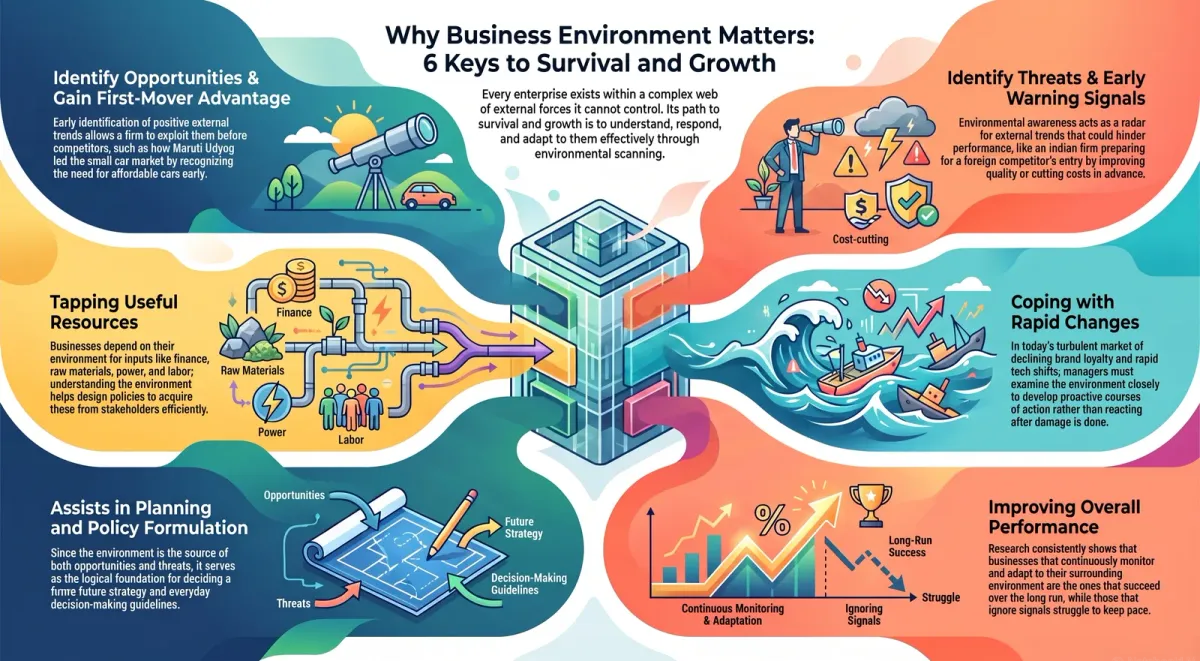
Why should a business manager spend time studying interest rates, government policies, or changing consumer habits instead of just focusing on the product? The answer lies at the heart of Chapter 3 of CBSE Class 12 Business Studies: understanding the business environment directly affects whether a firm survives, grows, or gets left behind. This post explains, in detail, the six key reasons why business environment and its understanding matter so much to managers and enterprises.
Business Enterprises Do Not Exist in Isolation
Just as no human being lives cut off from society, no business firm is an island unto itself. Every enterprise exists, survives, and grows within the context of the forces of its environment. An individual firm can do little to change these outside forces, so it has no alternative but to respond and adapt. A good understanding of the environment allows managers to identify, evaluate, and react to these forces effectively — which is exactly why this topic carries so much weight in the chapter.
1. It Helps the Firm Identify Opportunities and Gain First-Mover Advantage
Opportunities are positive external trends or changes that help a firm improve its performance. The environment constantly throws up such opportunities, and early identification allows an enterprise to be the first to exploit them instead of losing them to competitors. A classic example is Maruti Udyog, which became the leader in India’s small car market because it was the first to recognise the growing need for affordable small cars in an environment shaped by rising petroleum prices and a large, aspiring middle class. Firms that scan their environment regularly are simply better positioned to catch such openings before anyone else does.
2. It Helps the Firm Identify Threats and Early Warning Signals
Just as the environment creates opportunities, it is also a major source of threats — external trends and changes that can hinder a firm’s performance. Environmental awareness helps managers spot these threats on time, acting as an early warning system. For example, if an Indian firm learns that a foreign multinational is about to enter the domestic market with new substitute products, that information should act as a clear warning signal. Armed with this insight, the firm can prepare in advance by improving product quality, reducing production costs, or launching a more aggressive advertising campaign — rather than being caught off guard.
3. It Helps in Tapping Useful Resources
The environment is a source of the various resources a business needs to function — finance, machinery, raw materials, power, water, and labour, sourced from financiers, government bodies, and suppliers. These stakeholders provide resources in exchange for something in return: goods and services for customers, tax payments to the government, and returns on investment for financiers. Because a firm depends on its environment both for the inputs it needs and as the outlet for what it produces, understanding what the environment has to offer allows an enterprise to design better policies for acquiring the right resources at the right time.
4. It Helps in Coping with Rapid Changes
Today’s business environment is becoming increasingly dynamic, with changes happening at a fast pace. It is not simply the fact that change occurs that matters — it is the speed at which it occurs. Turbulent market conditions, declining brand loyalty, market fragmentation, more demanding customers, rapid technological change, and intense global competition are just a few of the forces shaping modern business. Enterprises of every size and type face this increasingly dynamic environment, and to cope effectively, managers must understand and examine it closely in order to develop suitable courses of action rather than reacting after the damage is done.
5. It Assists in Planning and Policy Formulation
Since the environment is a source of both opportunities and threats, understanding and analysing it forms the very basis for deciding a firm’s future course of action, whether that means long-term planning or setting guidelines for everyday decision-making. For instance, when new competitors enter a market, that single environmental change can push an enterprise to completely rethink its strategy — from pricing to product design to marketing — in order to remain competitive and relevant.
6. It Helps in Improving Performance
The final and perhaps most practical reason for understanding business environment relates to whether it genuinely makes a difference to a firm’s performance — and research consistently shows that it does. The future of an enterprise is closely tied to what is happening in its surrounding environment. Businesses that continuously monitor their environment and adapt their practices accordingly are the ones that not only improve their current performance but also continue to succeed in the market over the long run, while those that ignore environmental signals often struggle to keep pace.
Putting It All Together
These six points work together rather than in isolation. A firm that spots an opportunity early (point 1) still needs the right resources (point 3) and sound planning (point 5) to capture it. Identifying a threat (point 2) is only useful if the firm can cope with the pace of change (point 4). This interconnected relevance is why examiners often ask students to explain the importance of business environment with real examples — it tests whether you grasp the practical stakes behind a theoretical concept.
Related Reading
Ready to Master Business Studies Chapter 3?
Practice unlimited AI-generated MCQs and long-answer questions on the importance of business environment at just ₹10 a session. Visit ChampionsPrep for structured, exam-focused practice built for CBSE and Maharashtra Board Class 12 Commerce students.
Test Your Knowledge

Importance of Business Environment for Business Enterprises
Frequently Asked Questions
What is the importance of business environment in one line? +
It helps a business identify opportunities, spot threats early, access resources, adapt to rapid changes, plan effectively, and ultimately improve its performance.
What is meant by first-mover advantage in this context? +
First-mover advantage means being the first enterprise to identify and act on an environmental opportunity before competitors do, as Maruti Udyog did in India's small car market.
How does business environment act as an early warning system? +
By tracking external trends, such as a new competitor entering the market, a firm can anticipate threats in advance and take corrective measures like improving quality or cutting costs before the threat causes real damage.
Why is coping with rapid change considered so important today? +
Because modern business environments change at an increasingly fast pace due to technology, shifting customer expectations, and global competition, so firms that fail to adapt quickly risk falling behind.
How does business environment help in planning and policy formulation? +
Since the environment is a source of both opportunities and threats, analysing it gives managers the information needed to decide the enterprise's future strategy and set clear decision-making guidelines.
Keep practising Business Studies
AI-powered feedback and structured revision for Business Studies — free to start, at your own pace.
AI-powered practice — free to start