
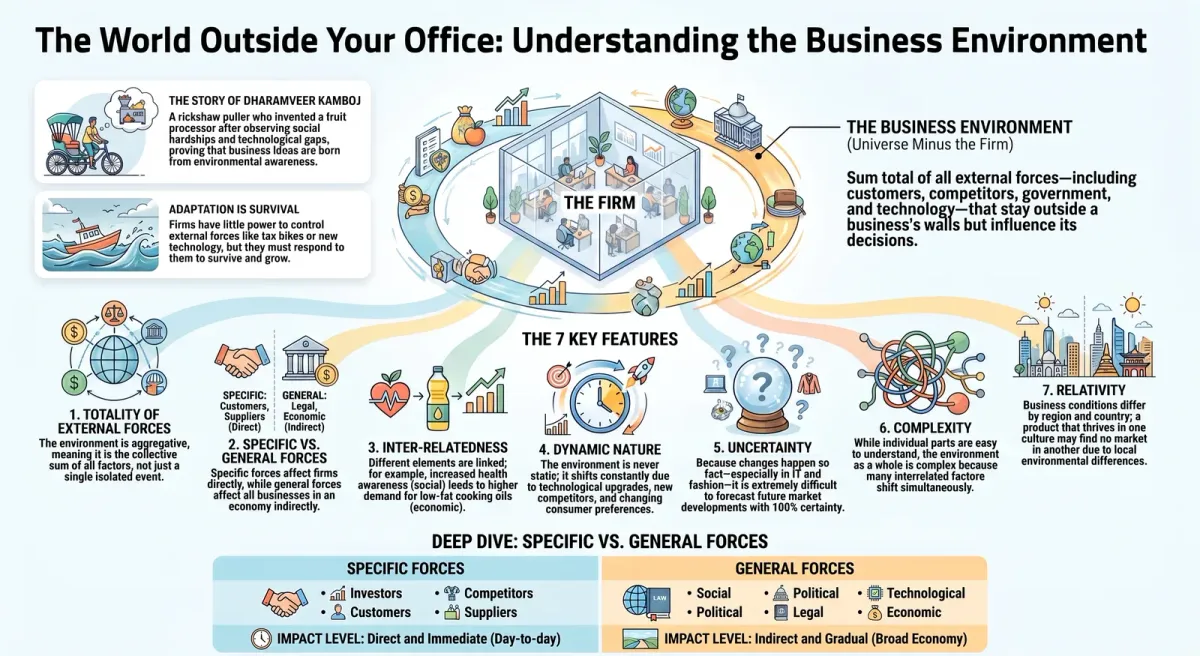
No business runs in a vacuum. A shop, a factory, or even a giant multinational company is constantly influenced by things happening outside its own walls — rising fuel prices, a new government policy, changing customer tastes, or a competitor launching a cheaper product. This “outside world” that shapes how a business performs is what Class 12 Business Studies calls the business environment. This post breaks down the meaning, definition, and defining features of this important foundational concept from Chapter 3.
Meaning of Business Environment
In simple terms, business environment refers to the sum total of all individuals, institutions, and other forces that lie outside the control of a business enterprise but that can still affect how it performs. These forces are not part of the organisation itself, yet they constantly interact with it and shape its decisions.
Think of it this way: if you take the entire universe and subtract from it everything that makes up the organisation, whatever remains is the environment. This includes competitors, customers, suppliers, investors, the government, consumer groups, courts, media, and broader forces like the economy, society, technology, and politics.
An important real-world illustration of this idea comes from the story of Dharamveer Kamboj, a rickshaw puller from Haryana who, after a life-changing accident, went on to invent a multipurpose fruit and vegetable processing machine after observing the struggles of women’s self-help groups in Rajasthan. His journey shows how social conditions (the hardship faced by rural women), economic constraints (lack of affordable machinery), and technological gaps (no cost-effective processing solution) came together to create both a problem and an opportunity — and how a business idea was born directly out of understanding that environment.
Why Business Firms Cannot Function in Isolation
Just like human beings do not live cut off from society, business enterprises exist, survive, and grow only within the context of the forces around them. A firm has little power to control these external forces — but it has no choice except to respond and adapt to them.
For instance, when the government raises taxes, products become costlier to buy. New technology can make existing products outdated almost overnight. Political uncertainty can scare away investors, while changing fashions can shift demand from old products to new ones. Increased competition can shrink profit margins across an entire industry — none of these forces are created by the firm, yet all directly affect its fortunes.
The Seven Key Features of Business Environment
Based on how it behaves and impacts enterprises, business environment can be understood through seven core features.
1. Totality of External Forces
Business environment is aggregative in nature — it is the sum total of everything external to a business firm, not just one or two isolated factors. It includes every individual, institution, and condition operating outside the organisation’s boundary.
2. Specific and General Forces
The environment includes both specific and general forces. Specific forces — such as investors, customers, competitors, and suppliers — affect an individual enterprise directly and immediately in its day-to-day functioning. General forces — such as social, political, legal, and technological conditions — affect all businesses in an economy, though usually indirectly and gradually.
3. Inter-relatedness
Different elements of the business environment do not act in isolation from one another; they are closely interconnected. For example, rising life expectancy and growing health awareness (a social trend) have increased demand for health-related products and services such as soft drinks, low-fat cooking oil, and wellness resorts (an economic outcome) — and these new products have, in turn, changed people’s daily lifestyles.
4. Dynamic Nature
The business environment is never static. It keeps changing constantly — whether through technological upgrades, shifts in what consumers prefer, or the entry of new competitors into a market. A firm that assumes today’s conditions will stay the same tomorrow is setting itself up for trouble.
5. Uncertainty
Because the environment is dynamic, it is also largely unpredictable. It is very difficult to forecast future developments with certainty, especially in fast-moving sectors like information technology or fashion, where changes can happen almost overnight.
6. Complexity
The business environment consists of numerous interrelated and constantly shifting conditions arising from many different sources. This makes it relatively easy to understand in isolated parts but genuinely difficult to grasp as a complete whole. For instance, it may be hard to know exactly how much of a change in product demand is due to social factors versus economic or legal ones.
7. Relativity
Business environment is a relative concept — it differs from one country to another and even from one region to another within the same country. Political conditions in the United States are very different from those in China or Pakistan. Similarly, a product that sees huge demand in one country may find almost no market in another, purely because of environmental differences.
Why This Concept Matters for Exams and Beyond
Understanding the meaning and features of business environment is not just an exam requirement — it is the foundation for every later topic in this chapter, including environment scanning, its dimensions (economic, social, technological, political, legal), and how policy changes like liberalisation reshaped Indian industry. Getting this concept right makes the rest of the chapter easier to connect, especially for board exam long-answer questions asking you to differentiate specific and general forces or explain a feature with an example.
Related Reading
Ready to Master Business Studies Chapter 3?
Practice unlimited AI-generated questions on Business Environment and get instant, exam-ready explanations — all for just ₹10 a session. Visit ChampionsPrep and start practicing Class 12 Business Studies MCQs and long-answer questions today, built specifically for CBSE and Maharashtra Board Commerce students.
Test Your Knowledge

What is Business Environment? Meaning, Definition and Key Features
Frequently Asked Questions
What is the simplest definition of business environment? +
Business environment is the sum total of all individuals, institutions, and forces that are outside a business enterprise's control but that can still influence its performance.
What are the main features of business environment? +
The seven key features are: totality of external forces, specific and general forces, inter-relatedness, dynamic nature, uncertainty, complexity, and relativity.
What is the difference between specific and general forces? +
Specific forces, such as customers and suppliers, affect an individual firm directly and immediately. General forces, such as political and legal conditions, affect all firms in the economy, usually indirectly.
Why is business environment called dynamic? +
It is called dynamic because it keeps changing constantly due to technological advancement, shifting consumer preferences, and new competitors entering the market.
Why is business environment considered a relative concept? +
Because conditions differ from country to country and region to region — a factor that boosts business in one place may have no effect, or even a negative effect, elsewhere.
Keep practising Business Studies
AI-powered feedback and structured revision for Business Studies — free to start, at your own pace.
AI-powered practice — free to start