
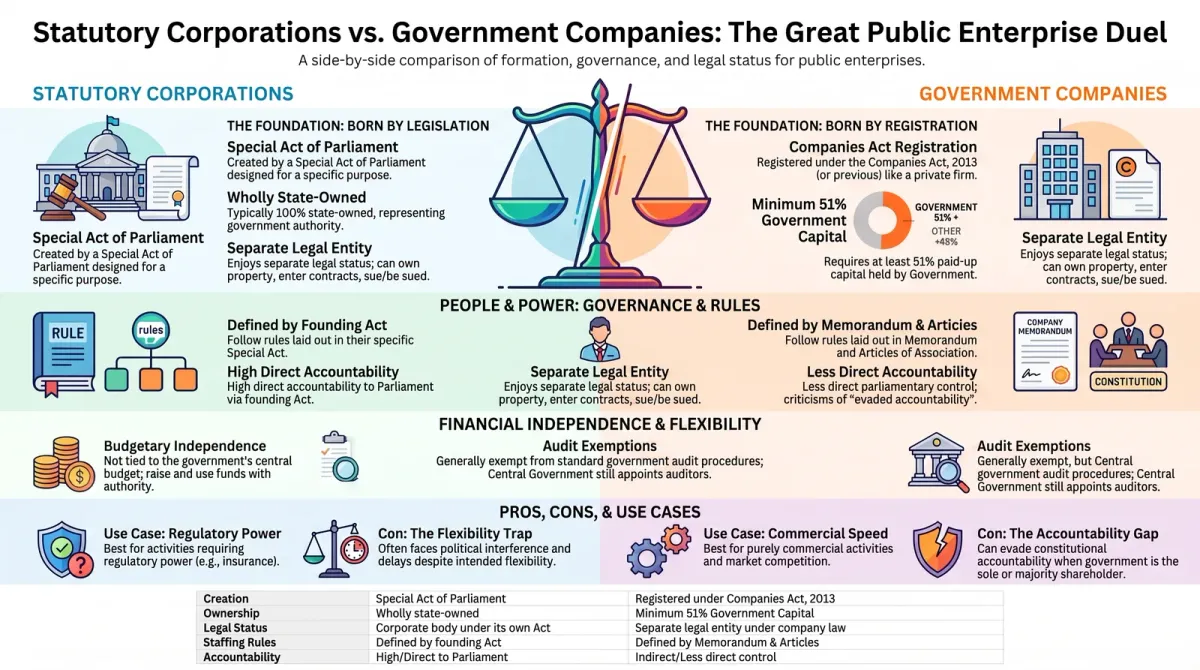
Not every government-owned enterprise runs the way Indian Railways does. Some, like the Life Insurance Corporation of India, were created by a special Act of Parliament and enjoy considerable independence. Others, like many public sector undertakings listed on the stock exchange, are registered under the Companies Act just like any private business. These are the two remaining forms of public enterprise covered in CBSE Class XI Business Studies Chapter 3: statutory corporations and government companies. This post breaks down how each is created, funded, and governed.
What Is a Statutory Corporation?
A statutory corporation is a public enterprise brought into existence by a special Act of Parliament. The Act itself defines the corporation’s powers, functions, and the rules governing its employees and its relationship with government departments. This makes it a corporate body created by the legislature — financially independent, with clear control over a specified area of commercial activity, and legally capable of acting in its own name.
Features of Statutory Corporations
-
Created by a Special Act — the Act defines the objects, powers, and privileges of the corporation.
-
Wholly state-owned — the government bears ultimate financial responsibility, appropriating profits and absorbing losses.
-
A body corporate — it can sue and be sued, enter contracts, and acquire property in its own name.
-
Independently financed — it raises funds through government borrowings or public revenue from the sale of goods and services, and retains authority to use those revenues.
-
Exempt from standard government audit procedures — it is not tied to the government’s central budget in the way a departmental undertaking is.
-
Employees are not civil servants — service conditions are governed by the Act itself, though some officers may be deputed from government departments.
Merits and Limitations of Statutory Corporations
On paper, statutory corporations combine government backing with private-sector-style operating flexibility, and they enjoy real independence from the government’s central budget. In practice, this flexibility is often diluted. Actions remain subject to the founding Act, government-appointed advisors on the board can delay contract decisions, and political interference frequently creeps into major financial calls. Where large sums or public dealings are involved, corruption risk also rises.
What Is a Government Company?
A government company is established under The Companies Act, 2013, and functions purely for business purposes, competing in the market much like any private company. Under Section 2(45) of the Companies Act, 2013, a company qualifies as a government company when at least 51 per cent of its paid-up capital is held by the central government, a state government, or a combination of both — including any company that is a subsidiary of such a government company. Its shares are typically purchased in the name of the President of India.
Features of Government Companies
-
Registered like any other company — formed under the Companies Act, 2013 or an earlier company law, without needing a separate Parliamentary Act.
-
Separate legal entity — it can sue, be sued, and enter contracts or acquire property in its own name.
-
Governed by the Companies Act — management follows the same provisions applicable to any public limited company.
-
Employees follow the company’s own rules — as laid down in its Memorandum and Articles of Association, not government service rules.
-
Exempt from standard government audit rules — though the Central Government appoints the auditor, and the Annual Report must still be tabled before Parliament or the State Legislature.
-
Diverse funding sources — government shareholding, private shareholders, and capital market borrowings are all permitted.
Merits and Limitations of Government Companies
A government company can be set up quickly simply by meeting Companies Act requirements, without a dedicated Parliamentary Act. It enjoys a separate legal identity apart from the government and considerable autonomy in day-to-day decisions, allowing it to act with genuine business prudence. However, when the government is the sole shareholder, ordinary Companies Act protections lose much of their relevance, since no independent shareholders exist to enforce them. This can also let the enterprise evade the constitutional accountability a government-financed body ought to have.
Statutory Corporation vs Government Company: Side-by-Side
| Basis | Statutory Corporation | Government Company |
|---|---|---|
| How it's created | Special Act of Parliament | Registered under the Companies Act, 2013 |
| Ownership | Wholly owned by the state | At least 51% government paid-up capital |
| Legal status | Corporate body under its own Act | Separate legal entity under company law |
| Employee rules | Governed by the founding Act | Governed by Memorandum & Articles |
| Accountability | To Parliament, via the Act | Indirect; less direct parliamentary control |
Choosing the Right Form
The government generally prefers a statutory corporation when an activity needs both regulatory power and operating flexibility, such as airport authorities or insurance regulators. A government company suits purely commercial activities where speed of incorporation and market-style governance matter more than statutory powers. Both differ from departmental undertakings, covered in the previous post, because they trade direct ministerial control for financial and managerial independence.
Master This Chapter with ChampionsPrep
Confusing statutory corporations with government companies on your last test? ChampionsPrep’s AI-powered practice questions and chapter-mapped mock tests help you lock in exactly this kind of distinction before exam day. Registration is free, and you pay only as you use — no subscriptions required. Start practising at https://app.championsprep.in .
Test Your Knowledge

Statutory Corporations vs Government Companies: Key Differences Explained
Frequently Asked Questions
What is the main difference between a statutory corporation and a government company? +
A statutory corporation is created by a special Act of Parliament and is wholly state-owned, while a government company is registered under the Companies Act, 2013, requiring only 51% government paid-up capital.
How much government shareholding is needed for a company to be called a government company? +
Under Section 2(45) of the Companies Act, 2013, at least 51 per cent of the paid-up capital must be held by the central government, a state government, or a combination of both.
Can a statutory corporation sue and be sued in its own name? +
Yes, a statutory corporation is a body corporate and has the legal capacity to sue and be sued, enter into contracts, and acquire property in its own name.
Are employees of a government company treated as civil servants? +
No, employees of a government company are appointed according to the company's own rules and regulations as laid out in its Memorandum and Articles of Association, not government service rules.
Why is a government company considered less accountable than a statutory corporation? +
A government company is not directly answerable to Parliament the way a statutory corporation is under its founding Act, which is why this form is sometimes criticised for evading direct constitutional accountability.
AI-powered practice — free to start