
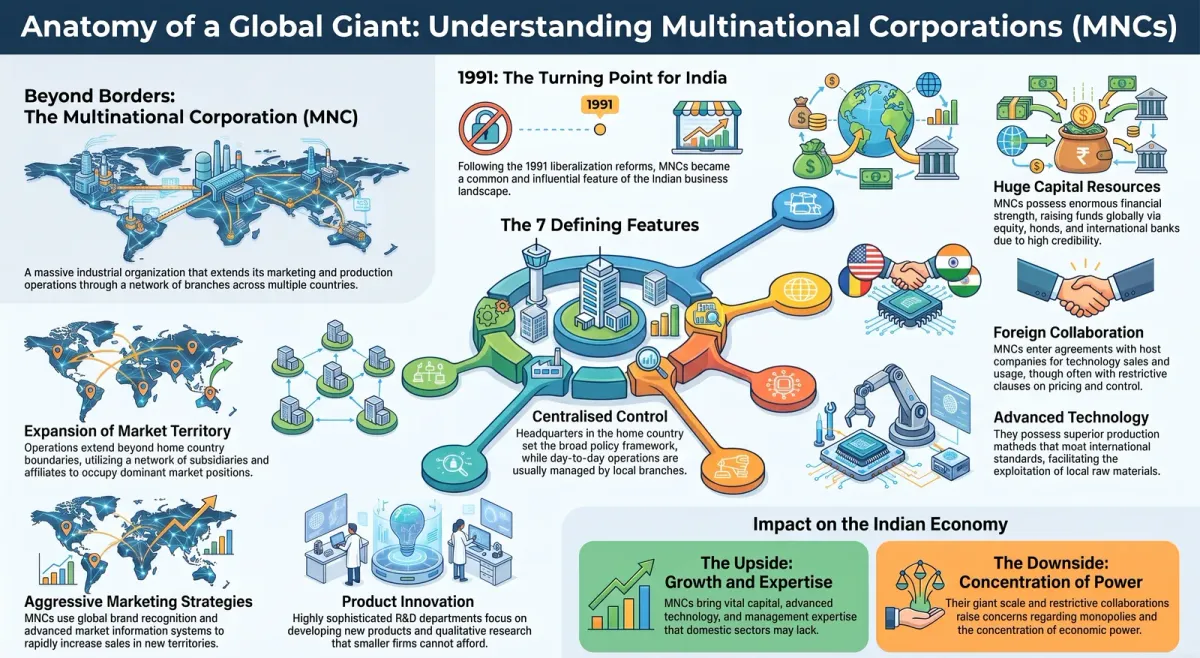
Open your phone, check the brand on your shoes, or look at the car in your driveway, and there’s a good chance a multinational corporation is behind at least one of them. Over the last few decades, global enterprises have become a defining feature of the Indian economy, sitting alongside the public and private sectors covered earlier in this series. This post explains what makes an enterprise “global,” the seven features that distinguish these giants from domestic companies, and why they matter so much to CBSE Class XI Business Studies students.
What Is a Global Enterprise?
A global enterprise, or Multinational Corporation (MNC), is a huge industrial organisation that extends its industrial and marketing operations through a network of branches across several countries. Rather than depending on one or two products in a single market, these enterprises spread operations across multiple countries and multiple product lines, aiming for scale rather than concentration. Since the 1991 liberalisation reforms opened India’s economy to greater foreign investment, MNCs have become a common and influential feature of the Indian business landscape.
Seven Features That Define Global Enterprises
1. Huge Capital Resources
Global enterprises possess enormous financial resources and the ability to raise funds from diverse sources — issuing equity shares, debentures, or bonds to the public, and borrowing from financial institutions and international banks. Because they enjoy strong credibility in capital markets, even investors and banks in host countries are willing to invest in them, giving these companies the financial strength to survive difficult economic conditions.
2. Foreign Collaboration
MNCs typically enter into agreements with Indian companies covering the sale of technology, production of goods, or use of brand names on final products. These collaborations can involve both public and private sector partners, though agreements often include restrictive clauses around technology transfer, pricing, dividend payments, and control by foreign technicians. Indian industrial houses looking to diversify have gained significantly from such tie-ups, though the same collaborations have also contributed to the growth of monopolies and concentrated economic power.
3. Advanced Technology
These enterprises possess technological superiority in their production methods and are able to meet international standards and quality specifications. This benefits the host country by enabling optimal exploitation of local resources and raw materials, and much of the computerisation and technological advancement seen in developing economies has arrived through MNC investment.
4. Product Innovation
Global enterprises run highly sophisticated research and development departments dedicated to developing new products and improving existing designs. Genuine qualitative research demands investment on a scale only global enterprises can typically afford, which is why product innovation tends to concentrate in MNC hands rather than smaller domestic firms.
5. Marketing Strategies
MNC marketing strategies are usually far more aggressive and effective than those of domestic competitors. With reliable, up-to-date market information systems and well-established advertising and sales promotion techniques, these companies can rapidly increase sales. Since their brands are already well-known globally, selling products in a new market rarely poses a serious challenge.
6. Expansion of Market Territory
MNC operations extend well beyond the physical boundaries of their home countries. As their international image builds, their market territory expands, enabling their brands to achieve genuinely global recognition. They operate through a network of subsidiaries, branches, and affiliates across host countries, often occupying a dominant market position simply because of their giant size.
7. Centralised Control
Global enterprises maintain their headquarters in their home country and exercise control over all branches and subsidiaries worldwide. This control, however, is usually limited to the broad policy framework set by the parent company — day-to-day operational decisions are typically left to local management rather than dictated from headquarters.
Why MNCs Matter for India
MNCs have played a significant role in India’s economy over the last two decades, bringing capital, technology, and management expertise that domestic public and private enterprises could not always supply on their own. At the same time, their scale and centralised control raise legitimate concerns around monopolistic practices and the concentration of economic power — themes that connect directly to the “check over concentration of economic power” argument covered in our earlier post on the public sector’s changing role.
Global Enterprises and the Rest of the Economy
Global enterprises don’t operate in isolation. They frequently collaborate with Indian public and private sector companies through joint ventures, an arrangement explored in detail in the next post of this series, and increasingly participate in Public Private Partnership projects for infrastructure development. Understanding how MNCs fit alongside the public and private sectors gives CBSE Class XI students the complete picture needed to answer comparative and application-based exam questions on this chapter.
Master This Chapter with ChampionsPrep
Want to test your understanding of MNC features before your next test? ChampionsPrep offers AI-powered practice questions and chapter notes mapped exactly to your CBSE or Maharashtra State Board syllabus. It’s free to register, and you pay only as you use — no subscriptions. Start practising at https://app.championsprep.in .
Test Your Knowledge

Global Enterprises (MNCs): Features and Role in the Indian Economy
Frequently Asked Questions
What is a global enterprise or MNC? +
A global enterprise, or Multinational Corporation, is a huge industrial organisation that extends its industrial and marketing operations through a network of branches in several countries, rather than concentrating on one or two products in a single market.
What are the seven key features of global enterprises? +
The seven features are huge capital resources, foreign collaboration, advanced technology, product innovation, aggressive marketing strategies, expansion of market territory, and centralised control from the home country.
How do MNCs collaborate with Indian companies? +
MNCs typically enter into agreements covering the sale of technology, production of goods, or use of brand names, collaborating with companies in both the public and private sectors, often with restrictive clauses on technology transfer and pricing.
Do global enterprises control the day-to-day operations of their branches? +
No, while global enterprises exercise centralised control over the broad policy framework from their home country headquarters, day-to-day operational decisions are usually left to local management in each branch.
Why are MNCs sometimes criticised in the Indian context? +
MNCs are sometimes criticised because their foreign collaborations and giant scale have contributed to the growth of monopolies and the concentration of economic power in a few hands.
AI-powered practice — free to start