
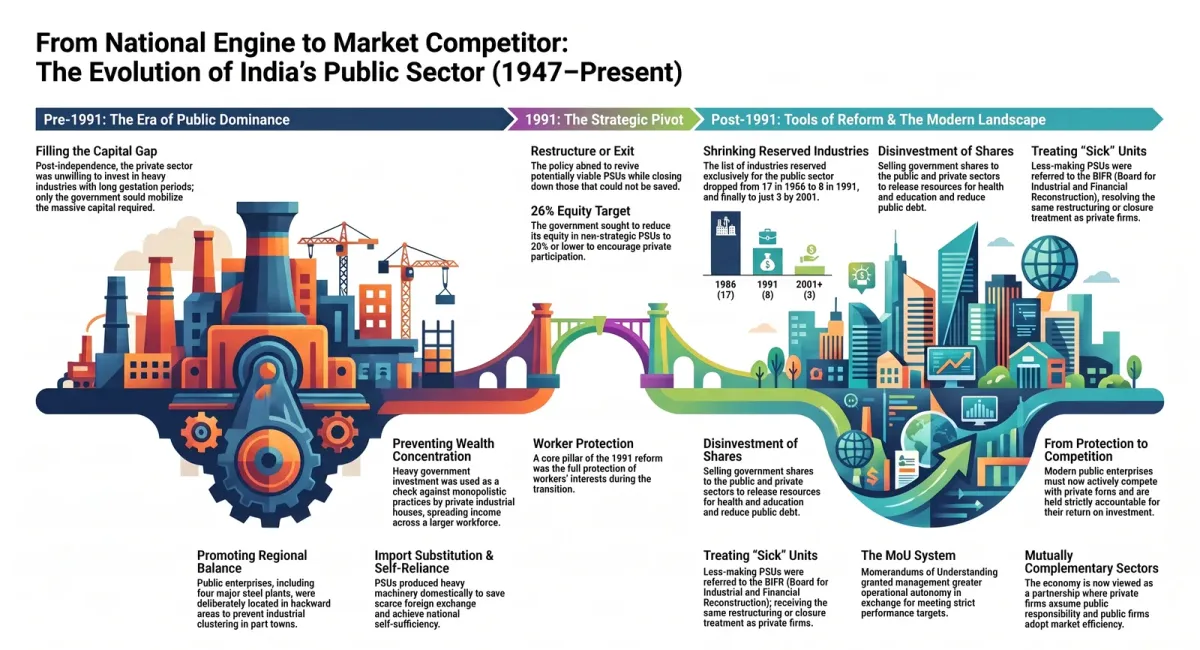
For nearly four decades after Independence, India’s public sector was treated as the engine of national development, expected to build everything the private sector wouldn’t touch. Then 1991 happened, and the rulebook changed almost overnight. This post traces why the public sector was created with such a heavy mandate, and how liberalisation redefined its purpose from passive builder to active market competitor.
Why the Public Sector Was Given Such a Big Role at Independence
At Independence, the private sector was unwilling to invest in projects requiring heavy capital and long gestation periods — think steel plants, power stations, or heavy engineering. Only the government could mobilise the huge capital, coordinate large-scale industrial construction, and train the technicians and workforce such projects demanded. The Five Year Plans in the early decades of development therefore gave enormous importance to the public sector, expecting it to act as both direct participant and catalyst for the wider economy.
Development of Infrastructure
Industrialisation cannot proceed without transportation, communication, fuel, and energy in place first. The private sector had neither the trained personnel nor the finances to build this infrastructure quickly, so the government took direct responsibility for rail, road, sea, and air transport, along with core-sector investment in steel, power generation, civil aviation, petroleum, and coal.
Regional Balance
Pre-Independence industrial growth clustered around a handful of port towns, leaving vast regions undeveloped. From 1951 onward, the Five Year Plans deliberately located new public enterprises — including four major steel plants — in backward areas to accelerate development and employment, while curbing the tendency of private firms to cluster only in already-advanced regions.
Economies of Scale
Certain industries — electric power, natural gas, petroleum, telephones — only function efficiently at a massive scale requiring huge capital outlay. Only the public sector had the resources and mass-production base to set up such large units economically.
Check on Concentration of Economic Power
Left entirely to the private sector, heavy industry investment risked concentrating wealth in a handful of industrial houses, encouraging monopolistic practices and income inequality. By taking on large-scale industries itself, the public sector spread the resulting income and benefits across a much larger base of employees and workers.
Import Substitution
During the second and third Five Year Plans, India pursued self-reliance and faced a persistent foreign exchange crunch that made importing heavy machinery difficult. Public sector companies in heavy engineering helped substitute these imports domestically, while enterprises like the State Trading Corporation (STC) and MMTC played an important role in expanding the country’s exports.
The 1991 Turning Point
By the late 1980s, this expansive role had produced a public sector burdened by inefficiency, mounting losses, and limited accountability. The 1991 industrial policy marked a radical departure from every policy before it, introducing four major reforms:
-
Restructure and revive potentially viable public sector undertakings (PSUs).
-
Close down PSUs that could not be revived.
-
Bring down government equity in all non-strategic PSUs to 26 per cent or lower, where necessary.
-
Fully protect the interests of workers throughout the transition.
Fewer Industries Reserved for the Public Sector
The 1956 Industrial Policy Resolution had reserved 17 industries exclusively for the public sector. By 1991, this had shrunk to just 8 — atomic energy, arms and communication, mining, and railways. By 2001, only three industries remained exclusively reserved: atomic energy, arms, and rail transport. The private sector could now enter virtually every other area, forcing the public sector to compete rather than simply operate.
Disinvestment of Shares
Disinvestment — the sale of government equity shares to the private sector and the public — became a central reform tool. Its goals included releasing public resources locked up in non-strategic enterprises for priorities like basic health and primary education, reducing public debt, transferring commercial risk to private investors, and freeing enterprises from government control in favour of corporate governance. In sectors like telecom where the public sector once held a monopoly, consumers gained more choice, lower prices, and better quality.
Treating Sick Units Like Private Ones
Loss-making public sector units were referred to the Board for Industrial and Financial Reconstruction (BIFR) to decide whether they should be restructured or shut down, the same treatment a struggling private company might receive. A National Renewal Fund was set up to retrain retrenched workers and compensate those opting for voluntary retirement, though its resources proved insufficient to fully meet the cost of these schemes.
Memorandum of Understanding (MoU) System
To improve performance without abandoning oversight altogether, the government introduced a Memorandum of Understanding system between individual public sector units and their administrative ministries. Under this arrangement, management received greater operational autonomy but was held strictly accountable for specified performance targets.
A Redefined, Competitive Role
The public sector’s role today is nowhere close to what was envisaged in the 1960s or 70s. Rather than playing a passive, protected role, public enterprises must now actively compete with private companies in the same industry, remaining accountable for losses and return on investment. Both sectors are now viewed as mutually complementary parts of the national economy — private firms are expected to assume greater public responsibility, while public enterprises must sharpen their performance in an increasingly competitive market.
Master This Chapter with ChampionsPrep
The 1991 reforms are a favourite topic for long-answer questions in CBSE board exams. ChampionsPrep’s AI-powered practice tests and detailed chapter notes help you break down exactly what examiners expect. Registration is free, and you pay only as you use — no subscriptions. Start practising at https://app.championsprep.in .
Test Your Knowledge

The Changing Role of India's Public Sector Since 1991
Frequently Asked Questions
Why did the public sector play such a dominant role at the time of Independence? +
The private sector was unwilling to invest in capital-intensive projects with long gestation periods, so the government stepped in to build infrastructure, achieve regional balance, exploit economies of scale, and support import substitution.
What were the four main elements of the 1991 public sector policy? +
The four elements were restructuring and reviving viable PSUs, closing down PSUs that could not be revived, reducing government equity in non-strategic PSUs to 26% or lower, and fully protecting workers' interests.
How many industries are exclusively reserved for the public sector today? +
As of 2001, only three industries remain exclusively reserved for the public sector: atomic energy, arms, and rail transport.
What is disinvestment? +
Disinvestment is the sale of government equity shares in public sector enterprises to the private sector and the public, aimed at raising resources and encouraging wider ownership participation.
What is the purpose of a Memorandum of Understanding (MoU) in the public sector? +
An MoU is an agreement between a public sector unit and its administrative ministry that grants the unit greater operational autonomy while holding it accountable for achieving specified performance targets.
AI-powered practice — free to start