
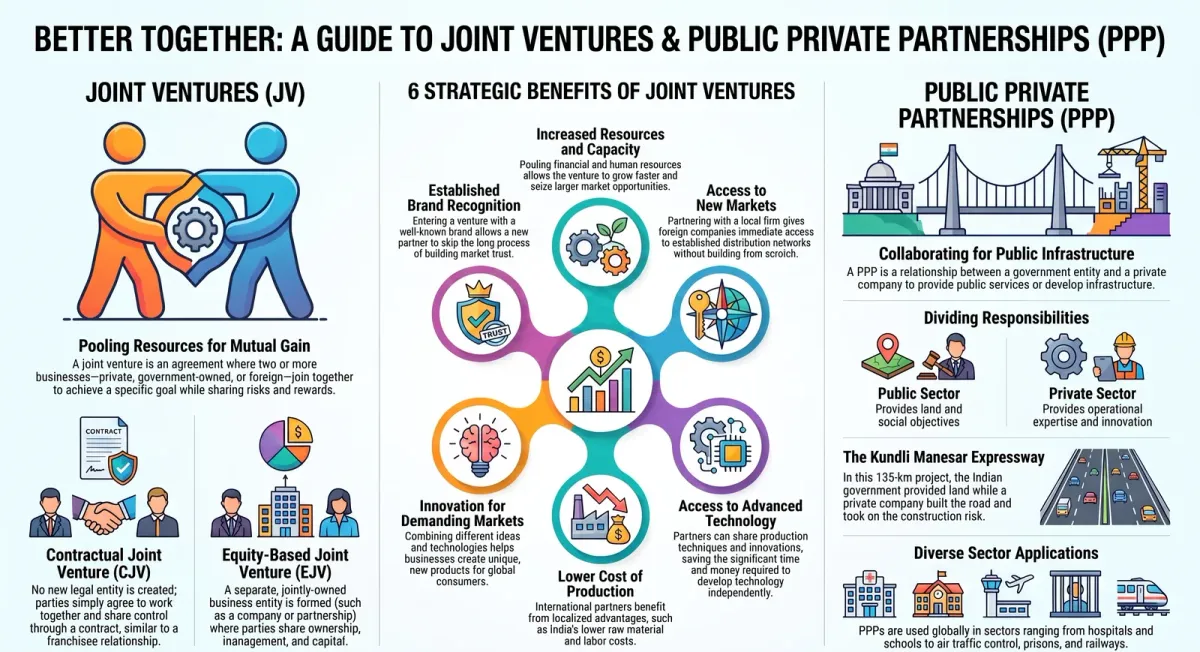
A private Indian company, a government-owned enterprise, and a foreign multinational rarely look alike on paper — yet they can, and often do, join hands for a common purpose. This closing post covers two important ways businesses across the public, private, and global sectors collaborate: joint ventures and Public Private Partnerships (PPP).
Types of Joint Ventures
Joint ventures generally fall into two categories, distinguished by whether a new jointly-owned entity is actually created.
Contractual Joint Venture (CJV)
In a contractual joint venture, no new jointly-owned entity is created — there is only an agreement to work together. Parties do not share ownership but exercise some control, as in a franchisee relationship. Key elements: a common intention to run a business venture, each party contributing inputs, shared control, and a longer-term relationship rather than a one-off transaction.
Equity-Based Joint Venture (EJV)
An equity joint venture is one where a separate business entity, jointly owned by two or more parties, is formed under their agreement. Joint ownership is the defining factor, and the entity may take the form of a company, partnership firm, trust, limited liability partnership, or venture capital fund. Key elements: an agreement to create a new entity (or join an existing one), shared ownership and management, shared capital and financing responsibility, and shared profits and losses.
Every joint venture must rest on a signed memorandum of understanding, and the agreement must confirm that all necessary governmental approvals and licences will be obtained within a specified period.
Six Benefits of Joint Ventures
Businesses can achieve gains through joint ventures that would be difficult alone, since even a party with strong growth potential benefits from the added capacity, resources, and expertise.
-
Increased resources and capacity — pooling financial and human resources lets the venture grow faster and seize new opportunities.
-
Access to new markets and distribution networks — a foreign partner entering India gains a vast market and established local distribution channels without building its own retail network.
-
Access to technology — advanced production techniques save time, energy, and investment, since partners avoid developing technology from scratch.
-
Innovation — combining ideas and technology, especially from a foreign partner, helps businesses create new products for demanding markets.
-
Low cost of production — international partners benefit from India’s lower raw material and labour costs.
-
Established brand name — partnering with an already well-known brand saves the time and money needed to build recognition from scratch.
How Responsibilities Are Divided in a PPP
The public sector ensures social obligations, sector reforms, and public investment targets are met, contributing capital and transferring supporting assets, plus social responsibility and local knowledge. The private sector brings operational expertise and drives innovation to run the business well.
Where PPPs Are Used
PPPs have been used worldwide across sectors including power, water and sanitation, refuse disposal, pipelines, hospitals, schools, stadiums, air traffic control, prisons, railways, roads, IT/billing systems, and housing. A well-known Indian example is the Kundli Manesar Expressway, a 135-kilometre stretch where the government provided the land and a private company laid the road surface, retaining ownership while transferring construction risk to the private partner.
Bringing the Chapter Together
Across this six-part series, we’ve covered how India’s mixed economy divides ownership between the public and private sectors, the three forms a public enterprise can take, how the public sector’s role evolved after 1991, and how global enterprises add a third dimension to the economy. Joint ventures and PPPs sit at the intersection of all three — private firms partnering with government bodies, domestic companies collaborating with multinationals, and public infrastructure built with private-sector efficiency. Collaboration across sectors is now the norm, not the exception.
Master This Chapter with ChampionsPrep
Ready to test your complete understanding of Chapter 3 — from public and private sectors to joint ventures and PPPs? ChampionsPrep’s AI-powered question banks and mock tests cover every topic in this chapter for CBSE and Maharashtra State Board students. It’s free to register, and you pay only as you use — no subscriptions, no hidden costs. Start practising at https://app.championsprep.in .
Test Your Knowledge

Joint Ventures and Public Private Partnership (PPP): Meaning, Types and Benefits
Frequently Asked Questions
What is a joint venture? +
A joint venture is an arrangement where two or more businesses — private, government-owned, or foreign — pool resources and expertise to achieve a common goal, sharing both the risks and rewards of the business.
What is the difference between a contractual joint venture and an equity-based joint venture? +
In a contractual joint venture, no new entity is created and parties only agree to work together, while in an equity-based joint venture, a new jointly-owned entity is formed with shared ownership, management, and profits.
What are the main benefits of entering into a joint venture? +
The main benefits include increased resources and capacity, access to new markets and technology, product innovation, lower cost of production, and access to an established brand name.
What is a Public Private Partnership (PPP)? +
A PPP is a relationship between public sector entities and private businesses for the development and completion of infrastructure and other public service projects, allocating tasks, obligations, and risks between them.
Can you give an example of a Public Private Partnership in India? +
The Kundli Manesar Expressway is a well-known Indian PPP example, where the government provided the 135-kilometre stretch of land and a private company built the road surface.
AI-powered practice — free to start