
Interest on Drawings: Methods of Calculation Explained
If interest on capital rewards partners for keeping money invested in the firm, interest on drawings does the opposite — it discourages partners from withdrawing cash excessively for personal use. This topic trips up many CBSE Class 12 Accountancy students not because the concept is hard, but because the calculation method changes depending on when and how the money was withdrawn. Let’s go through every scenario systematically.
What Is Interest on Drawings?
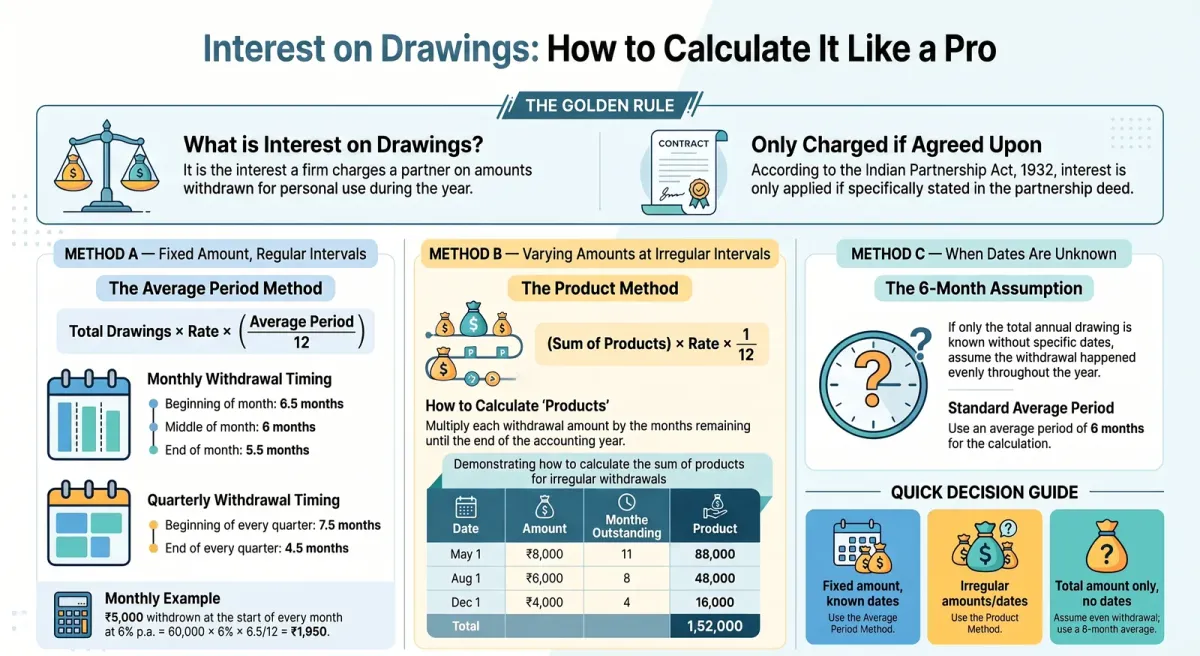
Interest on drawings is the interest a firm charges a partner on the amounts they withdraw during the year for personal use. Like interest on capital, it is charged only when the partnership deed specifically provides for it — the Indian Partnership Act, 1932 does not charge any interest on drawings by default.
Method 1: Fixed Amount Withdrawn Monthly
When a partner withdraws the same fixed amount every month, the key is figuring out the average period for which the money remained withdrawn, based on whether withdrawals happen at the beginning, middle, or end of each month.
-
Withdrawn at the beginning of every month: Average period = 6.5 months
-
Withdrawn in the middle of every month: Average period = 6 months
-
Withdrawn at the end of every month: Average period = 5.5 months
Formula: Interest on Drawings = Total Drawings × Rate × Average Period / 12
Example: If a partner withdraws ₹5,000 at the beginning of every month for a full year, and interest is charged at 6% per annum:
Total drawings = ₹5,000 × 12 = ₹60,000 Interest = 60,000 × 6% × 6.5/12 = ₹1,950
Method 2: Fixed Amount Withdrawn Quarterly
The same logic extends to quarterly withdrawals:
-
Withdrawn at the beginning of every quarter: Average period = 7.5 months
-
Withdrawn at the end of every quarter: Average period = 4.5 months
Example: A partner withdraws ₹20,000 at the end of every quarter, and interest is charged at 8% per annum.
Total drawings = ₹20,000 × 4 = ₹80,000 Interest = 80,000 × 8% × 4.5/12 = ₹2,400
Method 3: Varying Amounts Withdrawn at Irregular Intervals — The Product Method
When a partner withdraws different amounts on different, irregular dates, the average period method doesn’t work cleanly. Instead, accountants use the product method:
-
For each withdrawal, multiply the amount by the number of months it remained withdrawn (counted from the date of withdrawal to the last day of the accounting year).
-
Add up all these “products.”
-
Apply the interest rate to the total product for one month (i.e., divide by 12).
Formula: Interest on Drawings = (Sum of Products) × Rate × 1/12
Example: A partner withdraws ₹8,000 on May 1, ₹6,000 on August 1, and ₹4,000 on December 1, in a year ending March 31. Interest is charged at 9% per annum.
| Date | Amount | Months Outstanding | Product |
|---|---|---|---|
| May 1 | 8,000 | 11 | 88,000 |
| August 1 | 6,000 | 8 | 48,000 |
| December 1 | 4,000 | 4 | 16,000 |
| Total | 1,52,000 |
Interest = 1,52,000 × 9% × 1/12 = ₹1,140
Method 4: When Dates of Withdrawal Are Not Given
Sometimes a question only tells you the total amount withdrawn during the year, without specifying dates. In such cases, it is assumed that the amount was withdrawn evenly throughout the year, and the average period used is 6 months (as if drawings happened steadily, in the middle of each month).
Example: A partner withdraws a total of ₹72,000 during the year, with no dates specified, and interest is charged at 10% per annum.
Interest = 72,000 × 10% × 6/12 = ₹3,600
A Quick Decision Guide
| Scenario | Method to Use |
|---|---|
| Fixed amount, same interval, dates known | Average period method |
| Varying amounts, irregular dates | Product method |
| Total drawings known, no dates given | Assume even withdrawal; use 6-month average |
Common Mistakes to Avoid
-
Confusing “beginning of month” (6.5 months) with “end of month” (5.5 months) — always check the wording carefully.
-
Forgetting that the product method counts months up to the last day of the accounting year, not up to 12 months from the withdrawal date.
-
Applying interest on drawings even when the deed is silent — remember, this interest is charged only if expressly agreed upon.
Key Takeaways
-
Interest on drawings is charged only when the partnership deed specifically provides for it.
-
Use the average period method for fixed, regular withdrawals (monthly or quarterly).
-
Use the product method for irregular, varying withdrawals.
-
If no dates are specified, assume even withdrawal and use a 6-month average period.
Practice Every Drawings Scenario
Interest on drawings questions test multiple calculation methods within a single paper. Practice all the variations — monthly, quarterly, and product method — with instant feedback at https://app.championsprep.in .
Test Your Knowledge

Interest on Drawings: Average Period & Product Method Explained (with Examples)
Frequently Asked Questions
What is the average period for interest on drawings if a fixed amount is withdrawn on the first day of every month? +
The average period is 6.5 months, since the withdrawals are assumed to be spread across the year with the first drawing outstanding for the full 12 months and the last for just 1 month.
When should the product method be used instead of the average period method? +
The product method is used when a partner withdraws varying amounts of money at different, irregular intervals during the year, making a simple average period calculation impossible.
What if the dates of withdrawal are not mentioned in a question? +
When only the total drawings are given without specific dates, it is assumed that the amount was withdrawn evenly throughout the year, and interest is calculated using an average period of 6 months.
Does the Indian Partnership Act 1932 charge interest on drawings by default? +
No. Interest on drawings is charged only if the partnership deed expressly provides for it. In the absence of an agreement, no interest is charged on drawings.
How is interest on drawings calculated for quarterly withdrawals made at the end of each quarter? +
Multiply the total quarterly drawings by the interest rate and by an average period of 4.5 months, divided by 12.
AI-powered practice — free to start