
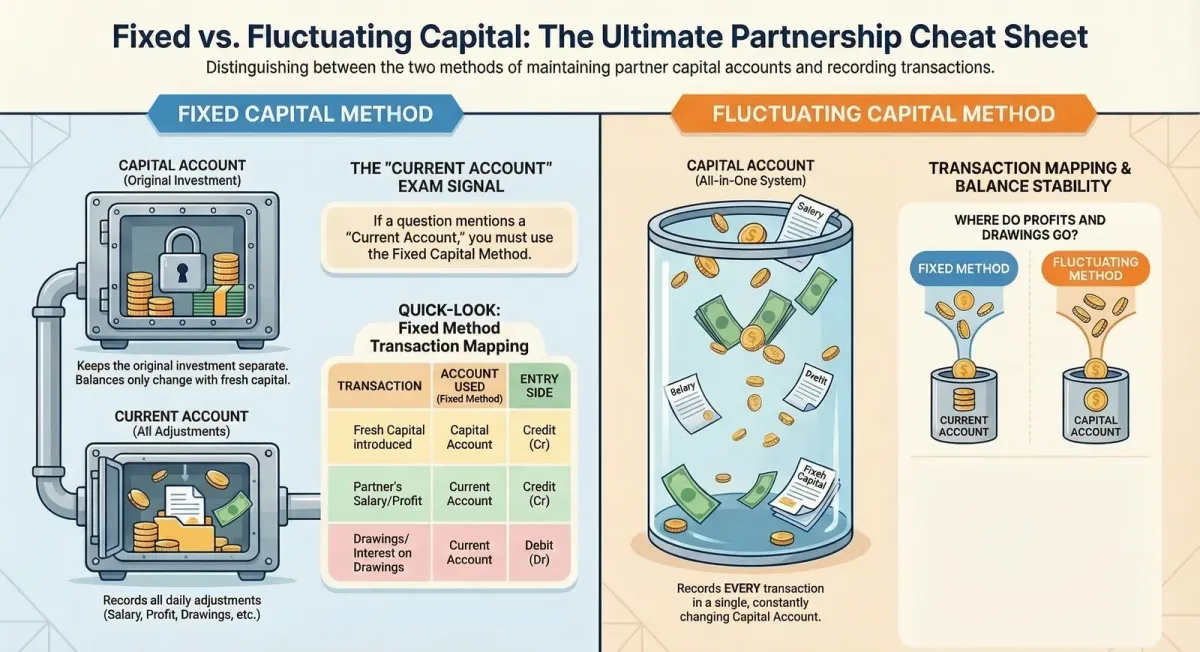
The difference between Fixed and Fluctuating Capital methods is one of the most frequently examined — and most frequently misunderstood — topics in Class 12 Accountancy. Once you understand the logic behind each method, the confusion disappears entirely.
Why Two Methods Exist
In a partnership, several things happen beyond the initial capital contribution: partners earn interest on their capital, take drawings, receive salaries, and share in profit or loss. The question is: where do you record all of this?
-
Fixed Capital Method: Keep the original capital separate. Record everything else in a secondary account.
-
Fluctuating Capital Method: Record everything in a single account per partner. The balance changes with every transaction.
Method 1: Fixed Capital Method
Under this method, each partner’s Capital Account balance stays constant throughout the year. It changes only if:
-
Fresh capital is introduced
-
Capital is permanently withdrawn
-
The profit-sharing ratio changes
All other adjustments are recorded in a separate Current Account.
What Goes Where
| Transaction | Account Used |
|---|---|
| Initial capital contribution | Capital Account (Cr) |
| Fresh capital introduced | Capital Account (Cr) |
| Permanent capital withdrawal | Capital Account (Dr) |
| Interest on capital | Current Account (Cr) |
| Partner's salary/commission | Current Account (Cr) |
| Share of profit | Current Account (Cr) |
| Share of loss | Current Account (Dr) |
| Drawings | Current Account (Dr) |
| Interest on drawings | Current Account (Dr) |
Format
Partner's Capital Account
─────────────────────────────────────────────────────
Dr                                              Cr
                          | Balance b/d  ₹X,XXX
                          | (remains constant)
Partner's Current Account
─────────────────────────────────────────────────────
Dr Cr
Drawings ₹X,XXX | Interest on Capital ₹X,XXX
Int. Drawings ₹X,XXX | Salary ₹X,XXX
Share of Loss ₹X,XXX | Share of Profit ₹X,XXXWhen to Use It
-
When the question mentions both a Capital Account and a Current Account for each partner
-
More suitable for stable partnerships where partners prefer clarity about their original investment
Method 2: Fluctuating Capital Method
Under this method, all transactions are recorded in a single Capital Account per partner. There is no separate Current Account. The balance fluctuates — rises and falls — with every entry.
What Gets Recorded in the Capital Account
| Transaction | Effect on Capital Account |
|---|---|
| Opening balance | Credit (Cr) |
| Fresh capital | Credit (Cr) |
| Interest on capital | Credit (Cr) |
| Partner's salary/commission | Credit (Cr) |
| Share of profit | Credit (Cr) |
| Drawings | Debit (Dr) |
| Interest on drawings | Debit (Dr) |
| Share of loss | Debit (Dr) |
Format
Partner's Capital Account
─────────────────────────────────────────────────────
Dr                              Cr
Drawings       ₹X,XXX | Balance b/d          ₹X,XXX
Int. Drawings  ₹X,XXX | Interest on Capital  ₹X,XXX
Share of Loss  ₹X,XXX | Salary               ₹X,XXX
Balance c/d    ₹X,XXX | Share of Profit      ₹X,XXX
When to Use It
-
When the question only mentions Capital Account (no Current Account)
-
More common in practice; simpler to maintain
-
Used when capital balances are expected to change regularly
Side-by-Side Comparison
| Feature | Fixed Capital Method | Fluctuating Capital Method |
|---|---|---|
| Accounts maintained | Capital Account + Current Account | Capital Account only |
| Capital balance changes? | Rarely | Every period |
| Profit/loss recorded in | Current Account | Capital Account |
| Drawings recorded in | Current Account | Capital Account |
| Complexity | Slightly higher | Simpler |
| Common use | Stable, long-term partnerships | Most practical applications |
Quick Identification Tricks for Exams
Fixed Capital — Spot It in 5 Seconds
The question uses both “Capital Account” and “Current Account” — or asks you to prepare both.
Fluctuating Capital — Spot It in 5 Seconds
Only “Capital Account” is mentioned, and the list of transactions includes profit share, drawings, interest, and salary — all going into one account.
Interactive Capital & Adjustment Flow Studio
Adjust depreciation rates and closing stock in the live engine below to watch how adjustments flow through Trading A/c, P&L A/c, and the Balance Sheet while preserving the fundamental accounting equation.
Interactive Double-Entry Balance Engine
Change any parameter and see why double-entry bookkeeping guarantees that the Balance Sheet always balances.
Balance Sheet balances — Liabilities = Assets
Trading A/c
Profit & Loss A/c
Balance Sheet
Syllabus Checkpoints & Exam Watch-Outs
- Depreciation must reduce the asset on the Balance Sheet as well as being debited to P&L.
- Closing stock appears twice: credited in Trading Account and shown as a Current Asset.
Common Mistakes to Avoid
| Mistake | Fix |
|---|---|
| Recording profit share in the Capital Account under Fixed method | Profit always goes to Current Account under Fixed method |
| Confusing which account has a debit or credit balance | Current Account can show a debit balance (partner owes the firm); Capital Account is almost always credit |
| Applying the wrong method | Read the question carefully — one mention of "Current Account" locks in Fixed method |
| Forgetting to carry forward Current Account balance | The Current Account balance carries forward year to year |
Journal Entries: At a Glance
Under Fixed Capital Method
Profit & Loss Appropriation A/c  Dr
    To Partner's Current A/c         (Share of Profit)

Partner's Current A/c            Dr
    To Partner's Capital A/c         ← WRONG
    To Partner's Current A/c         ← CORRECT (Drawings)
Under Fluctuating Capital Method
Profit & Loss Appropriation A/c  Dr
    To Partner's Capital A/c         (Share of Profit)

Partner's Capital A/c            Dr
    To Cash/Bank A/c                 (Drawings)
Board Exam Tip
When preparing capital accounts in the exam:
-
Label clearly — write “Capital Account” or “Current Account” as appropriate
-
Show opening balance on the correct side (Cr for both, usually)
-
Tick off each transaction as you enter it to avoid omissions
-
Balance both sides and write “Balance c/d” to close
The examiner rewards neat, correctly labelled accounts — even partial marks for format are worth earning.
What’s Next?
In Part 3 , we go into Interest on Capital and Interest on Drawings — the two calculations that appear in almost every partnership question. Learn the product method, time-based calculation, and the key rule that trips up most students: these only apply if the partnership deed says so.
💡 Interactive Worked Example: See how adjustments ripple through the Trading Account, P&L, and Balance Sheet in real time in our Final Accounts Adjustments Studio .
AI-powered practice — free to start