

The official CBSE Class 12 Economics Sample Paper 2026-27 contains four 6-mark long-answer questions. Two are from Macroeconomics and two from Indian Economic Development.
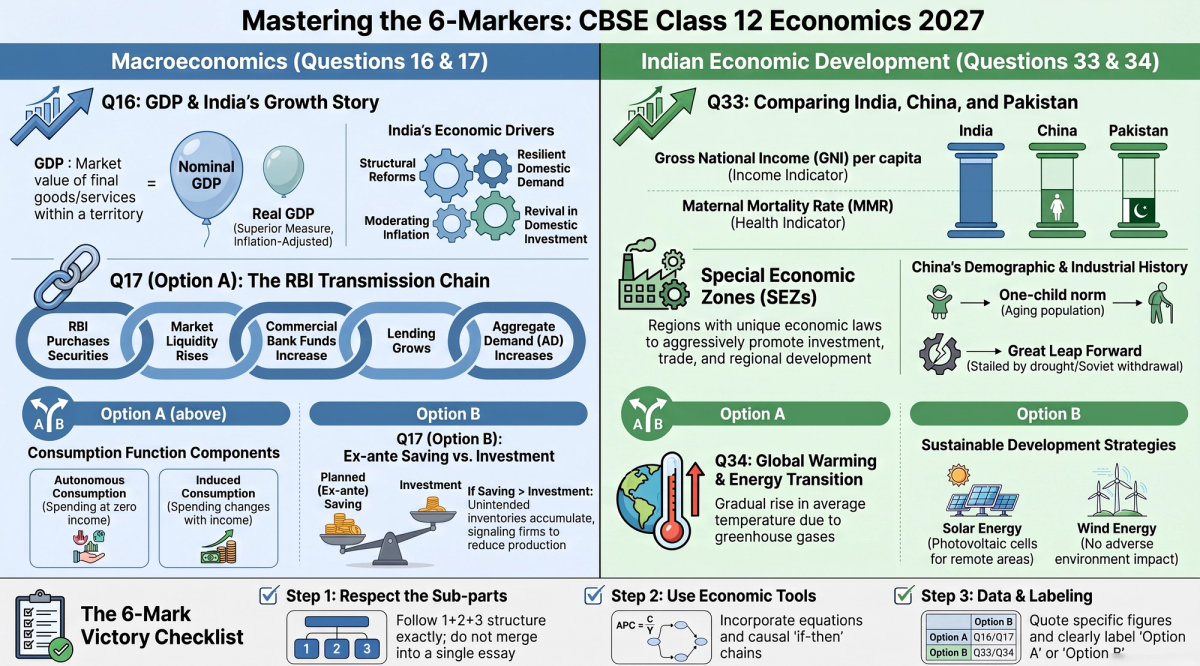
The important feature is that these are not purely memory-based. They combine definitions, reasoning, current economic context, data interpretation and evaluation, so a strong answer needs to move fluidly between stating a concept and applying it to the specific numbers or context given.
Quick Reference: What Each Question Tests
Q16 tests GDP concepts through India’s growth story. Q17 tests the Consumption Function and RBI’s Open Market Operations, or an alternative on APC and ex-ante saving/investment. Q33 tests Human Development indicators and Special Economic Zones, or China’s demographic and economic history. Q34 tests Global Warming and Sustainable Development strategies. Two of these four questions have a dedicated deep-dive article linked below, with extra practice questions.
Question 16: GDP and India’s economic growth
The passage discusses India’s economic growth and asks three things: Define GDP. Decide whether an inflation-adjusted GDP growth figure represents Nominal GDP or Real GDP. Explain India’s strong economic position and the reasons behind the growth surge.
Model Approach
GDP
Gross Domestic Product is the market value of final goods and services produced within the domestic territory of an economy during a given period.
Real GDP
Because the figure is adjusted for inflation, it represents Real GDP.
Why Real GDP Is Useful
Real GDP measures output at constant prices and therefore removes the effect of price changes, making it more useful for measuring real economic growth.
Growth drivers highlighted by the marking scheme include: policy and structural reforms; resilient domestic demand; moderating inflation; higher labour-force participation; revival in domestic investment; investor confidence; deeper global integration.
Exam tip: When a passage gives current data, do not drift into general commentary. Use only the economic reasoning needed by the question.
Question 17: Consumption Function and RBI Open Market Operations
Option A has two parts.
Components of Consumption Function
Autonomous Consumption is the minimum consumption that occurs even when income is zero.
Induced Consumption changes with the level of income.
RBI Open Market Operations
The question refers to RBI purchasing government securities.
The marking logic is: RBI purchases securities → liquidity rises → funds available with commercial banks rise → lending can increase → Aggregate Demand may increase.
This is a classic cause-and-effect question. Write the transmission chain clearly. The dedicated RBI/CRR/OMO article below covers both the CRR and OMO versions of this reasoning in full, with two extra practice questions.
Alternative Option
The alternative asks students to evaluate: APC at break-even income; ex-ante savings vs investment; distance between Aggregate Demand and Investment curves as income changes.
At break-even income, C = Y, so APC = C/Y = 1.
If ex-ante saving exceeds ex-ante investment, planned consumption is lower than firms expected and unintended inventories accumulate, which is itself a signal that firms will revise production downward in the next period.
Question 33: Human Development data and SEZ OR China
Option A uses a data table comparing India, China and Pakistan.
Students must: identify one income and one health indicator; compare India and China on selected indicators; explain Special Economic Zones.
The marking scheme identifies:
Income indicator — Gross National Income per capita in PPP terms.
Health indicator — Maternal Mortality Rate.
The sample answer compares India and China using actual values from the table and then explains SEZs as regions with economic laws different from the normal laws of the country, used to promote investment, development and trade.
Alternative Option
The alternative asks about China’s one-child norm and the Great Leap Forward.
The marking scheme states that the one-child policy contributed to demographic imbalance and a declining sex ratio, with an ageing population consequence.
Challenges to the Great Leap Forward mentioned include: severe drought; withdrawal of Russian professionals after conflict with China.
Question 34: Global Warming and Sustainable Development
The question uses a passage on India’s energy transition.
Students must: Define global warming. Identify two government initiatives. Explain two sustainable-development strategies.
The marking scheme defines global warming as a gradual rise in the average temperature of the lower atmosphere due to increased greenhouse gases.
Government initiatives named: National Nuclear Mission; Green Hydrogen Mission.
Strategies explained: wind energy; solar energy.
For wind, the marking scheme notes the absence of adverse environmental impact during generation and the long-run benefits despite high initial cost. For solar, it notes use of photovoltaic cells and usefulness in remote areas where grid access may be difficult or costly. The dedicated Sustainable Development article below solves this question fully and adds two extra practice questions.
How to Write a 6-mark Economics Answer
- Follow the sub-parts exactly.
Do not turn a 1+2+3 structure into one long essay.
- Use equations where relevant.
For APC, equilibrium income and multiplier, show the relationship.
- Quote data when the question provides it.
A comparison is stronger when it uses the actual values supplied.
- Show causal links.
Economics marks often depend on explaining why one variable affects another.
- Separate description from evaluation.
First define the concept, then apply it to the case.
- Label each option clearly.
When a question offers an internal choice, write "Option A" or "Option B" at the top of your answer so the evaluator does not have to guess which one you attempted.
ChampionsPrep Next Step
Practise these four long-answer structures until you can reproduce the logic without looking at the marking scheme. Registration on ChampionsPrep is free and you only pay as you use it, so once the structure is automatic, you can keep testing it against fresh contexts and numbers at no upfront cost.
Frequently Asked Questions
How many 6-mark questions are there in the Economics sample paper? +
Four: Questions 16, 17, 33 and 34 in the official 2026-27 sample paper.
Do 6-mark Economics questions include current affairs? +
Yes. The sample paper uses current policy and economic contexts, but the marks are awarded for applying syllabus concepts correctly.
Should I memorise the passage facts in these questions? +
No. Understand the underlying concept and learn how to use the facts supplied in the question, since the exact figures and context will change on the actual paper.
Which two questions have a dedicated deep-dive article? +
Question 17’s RBI Open Market Operations part and Question 34’s Sustainable Development question each have a dedicated article with two extra practice questions.
Are numericals tested in the 6-mark Economics questions? +
Yes, National Income measurement (Income and Expenditure methods) and Determination of Income (Investment Multiplier) frequently appear as 6-mark numericals.
Keep practising Economics
AI-powered feedback and structured revision for Economics — free to start, at your own pace.
AI-powered practice — free to start