

The CBSE Class 12 Economics Sample Paper for 2026-27 gives a clear message: current events can appear in the Board paper, but they are used to test syllabus concepts rather than general knowledge.
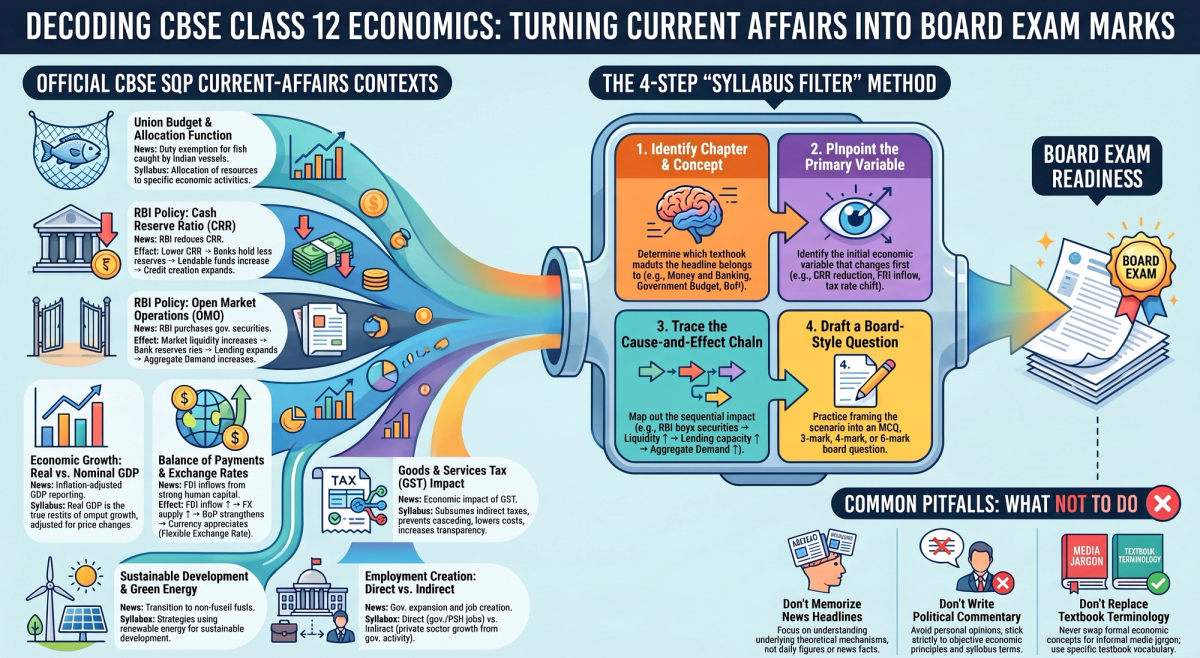
You do not need to memorise daily economic news. You need to be able to look at an event and identify the relevant chapter, variable and cause-and-effect mechanism. That single skill — converting a headline into a syllabus concept — is what this article is designed to build.
Here are the major current-affairs style contexts in the official SQP.
Q11: Union Budget Allocation Function
The sample paper refers to a Budget decision involving duty exemption for fish caught by Indian fishing vessels operating in specified zones.
The question asks students to identify the government function behind the initiative.
The marking scheme identifies Allocation Function.
What to revise: allocation function; distribution function; stabilisation function; revenue and expenditure measures.
How CBSE may test this: A Budget announcement can be turned into a one-mark identification question even if the announcement itself is unfamiliar.
- RBI and Cash Reserve Ratio
The paper refers to RBI reducing the Cash Reserve Ratio.
The question asks students to analyse the impact on credit creation.
Core chain: CRR falls → banks keep a smaller proportion of deposits as reserves → lendable funds increase → credit-creation capacity increases.
What to revise: meaning of CRR; credit multiplier logic; central-bank control of credit. The dedicated RBI/CRR/OMO article below solves both this CRR scenario and the OMO scenario in full, with two extra practice questions.
- RBI Open Market Operations
The paper also uses an RBI announcement of large purchases of government securities.
The marking scheme explains: RBI buys government securities → liquidity increases → commercial banks have more funds → lending can expand → Aggregate Demand may rise.
Chapter links: Money and Banking; Aggregate Demand; excess/deficient demand and monetary policy.
This is an excellent example of one event connecting two chapters.
- India’s GDP growth
A long-answer passage discusses India’s economic growth and gives an inflation-adjusted GDP growth figure.
Students are asked whether the measure is Nominal or Real GDP.
Because the figure is adjusted for inflation, the answer is Real GDP.
What to revise: GDP definition; current vs constant prices; Nominal vs Real GDP; why Real GDP is a better measure of real output growth.
The passage also asks for growth drivers. The marking scheme refers to structural reforms, domestic demand, moderating inflation, labour-force participation, investment, investor confidence and global integration.
- FDI and Balance of Payments
A hypothetical economy attracts more Foreign Direct Investment because of strong human capital.
The expected reasoning is: FDI inflow → supply of foreign exchange increases → Balance of Payments position strengthens.
The question then asks about the exchange-rate system when authorities do not intervene.
Answer: Flexible Exchange Rate System.
What to revise: credit/debit entries in BoP; current and capital accounts; demand and supply of foreign exchange; flexible vs fixed exchange rates.
- GST and taxation efficiency
The sample paper uses a cartoon on GST and asks students to analyse its impact on taxation and the economy.
The marking scheme highlights: subsuming multiple indirect taxes; reduction in cascading; lower production/business costs; competitiveness; transparency; ease of doing business.
What to revise: direct vs indirect taxes; tax structure; government budget; economic efficiency.
- Renewable energy and sustainable development
The paper uses a passage on India’s transition towards non-fossil-fuel energy.
The marking scheme asks students to identify initiatives including: National Nuclear Mission; Green Hydrogen Mission.
It also asks for sustainable-development strategies and explains: wind energy; solar energy. The dedicated Sustainable Development article below solves this exact question and adds two extra practice questions.
What to revise: sustainable development; global warming; renewable energy; environmental impact of development.
- Employment and government role
Indian Economic Development questions also connect policy and employment.
The marking scheme distinguishes:
Direct employment — jobs directly created by government departments, public-sector industries and organisations.
Indirect employment — expansion of related private-sector activity when government production and activity increase.
What current affairs should you actually study?
Use a syllabus filter.
For every major economic event, ask: Which chapter does this belong to? Which concept does it demonstrate? What variable changes first? What is the next economic effect? Could this become an MCQ, 3-mark, 4-mark or 6-mark question?
A good current-affairs notebook could have four columns: Event | Syllabus concept | Cause-effect chain | Possible Board question
Example: RBI buys government securities | OMO | liquidity ↑ → lending ↑ → AD ↑ | Explain impact on Aggregate Demand
Practice It Yourself
Practice Question 1
A newspaper reports that the government has announced a new subsidy scheme aimed specifically at reducing income inequality between states. Which government function does this illustrate, and how is it different from the Allocation Function shown in the official Budget example above?
Approach & Solution: State the concept — the Distribution Function of government aims to reduce inequality through taxation and transfer measures. Apply it: a subsidy aimed at reducing inequality between states is an example of the Distribution Function, whereas the fishing-duty exemption in the official example is closer to the Allocation Function, since it is about directing resources into a specific activity rather than redistributing income.
Practice Question 2
A news report states that India’s exports have grown faster than its imports this quarter. Explain the likely first-round effect on the Balance of Payments and the exchange rate under a flexible exchange-rate system.
Approach & Solution: State the mechanism — faster export growth relative to imports increases the supply of foreign exchange relative to demand for it. Apply it: this strengthens the Balance of Payments position and, under a flexible exchange-rate system with no intervention, would tend to cause the domestic currency to appreciate against foreign currencies.
What Not to Do
Do not memorise large numbers of news headlines.
Do not write political or opinion-based commentary.
Do not replace textbook terminology with newspaper language.
Do not add facts not given in the question unless they are required by the syllabus.
ChampionsPrep Next Step
Whenever you read an economic headline, try converting it into one Board-style question. Registration on ChampionsPrep is free and you only pay as you use it, so once this habit feels natural, you can keep testing your conversions against fresh news and syllabus-aligned practice at no upfront cost.
Frequently Asked Questions
Does CBSE ask current affairs in Class 12 Economics? +
The official sample paper uses recent economic contexts, but the questions remain syllabus-based.
Should I follow daily business news for Boards? +
A focused weekly review of syllabus-relevant events is more useful than trying to memorise everything in the news.
Which current-affairs areas are most useful to track? +
RBI policy, Union Budget measures, GDP/inflation, employment, foreign exchange/FDI, and sustainability-related policy are natural fits with the syllabus.
How should I convert a news headline into exam preparation? +
Ask which chapter it belongs to, which concept it demonstrates, what variable changes first, and what the next economic effect is — then try writing it as a Board-style question.
Does CBSE expect students to memorise current-affairs statistics? +
No. The case prompt provides all relevant statistics and newspaper excerpts; students are evaluated on connecting the real data to NCERT syllabus concepts.
Keep practising Economics
AI-powered feedback and structured revision for Economics — free to start, at your own pace.
AI-powered practice — free to start