

The official CBSE Class 12 Economics Sample Paper 2026-27 uses two recent RBI-style policy situations to test Money and Banking: a change in the Cash Reserve Ratio and Open Market Operation purchases.
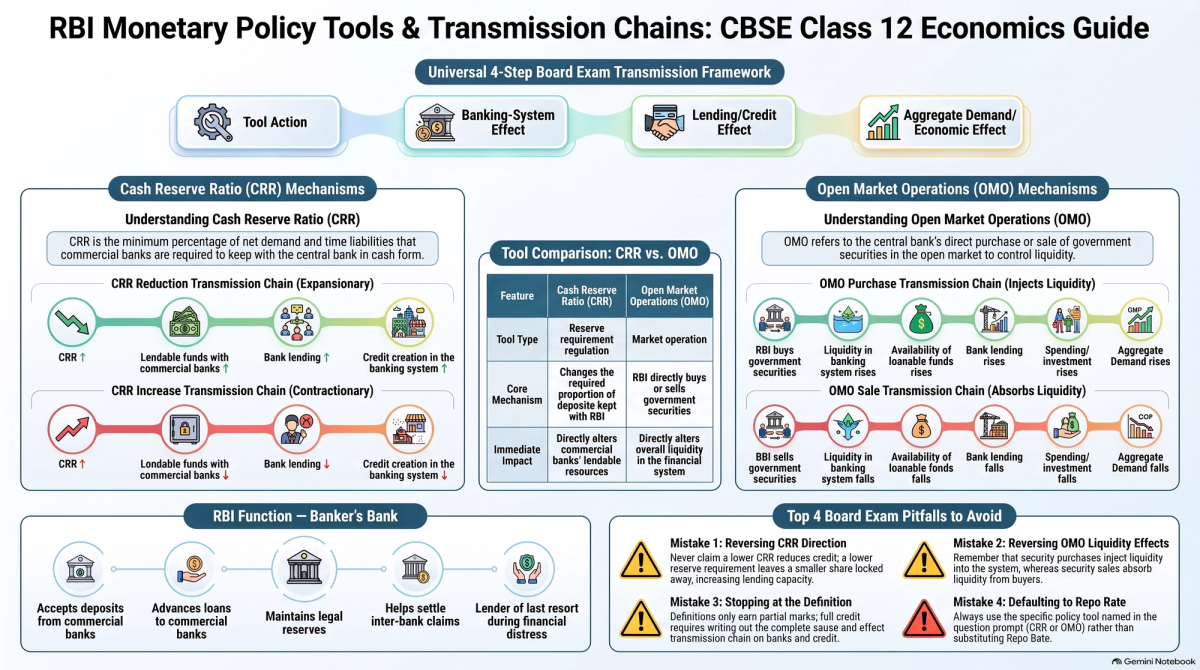
These are high-value questions because the marks depend on explaining the transmission mechanism, not just defining the policy tool — CBSE wants to see the chain of cause and effect, not a one-line definition.
Quick Reference: the Two Transmission Chains
CRR change: CRR ↓ → lendable funds with banks ↑ → bank lending ↑ → credit creation ↑ (and the reverse for a CRR increase). OMO purchase: RBI buys securities → liquidity in banking system ↑ → loanable funds ↑ → bank lending ↑ → Aggregate Demand may rise (and the reverse for an OMO sale). Keep both chains written out exactly like this in your revision notes.
Cash Reserve Ratio: Meaning
Cash Reserve Ratio, or CRR, is the minimum percentage of net demand and time liabilities that commercial banks are required to keep with the central bank in cash form.
Core relationship: Higher CRR → less money available for bank lending. Lower CRR → more money available for bank lending.
Q13: RBI CRR Reduction & Lending Capacity
The sample paper asks students to analyse what happens when RBI reduces CRR.
The marking scheme explains: Banks are required to keep a smaller reserve with RBI. More funds remain available with commercial banks. Lending capacity can increase. Credit creation in the banking system can increase.
A clear Board answer can be written as a cause-effect chain:
CRR ↓ → lendable funds ↑ → bank lending ↑ → credit creation ↑
Do not overcomplicate the answer.
Open Market Operations: Meaning
Open Market Operations refer to the central bank’s purchase or sale of government securities in the open market.
When RBI purchases government securities: money/liquidity is injected into the financial system; banks may have more funds available; credit conditions can become easier.
When RBI sells securities, the reverse mechanism generally applies.
Q17: RBI Open Market Operations & Liquidity Infusion
The sample paper refers to RBI conducting purchase auctions of Government of India securities.
The marking scheme states: RBI purchase → liquidity infusion → greater availability of funds with commercial banks → more lending → Aggregate Demand may rise.
This is important because the question links Money and Banking with Aggregate Demand, a connection students often revise as two separate chapters rather than as one continuous story.
Transmission Chain
OMO purchase
↓
Liquidity in banking system rises
↓
Availability of loanable funds rises
↓
Bank lending can rise
↓
Spending/investment can rise
↓
Aggregate Demand rises
RBI As Banker’s Bank
The paper also tests another RBI function.
The marking scheme explains that RBI: accepts deposits from commercial banks; advances loans to them when required; maintains their reserves; helps settle inter-bank claims; supports banks during financial distress as lender of last resort.
This should be revised alongside quantitative credit-control tools because both appear in the same chapter area, and an application question can easily combine a CRR or OMO scenario with a one-line question on this function.
CRR vs OMO
CRR
Type: reserve requirement
Mechanism: changes the proportion of deposits banks must hold with RBI
Immediate impact: changes lendable resources
OMO
Type: market operation
Mechanism: RBI buys or sells government securities
Immediate impact: changes liquidity in the financial system
What Students Often Get Wrong
Mistake 1
Saying lower CRR reduces credit creation.
The direction is opposite. Lower reserve requirement generally increases lending capacity, since a smaller share of every deposit is locked away with RBI.
Mistake 2
Saying RBI buys securities to reduce liquidity.
Purchases inject liquidity; sales absorb liquidity. Students sometimes reverse this pairing under exam pressure, so it is worth writing the two directions out explicitly during revision.
Mistake 3
Stopping after defining the tool.
Application questions require the effect on banks, credit and often Aggregate Demand — a definition alone typically earns only the opening mark of a multi-mark question.
Mistake 4
Treating every RBI action as a repo-rate question.
The sample paper specifically tests CRR and OMO. Use the tool named or implied in the question rather than defaulting to whichever tool you remember best.
Practice It Yourself
Practice Question 1
RBI increases the Cash Reserve Ratio from 4% to 4.5% while total bank deposits remain unchanged. Explain, using a cause-effect chain, the likely impact on bank lending and credit creation.
Approach & Solution: State the mechanism — a higher CRR requires banks to keep a larger proportion of deposits with RBI. Apply it: CRR ↑ → funds available for lending ↓ → bank lending ↓ → credit creation ↓. Conclude by noting this is the mirror image of a CRR cut, so the same chain simply runs in the opposite direction.
Practice Question 2
RBI decides to sell government securities worth a large sum in the open market. Explain the likely impact on liquidity in the banking system and on Aggregate Demand.
Approach & Solution: State the mechanism — an OMO sale draws money out of the banking system as buyers pay RBI for the securities. Apply it: OMO sale → liquidity in banking system ↓ → loanable funds ↓ → bank lending ↓ → spending/investment ↓ → Aggregate Demand may fall. This is the reverse of the OMO purchase chain shown above.
Exam-style Practice Questions
- RBI reduces CRR while deposits remain unchanged. Explain the likely impact on credit creation.
- RBI sells government securities in the open market. Explain the likely impact on liquidity and Aggregate Demand.
- Why is RBI called Banker’s Bank?
- Distinguish the first-round impact of a CRR reduction from an OMO purchase.
- Explain how an expansionary monetary-policy action can affect Aggregate Demand.
Quick Answer Framework
For any RBI application question: Tool → Banking-system effect → Lending/credit effect → Aggregate Demand/economic effect
RBI Monetary Policy & Credit Creation Simulator
Adjust commercial bank deposits, initial vs revised CRR, and RBI open market operations to observe changes in banking liquidity and maximum credit expansion.
CRR channel
Open Market Operations
Simple money-multiplier model
More banking-system liquidity can support additional lending and aggregate demand.
Illustrative upper bound only: the simple multiplier assumes every lendable rupee is redeposited. Actual lending depends on banks, borrowers and policy conditions.
ChampionsPrep Next Step
Practise each monetary-policy tool in both directions: increase and decrease, purchase and sale. Registration on ChampionsPrep is free and you only pay as you use it, so once you can reverse the cause-effect chain correctly in either direction, you can keep testing it on fresh RBI scenarios at no upfront cost.
Frequently Asked Questions
Does a lower CRR always guarantee more lending? +
The marking logic is about increased lending capacity. Actual lending can depend on other conditions, but for the Board question use the mechanism asked.
What happens when RBI buys government securities? +
Liquidity rises, because RBI injects money into the banking system in exchange for the securities it purchases.
What happens when RBI sells government securities? +
Liquidity is absorbed from the financial system, as money flows from buyers of the securities back to RBI.
Why is RBI called the Banker’s Bank? +
Because it accepts deposits from commercial banks, advances loans to them, maintains their reserves, helps settle inter-bank claims, and acts as lender of last resort.
What happens to commercial bank liquidity during an RBI OMO purchase? +
When the RBI buys government securities in the open market, it pays cash into the banking system, directly boosting bank reserves and expanding lending capacity.
Keep practising Economics
AI-powered feedback and structured revision for Economics — free to start, at your own pace.
AI-powered practice — free to start