

Human Capital Formation and Human Development are closely related concepts, which is exactly why CBSE can turn them into an effective case-study question.
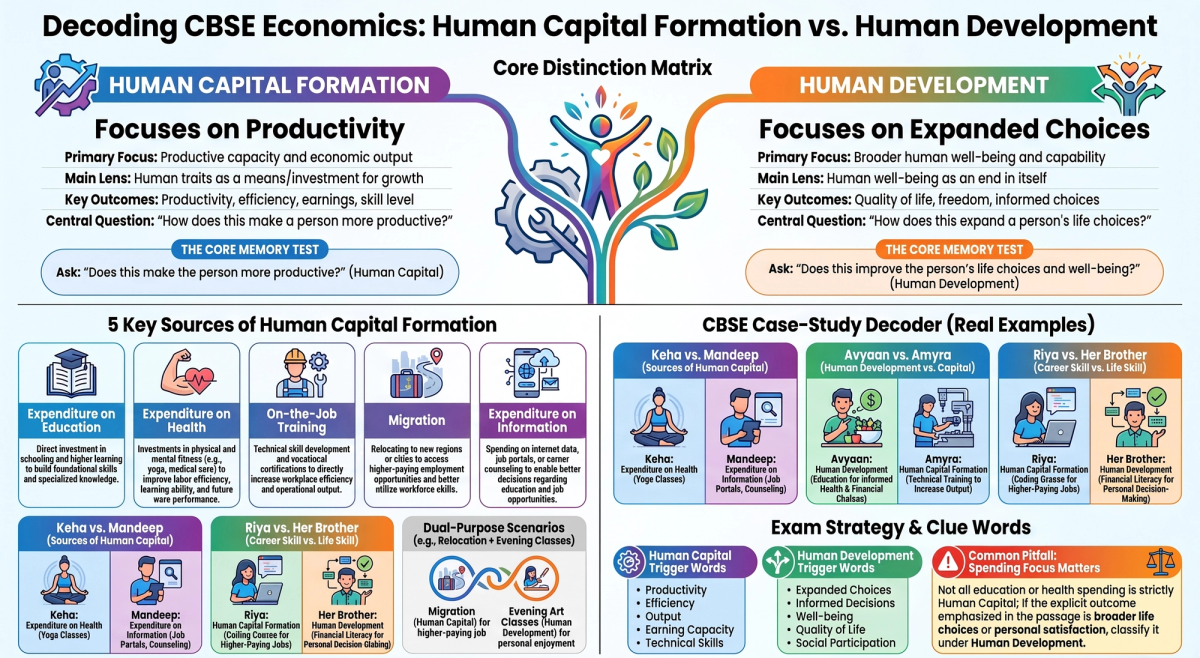
The 2026-27 official Class 12 Economics Sample Paper tests both ideas through practical examples rather than asking only for textbook definitions, so recognising the concept inside a story matters as much as knowing the definition itself.
Q32: Sources of Human Capital Formation (Official Case)
One option describes two recent graduates.
Keha spends on yoga classes to improve fitness, reduce stress and improve well-being.
Mandeep spends on internet data, online job portals and career counselling to explore employment opportunities.
The marking scheme identifies two sources of Human Capital Formation:
Keha: Expenditure on Health
Better health can improve: efficiency; learning ability; long-term work performance; future labour-force quality.
Mandeep: Expenditure on Information
Information about jobs and career opportunities can: improve employability; guide occupational choices; improve productivity; increase earning potential.
Exam lesson: CBSE may describe an activity without naming the source. You must classify it.
Main Sources to Revise
Common sources of Human Capital Formation include: education; health; on-the-job training; migration; expenditure on information.
For case questions, focus on why the spending can improve future productivity or earning capacity, rather than simply listing the five sources without linking them to the case.
Official alternative: Human Development vs Human Capital Formation
The alternative case contrasts two people.
Avyaan’s education helps him make informed choices related to health, finances and social responsibilities.
Amyra receives technical training in machine operations to improve skill, productivity and output.
The marking scheme identifies:
Avyaan → Human Development
Why: the emphasis is on expanding choices and improving overall well-being, not merely income or production.
Amyra → Human Capital Formation
Why: the training is aimed primarily at increasing skills, efficiency, output and economic productivity.
Human Capital Formation
Focus: productive capacity
Main lens: education/health/training as investment
Outcome emphasised: productivity, efficiency, earnings, output
Human Development
Focus: broader human well-being
Main lens: expansion of choices and capabilities
Outcome emphasised: quality of life, freedom, informed choice, well-being
A Simple Memory Device
Human Capital asks: "How does this make a person more productive?"
Human Development asks: "How does this improve the person’s life and choices?"
The concepts overlap, but the emphasis is different, and CBSE case questions are usually written to make one emphasis clearly stronger than the other.
How CBSE Can Disguise the Concept
Example 1: A worker completes a technical certification and becomes more productive.
Likely focus: Human Capital Formation.
Example 2: Education helps a person make better health, civic and financial decisions.
Likely focus: Human Development.
Example 3: A family spends on medical care that improves a person’s ability to work.
Likely focus: Expenditure on Health as Human Capital Formation.
Example 4: A student pays for a career database and counselling to find suitable job opportunities.
Likely focus: Expenditure on Information.
Example 5: A young adult moves to another city for a better-paying job and, after settling in, also joins evening classes purely out of personal interest with no career goal attached.
Likely focus: the relocation is Migration as a source of Human Capital Formation, while the evening classes taken purely for personal interest sit closer to Human Development, since the stated motive is enjoyment and well-being rather than productivity.
Common Mistakes
Mistake 1
Saying Human Development means only education.
It is broader than education and includes expansion of choices and well-being across health, income and social participation, not just schooling.
Mistake 2
Saying every education expense is automatically only Human Capital Formation.
The classification depends on the focus of the question — the same rupee spent on education can be framed as either concept depending on what outcome the passage emphasises.
Mistake 3
Ignoring the clue "productivity".
Productivity, efficiency and earnings strongly point towards human capital, and examiners often plant this word deliberately in the case.
Mistake 4
Ignoring the clue "choices".
Expanded choices and quality of life strongly point towards human development; look for words like "informed decisions" or "well-being" as the signal.
Practice It Yourself
Practice Question 1
A factory worker attends a six-month welding certification programme that qualifies him for higher-paying skilled roles. Classify this as an example of Human Capital Formation or Human Development, and justify your answer using the outcome described.
Approach & Solution: State the rule — check whether the outcome is mainly productivity/earnings or mainly expanded choices/well-being. Apply it: the certification directly targets skill and earning capacity in a specific trade, so this is Human Capital Formation. Conclude by naming the specific source: on-the-job/vocational training.
Practice Question 2
A government programme provides free access to a public library and adult-literacy classes in a village, enabling residents to read medicine labels, understand loan documents and participate more confidently in local decisions. Classify this, and explain your reasoning.
Approach & Solution: State the rule as above. Apply it: the outcome described — reading medicine labels, understanding documents, participating in decisions — is about expanded choices and everyday well-being rather than a specific productivity or earnings gain, so this is Human Development. Note that literacy could also feed into Human Capital Formation later, but the outcome emphasised here is the broader one.
Exam-style Practice
Question: Riya takes a professional coding course to qualify for higher-paying jobs. Her brother studies financial literacy to make better long-term personal decisions.
Possible classification:
Riya — Human Capital Formation, because the focus is skills and earning capacity.
Brother — Human Development, if the emphasis is broader informed choice and well-being.
ChampionsPrep Next Step
Practise by highlighting clue words in each case: productivity, output, earning capacity, choices, health, information, well-being. Registration on ChampionsPrep is free and you only pay as you use it, so once classification becomes fast and automatic, you can keep testing it against fresh case scenarios at no upfront cost.
Frequently Asked Questions
Are Human Capital and Human Development completely separate? +
No. They overlap. The exam distinction depends on the primary objective and outcome described in the case.
Is expenditure on health a source of Human Capital Formation? +
Yes, when it improves productive capacity and efficiency, such as better fitness and reduced stress that improve future work performance.
Is expenditure on information a source of Human Capital Formation? +
Yes, when it helps people make better employment, education or career decisions, such as spending on job portals or career counselling.
What is the quickest way to classify a case as Human Capital or Human Development? +
Check whether the described outcome is mainly about productivity, skill and earnings (Human Capital Formation) or about expanded choices and overall well-being (Human Development).
What is the fundamental difference in purpose between Human Capital and Human Development? +
Human Capital treats human beings as a means to increase economic productivity, while Human Development treats human well-being and choice expansion as an end in itself.
Keep practising Economics
AI-powered feedback and structured revision for Economics — free to start, at your own pace.
AI-powered practice — free to start