

Sustainable Development appears as a full 6-mark question in the official CBSE Class 12 Economics Sample Paper 2026-27.
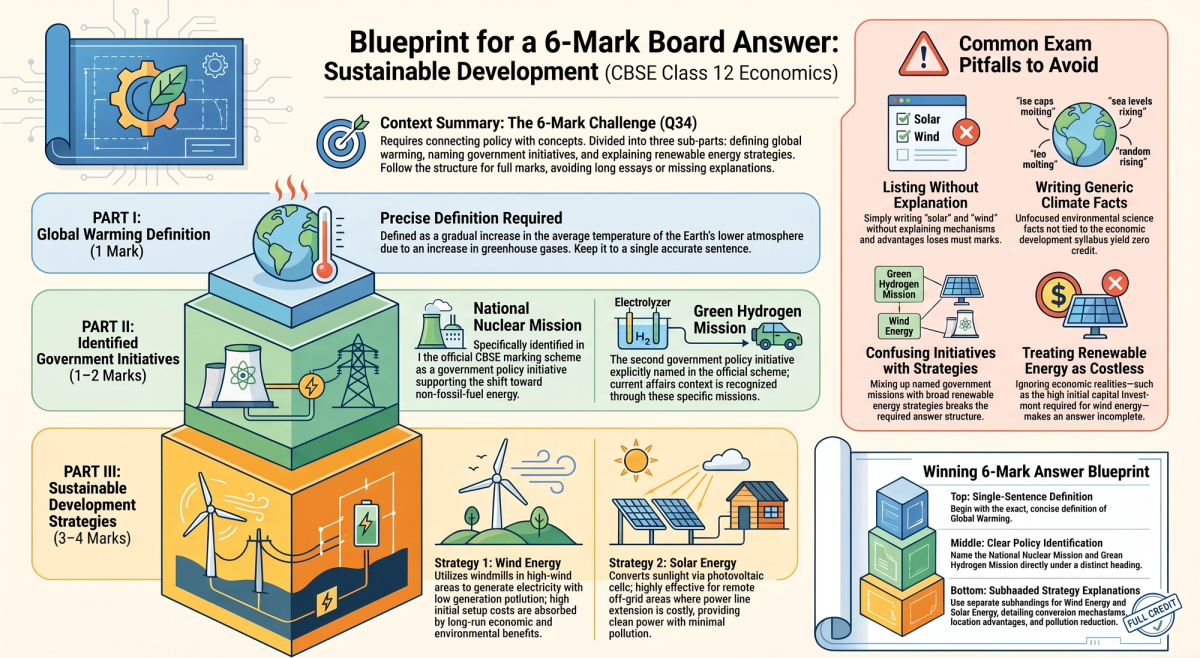
The question uses a passage on India’s energy transition and asks students to connect a contemporary policy context with textbook concepts, which is why revising the topic only as a list of definitions leaves marks unclaimed.
Q34: Global Warming & Sustainable Development Strategies
The three parts ask students to: state the meaning of Global Warming; identify two government initiatives supporting the energy transition; elaborate two strategies adopted by India to ensure Sustainable Development.
Global Warming: Expected Definition
The marking scheme defines Global Warming as a gradual increase in the average temperature of the earth’s lower atmosphere due to an increase in greenhouse gases.
For the exam, keep the definition precise. Do not turn a one-mark definition into a long environmental essay — a single accurate sentence earns the mark, and time spent beyond that is better used on the strategy sections.
Government Initiatives in the Marking Scheme
The official marking scheme names: National Nuclear Mission; Green Hydrogen Mission.
The question context also refers to a broader shift towards non-fossil-fuel energy, but the marking scheme specifically identifies these two initiatives for the asked part, so naming other schemes you may know from current affairs is not required and will not add extra marks.
Strategy 1: Wind Energy
The marking scheme explains that windmills can be used where wind speeds are sufficiently high to generate electricity without adverse environmental impact from the generation process.
It also notes: initial cost may be high; long-run benefits can absorb the high initial cost.
Board-answer structure: Wind energy → renewable source → low pollution impact during generation → suitable in high-wind areas → supports sustainable development.
Strategy 2: Solar Energy
Solar energy can be converted into electricity using photovoltaic cells/solar panels.
The marking scheme highlights its usefulness: in remote areas; where grid supply is unavailable; where extending power lines would be costly; with very low pollution from the energy source.
Board-answer structure: Solar energy → renewable → photovoltaic conversion → remote-area usefulness → pollution reduction.
Why This Is a High-value Question
The question combines: environmental economics; policy application; definition; identification; explanation.
It is therefore more useful for revision than simply memorising a list of sustainable-development measures, because it rewards students who can move fluidly between a definition, a named policy and an explained strategy within the same answer.
Global Warming
Know the link between greenhouse gases and rising atmospheric temperature.
Sustainable Development
Development should meet current needs while preserving the ability of future generations to meet theirs.
Renewable Energy
Understand why renewable sources reduce dependence on exhaustible and pollution-intensive energy sources.
Energy Access
Sustainable development is not only about pollution. Reliable access, especially in remote areas, also matters, and this is precisely the angle the marking scheme takes for solar energy.
Common Mistakes
Mistake 1
Listing solar and wind without explaining them.
The 4-mark strategy part requires explanation, not just naming — a bare list of two words earns very little of the available marks.
Mistake 2
Writing generic climate-change facts not asked by the question.
Stay within the economic-development syllabus and passage; general environmental-science knowledge that is not tied to the syllabus framing does not earn credit here.
Mistake 3
Confusing an initiative with a strategy.
The question separates named government initiatives from broader sustainable-development strategies, and answering one part with content meant for the other misses the structure the marking scheme expects.
Mistake 4
Treating renewable energy as costless.
The marking scheme itself recognises that initial wind-energy costs can be high, so an answer that ignores this nuance is less complete than one that acknowledges the cost and explains why long-run benefits justify it.
Practice It Yourself
Practice Question 1
A coastal state announces a new scheme to install offshore wind turbines, citing strong and consistent sea winds. Explain, using the syllabus concept of renewable energy, why this location choice supports the goal of Sustainable Development.
Approach & Solution: State the concept — sustainable development uses resources in a way that meets present needs without compromising the ability of future generations to meet theirs. Apply it: wind energy is renewable and generates electricity with low pollution impact, and choosing a location with strong, consistent winds makes the generation more reliable and efficient. Conclude that this supports sustainable development by reducing dependence on exhaustible, polluting energy sources while meeting current electricity needs.
Practice Question 2
A remote hill village with no grid connection receives standalone solar panels instead of a new transmission line. Explain two reasons, based on the official marking-scheme logic, why solar energy is a suitable choice here.
Approach & Solution: Apply the marking scheme’s own reasoning for solar energy: it is useful where grid supply is unavailable, and it avoids the high cost of extending power lines to a remote area. A second reason is the very low pollution associated with the energy source itself, which aligns with the environmental goal of sustainable development alongside solving the immediate access problem.
Possible Related Board Questions
- Explain any two strategies for sustainable development.
- How can renewable energy reduce environmental pressure?
- Why is solar energy useful for remote areas?
- Explain the economic challenge of high initial cost in renewable-energy adoption.
- Define Global Warming and state its major cause.
- Explain how energy transition can support both energy security and environmental goals.
How to Write a 6-mark Sustainability Answer
Use the sub-part structure.
Part I — Definition
One precise statement.
Part II — Initiatives
Name two clearly.
Part III — Strategies
Use two separate headings, each with a full explanation.
Do not merge both strategies into one paragraph.
ChampionsPrep Next Step
Practise one-page answer maps: definition at the top, initiatives in the middle, and two strategies with reasons below. Registration on ChampionsPrep is free and you only pay as you use it, so once this map is easy to recall under exam conditions, you can keep testing it against fresh policy contexts at no upfront cost.
Frequently Asked Questions
Is Sustainable Development important for the 2027 Boards? +
It appears as a 6-mark question in the official SQP, so it is a high-priority revision area.
Do I need current-affairs knowledge for this question? +
You need to recognise the policy context provided, but the marks are earned by applying syllabus concepts to that context.
Which two government initiatives appear in the official marking scheme? +
The National Nuclear Mission and the Green Hydrogen Mission.
Which two renewable-energy strategies does the marking scheme explain? +
Wind energy and solar energy, each explained with its own advantages and use cases.
What are the two major national green initiatives highlighted in the official CBSE SQP? +
The National Green Hydrogen Mission and the expansion of Nuclear Power are specifically cited in the SQP as long-term decarbonisation strategies.
Keep practising Economics
AI-powered feedback and structured revision for Economics — free to start, at your own pace.
AI-powered practice — free to start