
This post provides complete, exam-ready NCERT solutions for “Poets and Pancakes” by Asokamitran, covering all four “Think as You Read” boxes plus “Understanding the Text” and “Talking about the Text” from CBSE Class 12 English Flamingo Chapter 6. Every answer is written in explanatory student language rather than lifted from the textbook — exactly what CBSE examiners expect.
Think as You Read — Set 1
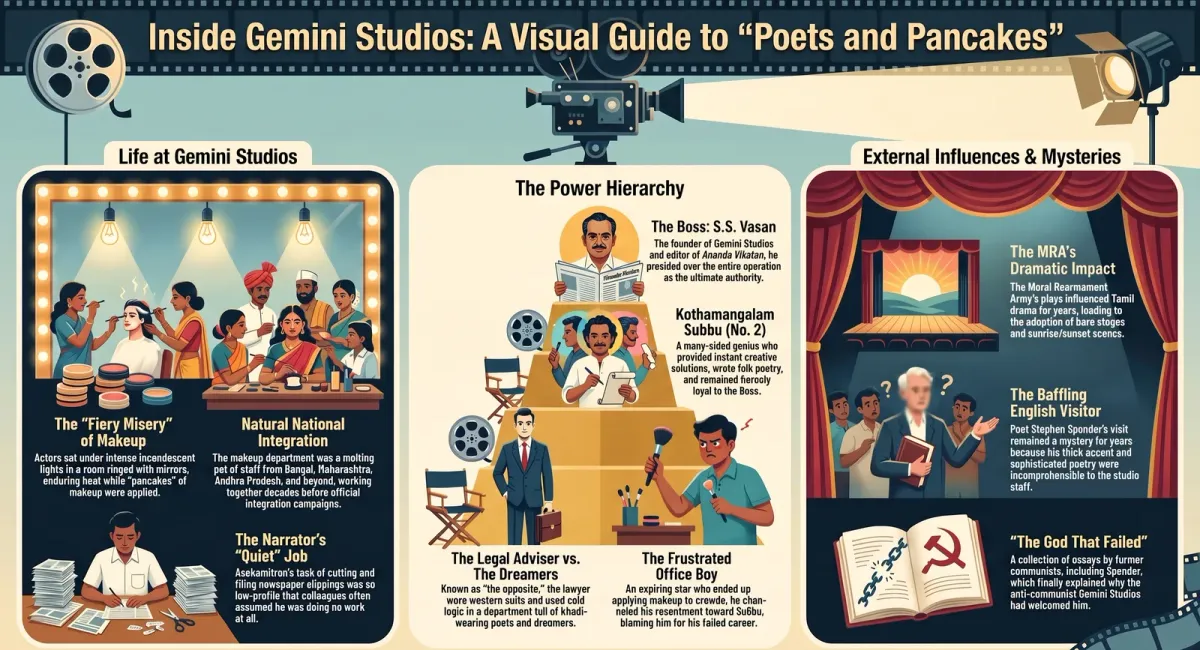
1. What does the writer mean by “the fiery misery” of those subjected to make-up? The make-up room was ringed with intense incandescent lights, under which actors sat for long stretches while their faces were worked on.
2. What is the example of national integration that the author refers to? The make-up department was led over time by a Bengali, a Maharashtrian, a Kannadiga, an Andhra, a Madras Christian, and an Anglo-Burmese alongside local Tamils — “integration” before official campaigns promoted the idea.
3. What work did the “office boy” do? Why did he join? Why was he disappointed? He applied make-up to crowd players. He had joined hoping to become a star actor, screenwriter, director, or lyricist, and was disappointed to end up with the department’s lowest-status work instead.
4. Why did the author appear to be doing nothing at the studios? His actual job — cutting and filing newspaper clippings by hand — was quiet and produced no visible output, so people assumed he had no real occupation.
Think as You Read — Set 2
1. Why was the office boy frustrated? Who did he show his anger on? His early ambitions of stardom never materialised, leaving him doing crowd make-up. He directed his anger at Kothamangalam Subbu, blaming him for his own disappointments.
2. Who was Subbu’s principal? The Boss, S.S. Vasan, founder of Gemini Studios.
3. Subbu is a many-sided genius. List four of his special abilities. Instant story solutions on demand, poetry in folk diction, the novel Thillana Mohanambal, and skilled acting in supporting roles.
4. Why was the legal adviser called “the opposite” by others? An ironic wordplay nickname reflecting his dry manner among the emotional poets of the Story Department.
5. What made the lawyer stand out from the others? Unlike his khadi-wearing colleagues, he wore pants, a tie, and a coat “like a coat of mail” — a man of “cold logic in a crowd of dreamers.”
Think as You Read — Set 3
1. Did the people at Gemini Studios have any particular political affiliations? No — most wore khadi and admired Gandhiji outwardly but had no genuine political understanding, including vague suspicion of Communism.
2. Why was the Moral Rearmament Army welcomed at the Studios? Gemini Studios was known for hospitality, and the two-hundred-strong MRA troupe was given a grand welcome as professional performers.
3. Name one example showing Gemini Studios was influenced by MRA’s plays. After watching “Jotham Valley” and “The Forgotten Factor,” many Tamil plays copied their staging — a bare stage, white curtain, sunrise-sunset scene, and flute tune.
4. Who was The Boss of Gemini Studios? S.S. Vasan, founder of Gemini Studios and editor of the Tamil weekly Ananda Vikatan.
5. What caused the lack of communication between the Englishman and the studio staff? His strong accent made him hard to follow, while the audience had little familiarity with English poetry.
6. Why is the Englishman’s visit called an unexplained mystery? Because nobody, including The Boss, understood who he really was — solved only years later.
Think as You Read — Set 4
1. Who was the English visitor to the studios? Stephen Spender, the English poet and essayist.
2. How did the author discover who the visitor was? Years later, checking a copy of The Encounter before entering its story contest, he recognised the editor’s name as the visitor.
3. What does “The God That Failed” refer to? A book of six essays by writers, Spender included, on their disillusionment with Communism — it explained why Gemini Studios had welcomed him so warmly.
Understanding the Text
1. The author uses gentle humour to point out human foibles. Give instances. The “national integration” joke, the office boy’s self-important lectures, the narrator’s mock-serious claim about prose-writing and genius, and the studio’s uncomprehending welcome for an unknown Englishman all keep the essay light while making serious points about envy and political naivety.
2. Why was Kothamangalam Subbu considered No. 2 in Gemini Studios? He was always seen with The Boss and supplied the creative direction that kept productions running — his loyalty made him effectively the studio’s second-most important figure.
3. How does the author describe the incongruity of an English poet addressing the Gemini audience? An audience familiar with little beyond Wordsworth, Tennyson, Keats, Shelley, and Byron sat baffled by his accent — the poet himself, the author notes, “looked pretty baffled” too.
4. What do you understand about the author’s literary inclinations from the account? He is quietly interested in writing — attempting a story for The Encounter, reflecting on literary genius, and reading widely — showing patience rather than the office boy’s loud, resentful claims to wasted talent.
Talking about the Text
1. Film-production today has come a long way from the early days of Gemini Studios. Discuss how the improvised, hierarchical studio culture shown here compares with today’s technology-driven, professionally structured film production.
2. Poetry and films. Discuss how poets like Subbu found a place within the commercial film industry, and how creative writing coexisted with the practical demands of studio film-making.
3. Humour and criticism. Discuss how gentle humour can deliver serious critical observations — about hierarchy, envy, or political naivety — more effectively than direct criticism.
Related Reading
-
Poets and Pancakes Summary and Analysis – CBSE Class 12 English Flamingo Chapter 6
-
Poets and Pancakes Character Sketch – Subbu, the Lawyer & More (CBSE Class 12 Flamingo)
-
Poets and Pancakes Themes Explained – CBSE Class 12 English Flamingo Chapter 6
-
Poets and Pancakes Exam Tips, Important Questions & Revision Checklist – CBSE Class 12 Flamingo
Start Learning with ChampionsPrep
Want fully explained NCERT solutions for every Flamingo chapter, ready for revision? It is free to register & pay as you use — explore ChampionsPrep for structured CBSE Class 12 English study material.
Test Your Knowledge
Poets and Pancakes NCERT Solutions – CBSE Class 12 English Flamingo Chapter 6
Frequently Asked Questions
Where can I find NCERT solutions for "Poets and Pancakes"? +
This post covers all four "Think as You Read" sets plus "Understanding the Text" and "Talking about the Text" from Flamingo Chapter 6.
Why was Kothamangalam Subbu considered No. 2 at Gemini Studios? +
He provided constant creative direction, stayed closely aligned with The Boss, and was always seen alongside him despite his official Story Department placement.
How does the chapter describe the mismatch between the English poet and his audience? +
Through the audience's confusion at his accent and unfamiliar references, and the poet's own visible awareness that his talk felt out of place there.
What does "The God That Failed" reveal in the chapter? +
That Stephen Spender was one of six writers who had renounced Communism, explaining why Gemini Studios welcomed him so warmly.
What should I focus on when answering "Understanding the Text" questions? +
Specific textual details - exact incidents, motivations, and Asokamitran's humour - rather than general statements, since CBSE evaluators reward precise textual references.
AI-powered practice — free to start