
Part II of “The Interview” takes a completely different form from Part I. Instead of an essay commenting on interviews from the outside, students read an actual interview transcript — a real conversation between journalist Mukund Padmanabhan of The Hindu and Italian scholar-novelist Umberto Eco. This post walks through the interview’s key moments and explains why they matter for understanding both Eco’s personality and the craft of interviewing itself.
Who Is Umberto Eco?
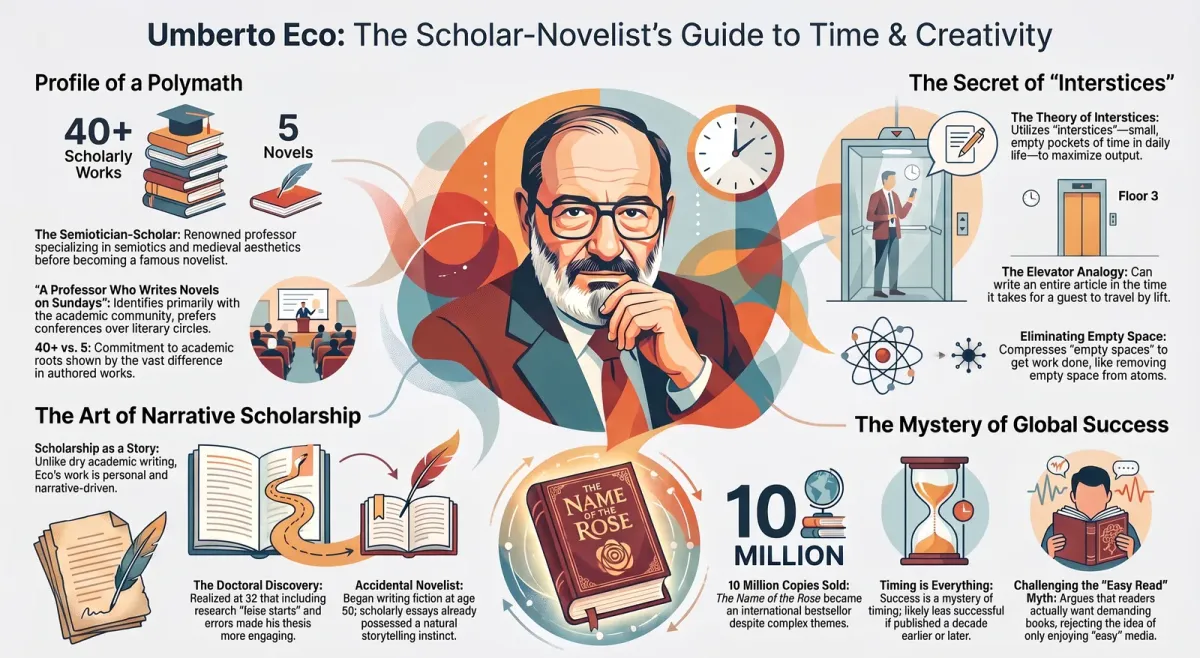
Before the transcript begins, the chapter introduces Eco as a professor at the University of Bologna who had already built a formidable academic reputation in semiotics (the study of signs), literary interpretation, and medieval aesthetics before he ever wrote a novel. His output across academic texts, essays, children’s books, and newspaper articles was already vast when, in 1980, he published The Name of the Rose — a novel that went on to sell more than ten million copies and turned him into an internationally recognised literary figure.
”I Am Always Doing the Same Thing”
The interview opens with Padmanabhan quoting novelist David Lodge, who admitted he could not understand how one person could do all the things Eco does. Eco’s response sets the tone for the entire conversation: rather than accepting the image of himself as scattered across many unrelated fields, he insists he is always pursuing the same small set of ethical and philosophical interests — whether he is writing an academic paper, a children’s book about non-violence, or a novel. For Eco, the variety is only on the surface; underneath, everything connects back to the same core concerns.
The Theory of Interstices
One of the most memorable parts of the interview is Eco’s explanation of how he finds time to write so much. He describes what he calls “interstices” — small pockets of otherwise empty time that most people simply let pass. His example is vivid: while waiting for a visitor’s lift to travel from the first floor to the third, he claims he can already have written an article. He extends the idea further with a playful thought experiment about the universe: if all the empty space inside atoms were removed, the entire universe would shrink to the size of his fist. In the same way, he argues, our daily lives are full of empty spaces that most people waste — and he has simply trained himself to work inside them.
A Narrative Style for Scholarship
Padmanabhan then turns to Eco’s distinctive writing style, noting that his scholarly work has a playful, personal quality unusual for academic writing, which is often dry and impersonal. Eco explains that this goes back to his very first doctoral dissertation, when a professor pointed out that most scholars present their conclusions only after quietly discarding their false starts, while Eco had told the entire story of his research, including his errors. At twenty-two, Eco says, this shaped his lifelong belief that scholarly writing should have a narrative shape. He connects this directly to his late start as a novelist — he began writing fiction only around the age of fifty, almost by accident, after realising his essays already had a storytelling instinct running through them. He also recalls his friend Roland Barthes, who longed to write fiction but died before he could, a contrast Eco uses to explain his own comparative lack of frustration.
The Professor Who Writes Novels on Sundays
When Padmanabhan points out that Eco has written more than forty scholarly works against a handful of novels, yet is popularly known only as “the novelist,” Eco admits this does bother him. He describes himself instead as a university professor who writes novels on Sundays, insisting this self-description is not a joke — he identifies with academic conferences, not literary circles. At the same time, he acknowledges the practical reality: fiction reaches a much larger audience than technical writing on semiotics ever could.
Explaining the Mass Success of The Name of the Rose
The interview’s final stretch tackles the question every reader wants answered: how did a dense novel about medieval history, theology, and semiotics become a global bestseller? Eco rejects the idea that publishers and journalists understand readers correctly when they assume audiences only want easy, undemanding books. He points out that even a small percentage of a planet with billions of people is still millions of readers willing to take on a difficult text. He also shares an anecdote about his American publisher, who expected the book to sell only a few thousand copies in a country with little connection to Latin or cathedrals, yet it eventually sold millions there. Eco’s own conclusion is refreshingly honest: he calls the book’s success a genuine mystery, one that could not have been repeated if he had written it a decade earlier or later.
What This Interview Teaches About Good Interviewing
Beyond Eco’s answers, the transcript is a useful model of interviewing technique. Padmanabhan uses precise follow-up questions, lets Eco’s own analogies drive the conversation forward, and returns repeatedly to the tension between Eco-the-scholar and Eco-the-novelist. This structure is exactly what the chapter’s Writing section asks students to notice and later reproduce in their own report of the interview.
Ready to Master Class 12 Flamingo?
Get chapter-wise summaries, NCERT solutions, and exam-focused practice for every Flamingo chapter on ChampionsPrep. It is free to register & pay as you use — no subscriptions, no bundles, just the help you need when you need it.
Test Your Knowledge

Umberto Eco Interview Explained: Part II of The Interview (CBSE Class 12 English)
Frequently Asked Questions
What is the main theme of the Umberto Eco interview? +
The interview explores how Eco unites his academic and creative work through the same philosophical interests, and how he became a bestselling novelist despite starting fiction late in life.
What does Umberto Eco mean by 'interstices'? +
Interstices are the small gaps of empty time in daily life, such as waiting for a lift, which Eco uses productively for thinking and writing instead of letting them pass unused.
Why does Umberto Eco call himself 'a professor who writes novels on Sundays'? +
He uses this phrase to show that he identifies primarily with the academic community, even though his novels made him far more famous with the general public.
How does Eco explain the success of The Name of the Rose? +
Eco describes the book's mass success as a genuine mystery, arguing it could not have been predicted and would not have happened the same way at any other time.
Who interviewed Umberto Eco in this chapter? +
The interview was conducted by Mukund Padmanabhan, a journalist with The Hindu.
AI-powered practice — free to start