
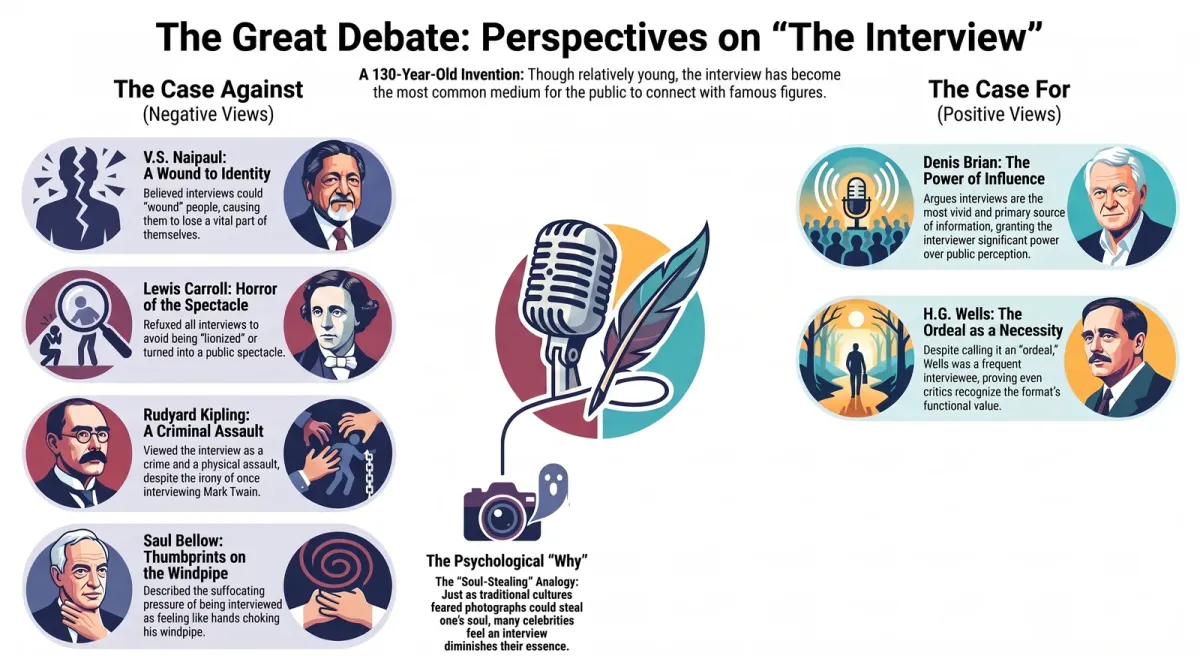
Part I of “The Interview” is built almost entirely around a single question: why does a simple conversation between two people provoke such extreme reactions? Christopher Silvester spends this essay collecting evidence from both sides — celebrities who loathe being interviewed and thinkers who see the interview as indispensable — before arriving at a balanced verdict. For CBSE Class 12 students, this makes Part I an excellent case study in how a writer builds an argument using contrasting examples rather than simply stating an opinion.
A Journalistic Form Barely 130 Years Old
Silvester begins by placing the interview in historical context. It is a relatively young invention, yet in just over a century it has become one of the most common ways people encounter public figures. Because so many celebrities have been interviewed repeatedly over the decades, Silvester notes that opinions on the interview’s function, methods, and merit inevitably vary. This sets up the essay’s structure: a tour through wildly different reactions to the same journalistic practice.
The Case Against the Interview
Most of Part I is devoted to the interview’s harshest critics, and Silvester chooses his examples carefully to show a spectrum of resistance.
V. S. Naipaul: Losing a Part of Oneself
Silvester opens the list of critics with Nobel laureate V. S. Naipaul, who believed that some individuals are genuinely wounded by interviews, losing a part of themselves in the process. This framing is important: it treats the interview not as a neutral exchange of information but as something that can actively cost the subject a piece of their identity.
Lewis Carroll: A Lifelong Refusal
Lewis Carroll, the author of Alice in Wonderland, is presented as the most extreme case in the essay. Silvester describes Carroll’s horror of interviewers as so intense that he refused every request throughout his life and even avoided casual acquaintances who might turn into interviewers or autograph-seekers. Carroll’s fear, Silvester implies, was really a fear of being made into a public spectacle — of being “lionized” against his will.
Rudyard Kipling: The Interview as Assault
Kipling offers the essay’s most dramatic condemnation. Through his wife Caroline’s diary entry, Silvester shows Kipling describing being interviewed in the language of crime and violence — comparable to a physical assault deserving punishment. Silvester adds a pointed irony: Kipling himself had once interviewed Mark Twain, meaning the very act he condemned so fiercely was one he had also carried out on someone else.
H. G. Wells: The Reluctant Regular
Wells complicates the picture further. He is quoted describing the experience as an “ordeal,” yet remained a frequent interviewee throughout his career, even interviewing Soviet leader Joseph Stalin decades later. Silvester uses Wells to show that discomfort with interviews and willingness to give them are not mutually exclusive.
Saul Bellow: Thumbprints on the Windpipe
Novelist Saul Bellow, who consented to being interviewed multiple times, still described the sensation as being like thumbprints pressed against his windpipe — an image of quiet, persistent pressure rather than outright violence. This is one of the most quoted lines associated with the chapter, and it captures the essay’s recurring idea: even willing interviewees can feel constrained or exposed by the process.
The Soul-Stealing Photograph Analogy
To tie all these reactions together, Silvester reaches for a striking cross-cultural comparison. He notes that in some traditional cultures, people believed a photograph could steal the soul of the person photographed. He suggests that celebrities who despise interviews feel something similar — that being interviewed diminishes them or takes something irreplaceable away. This analogy is worth remembering for exam answers, since it is often the detail examiners ask students to explain in their own words.
The Case For the Interview: Denis Brian’s Defence
After building such a strong case against the interview, Silvester deliberately turns the argument around. He brings in writer Denis Brian, who argues that in the modern era, people’s most vivid impressions of public figures come almost entirely through interviews. Brian’s point is that because so much of what reaches the public happens through one person questioning another, the interviewer holds a position of genuine power and influence over how society understands its most prominent figures.
Balancing Both Views: What Silvester Wants Us to See
Silvester’s essay is not simply a list of complaints followed by a rebuttal — it is a demonstration of how contested and layered the interview really is. By placing extreme critics like Carroll and Kipling alongside reluctant participants like Wells and Bellow, and finally a strong defender like Brian, Silvester lets readers see that no single verdict on the interview is complete. The interview can be an intrusion and an art form, an ordeal and an essential public service, sometimes to the very same person.
CBSE Exam Angle: Positive vs Negative Views
Class 12 exam papers frequently ask students to list the positive and negative views on interviews presented in this chapter. A strong answer separates the two clearly: negative views include Naipaul’s idea of lost identity, Carroll’s lifelong refusal, Kipling’s comparison to assault, and Bellow’s windpipe image; positive views centre on Denis Brian’s argument that interviews are our chief modern source of information about people, giving the interviewer real influence and power.
Ready to Master Class 12 Flamingo?
Get chapter-wise summaries, NCERT solutions, and exam-focused practice for every Flamingo chapter on ChampionsPrep. It is free to register & pay as you use — no subscriptions, no bundles, just the help you need when you need it.
Test Your Knowledge

Why Celebrities Fear the Interview: Analysing Part I of The Interview (CBSE Class 12 Flamingo)
Frequently Asked Questions
What are the negative views on interviews mentioned in Part I? +
Negative views include V. S. Naipaul's belief that interviews wound people, Lewis Carroll's lifelong refusal to be interviewed, Rudyard Kipling's comparison of interviews to assault, and Saul Bellow's image of thumbprints on his windpipe.
What is the positive view on interviews given in the chapter? +
Writer Denis Brian argues that interviews are the primary way modern readers form impressions of public figures, which gives the interviewer significant power and influence.
Why did Lewis Carroll refuse to be interviewed? +
Lewis Carroll had a deep horror of being interviewed and of being made into a public spectacle, so he refused every interview request throughout his life.
What does the 'stolen soul' comparison mean in the chapter? +
Silvester compares celebrities' fear of interviews to a belief in some traditional cultures that a photograph could steal a person's soul, suggesting interviews can feel like they take something essential from the subject.
Why is H. G. Wells an important example in Part I? +
Wells called interviews an 'ordeal' but still gave many of them throughout his career, showing that even reluctant interviewees can recognise the format's value.
AI-powered practice — free to start