
Beneath its fairy-tale surface, The Rattrap explores several ideas that make it one of the richest chapters in the CBSE Class 12 English Flamingo syllabus. Selma Lagerlöf uses a simple wire trap as a lens to examine greed, isolation, appearance-based judgment, and — above all — the human capacity for change. This post explains the major themes you need to know for your exam, with examples drawn directly from the story.
The World as a Rattrap: Materialism and the Human Predicament
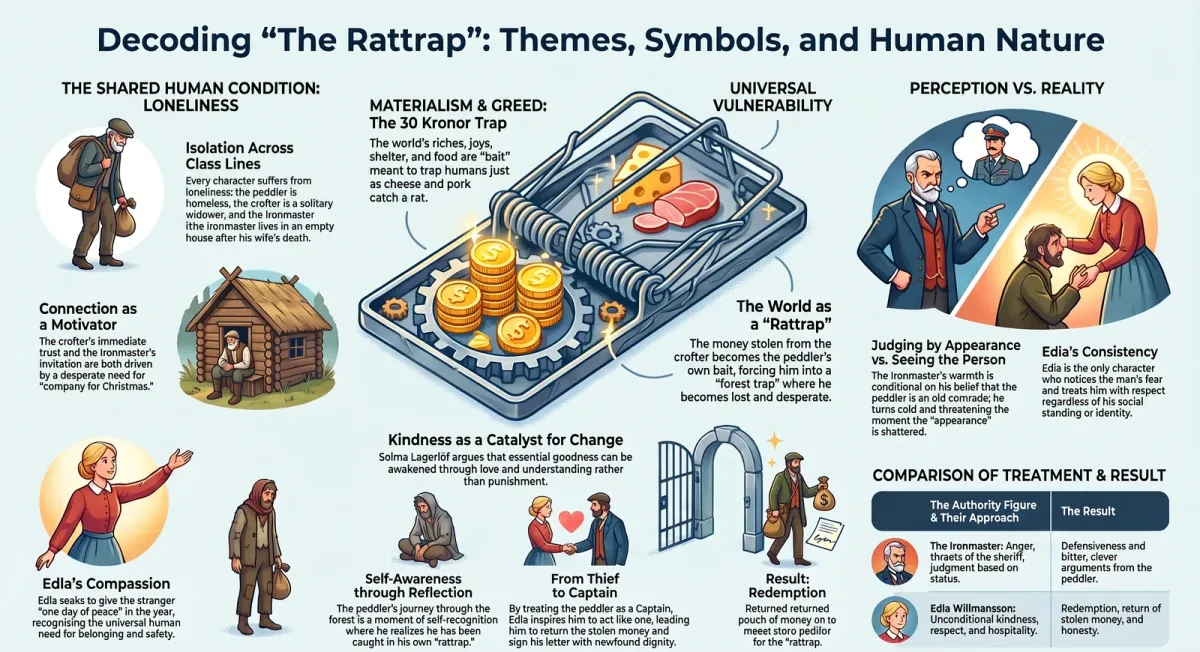
The story’s title is also its governing metaphor. The peddler’s theory — that the world offers riches, comfort and shelter only to trap the people who reach for them, exactly as his wire traps offer cheese and pork to catch rats — captures a deep suspicion of material temptation. What makes the metaphor so effective is that it proves true for the peddler himself: the thirty kronor he steals becomes his own bait, and the forest he flees into becomes his own trap. Lagerlöf suggests that anyone, regardless of status, can be “caught” by greed the moment they let themselves be tempted — a warning she extends explicitly to the ironmaster near the end of the story, when the peddler reminds him that he too might one day reach for “a big piece of pork.”
Loneliness and the Need for Human Connection
Nearly every character in The Rattrap is, in some way, alone. The peddler wanders without a home or companion. The old crofter lives by himself, so starved for conversation that a passing stranger’s company is reward enough for a free meal and a night’s confidences. Even the ironmaster, prosperous and respected, admits that his household feels empty since his wife’s death and his sons’ departure abroad. This shared loneliness explains much of the story’s behaviour: the crofter’s trust, the ironmaster’s eagerness to have “company for Christmas,” and Edla’s determination to give a stranger “one day of peace” in the whole year. Lagerlöf uses this theme to show that the need to connect with others cuts across class and circumstance alike.
Judging by Appearance versus Seeing the Person
The story repeatedly shows characters reacting to how the peddler looks rather than who he actually is. The blacksmiths barely glance at him because vagrants are common sights at the forge. The ironmaster’s opinion swings sharply with his guest’s appearance — warm when he mistakes him for an old comrade, then instantly cold once daylight reveals his mistake. Edla is the clear exception: she notices the man’s fear and treats him with the same respect whether he turns out to be a captain or a common thief. Through this contrast, Lagerlöf critiques a society that extends dignity only to those who look like they deserve it, and holds up Edla’s consistency as the better path.
Redemption Through Kindness and Understanding
This is the theme Lagerlöf herself is famous for across her body of work: her belief that essential goodness in a person can be awakened through understanding and love. The peddler is offered two very different responses to his dishonesty. The ironmaster’s response — anger, threats of the sheriff — produces only defensiveness and a bitter, clever speech in his own defence. Edla’s response — unconditional kindness, given even though she half-suspects he is a thief — produces genuine change. It is her compassion, not any threat of punishment, that persuades the peddler to return the stolen money and sign his letter with dignity as “Captain von Stahle.” The story argues, quite directly, that people are far more likely to become honest when they are treated as though they already are.
Honesty, Deception and Self-Awareness
Deception runs throughout the story, from the peddler’s outright theft to his decision not to correct the ironmaster’s mistaken identity. Yet Lagerlöf is careful not to present the peddler as simply dishonest by nature. His long walk through the forest, in which his own rattrap theory is turned back on him, becomes a moment of self-recognition rather than mere misfortune. By the end of the story, his choice to leave the money and a confessional letter shows a man who has finally been honest with himself as well as with others — an important shift that examiners often ask students to trace across the narrative.
A Story That Is Both Entertaining and Philosophical
Part of why The Rattrap works so well as a CBSE text is that it wears its philosophy lightly. The peddler’s dry humour, the fairy-tale narration, and the neat twist of the final letter keep the story engaging even as it makes a serious point about human nature — a balance worth mentioning if you are asked to comment on the story’s tone.
Related Reading
-
The Rattrap Summary and Analysis – CBSE Class 12 English Flamingo Chapter 4
-
The Rattrap Character Sketch: Peddler, Crofter, Ironmaster and Edla – CBSE Class 12
-
Literary Devices in The Rattrap: Symbolism, Irony and Narrative Style
-
The Rattrap NCERT Solutions – Understanding the Text, Working with Words & More
Prepare Smarter with ChampionsPrep
Thematic questions carry real weight in CBSE Class 12 English exams — practise them with structured notes and topic-wise questions built for chapters like The Rattrap. It is free to register & pay as you use — so you only spend on the practice you actually need, whenever you need it.
Test Your Knowledge

Themes in The Rattrap: Materialism, Loneliness and Redemption Explained
Frequently Asked Questions
What does the rattrap symbolise in the story? +
The rattrap symbolises the material temptations of the world — riches, comfort and shelter — that can trap anyone who reaches for them without caution.
How is loneliness portrayed in The Rattrap? +
Nearly every major character, from the peddler to the old crofter to the ironmaster, experiences isolation, which explains their eagerness for company and shapes their actions.
What is the central message of The Rattrap? +
That kindness and understanding, not judgment or punishment, are what awaken genuine goodness and honesty in people.
How does the theme of appearance versus reality work in the story? +
Characters like the ironmaster react to the peddler based on how he looks, while Edla looks past appearance to treat him with consistent respect, ultimately proving more effective at changing him.
Why is redemption considered the most important theme in The Rattrap? +
Because the entire plot builds toward it — the peddler's transformation from a cynical thief to someone who returns stolen money is the story's central arc and its clearest philosophical statement.
AI-powered practice — free to start