
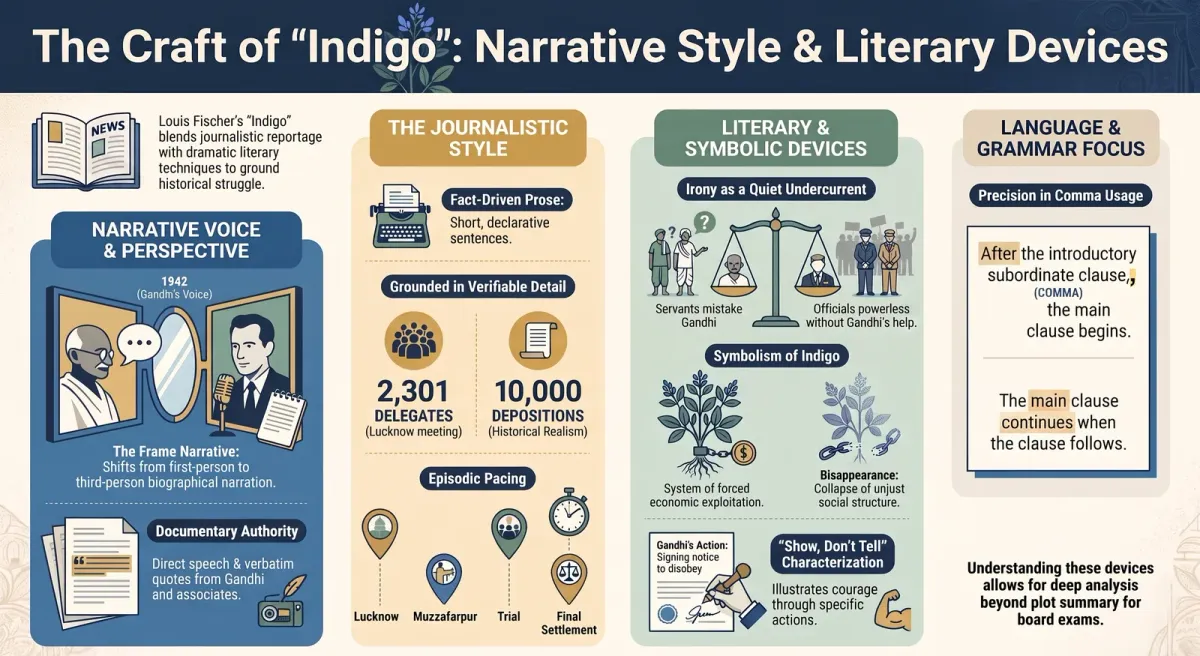
Unlike the short stories elsewhere in Flamingo, “Indigo” is drawn from a full-length biography, and its craft reflects that origin. Louis Fischer writes as a journalist-historian rather than a novelist, blending factual reportage with carefully chosen dramatic detail. This post examines the narrative techniques and literary devices that make the chapter effective, a topic directly addressed in the NCERT “Thinking about Language” and “Noticing Form” sections.
A Frame Narrative: First-Person Opening, Third-Person Body
The chapter opens in Gandhi’s own voice, recalling in 1942 how he decided, back in 1917, to challenge British rule. This first-person frame immediately establishes authenticity — readers understand they are hearing Gandhi’s own account, filtered through Fischer’s biographical reconstruction. Once this frame is set, the narration shifts into third-person biographical prose for the bulk of the chapter, allowing Fischer to move across locations, time, and multiple characters’ perspectives while still returning periodically to quoted first-person testimony from Gandhi and others.
Extensive Use of Direct Speech
One of the chapter’s defining stylistic choices is its heavy reliance on direct quotation — Gandhi’s own words, Rajkumar Shukla’s plea to “fix a date,” the commissioner’s warning to leave Tirhut, Rajendra Prasad’s later reflections. The NCERT textbook itself invites students to consider why the author uses quotations so extensively in his narration. The answer lies in credibility and immediacy: because Fischer had direct access to Gandhi and his associates, quoting them verbatim lends the account documentary authority that paraphrase would dilute. Direct speech also compresses complex motivations into vivid, memorable lines, letting readers hear conviction rather than simply being told about it.
Journalistic, Fact-Driven Prose
Fischer’s sentences are typically short, declarative, and information-dense — a style shaped by his career as a newspaper correspondent. Numbers, dates, and precise details (2,301 delegates, the midnight train on 15 April 1917, ten thousand depositions) ground the narrative in verifiable fact rather than impressionistic storytelling. This journalistic restraint makes the chapter’s occasional emotional moments, such as the spontaneous peasant demonstration outside the courthouse, land with greater force by contrast.
Structural Pacing: Escalation Through Episodes
The chapter is structured as a sequence of discrete episodes — the Lucknow meeting, the journey through Cawnpore and Calcutta, the Muzzafarpur arrival, the notice to quit, the trial, the settlement, and the social reconstruction that follows. Each episode raises the stakes slightly higher than the last, building toward the courtroom climax and its resolution. This episodic pacing mirrors how a biography naturally accumulates evidence of character over time, rather than compressing events into a single dramatic arc as fiction might.
Irony as a Quiet Undercurrent
Several moments carry understated irony. When Rajendra Prasad’s servants let Shukla and Gandhi stay on the grounds because they assume Gandhi is “another peasant,” the text pointedly notes that Gandhi was still barred from drawing water from the well in case his touch polluted it — the servants cannot recognise India’s most consequential leader standing before them, yet caste prejudice still operates automatically. Later, the British officials who dismiss Gandhi as an outsider find themselves powerless without his cooperation to control the very crowds his presence has drawn. These ironies reinforce the chapter’s larger point about authority being more fragile than it appears.
Symbolism of Indigo Itself
Indigo functions as more than a crop; it symbolises an entire system of forced economic exploitation dressed up as ordinary contractual obligation. The eventual disappearance of indigo sharecropping — accelerated by the arrival of synthetic dye — becomes a symbol of how quickly an unquestioned structure can collapse once its underlying injustice is exposed and challenged.
Comma Usage and Sentence Construction
The NCERT “Thinking about Language” exercise specifically asks students to notice comma usage around subordinate clauses. Fischer generally places a comma after an introductory subordinate clause (“When I first visited Gandhi in 1942 at his ashram in Sevagram, he told me…”) but omits it when the subordinate clause follows the main clause (“He had not proceeded far when the police superintendent’s messenger overtook him”). This consistent pattern reflects standard English convention and is a useful, testable grammar point tied directly to the chapter.
Understated Characterisation Through Action
Fischer rarely tells readers directly that Gandhi is courageous or principled; instead, he shows it through small, specific actions — signing a notice while stating intent to disobey it, refusing bail, asking the lawyers a pointed question about what they would do if he were jailed. This “show, don’t tell” approach, unusual for expository biographical writing, gives the chapter a literary quality closer to narrative non-fiction than a conventional historical account.
Why Narrative Technique Matters for Exams
CBSE Class 12 answers on narrative style should go beyond identifying devices; they should explain the effect each device has on the reader’s understanding of Gandhi’s character and the movement’s significance. Recognising how direct speech builds authenticity, or how ironic detail exposes social prejudice, allows students to write analytical rather than purely descriptive responses.
Start Learning Smarter with ChampionsPrep
Looking for exam-ready notes on literary devices and writing style across every Flamingo chapter? ChampionsPrep offers CBSE and Maharashtra Board Class XI–XII students structured, exam-focused content for boards and entrance exams like CUET, IPMAT, NPAT, and SET. It is free to register & pay as you use — start exploring ChampionsPrep today.
Test Your Knowledge
Literary Devices and Narrative Style in Indigo – CBSE Class 12 English
Frequently Asked Questions
Why does the author use direct speech so frequently in Indigo? +
Because Fischer had firsthand access to Gandhi and his associates, direct quotation lends the biography documentary authenticity and conveys conviction more vividly than paraphrase.
What narrative point of view does the chapter use? +
It opens in Gandhi's first-person voice as a framing device, then shifts to Fischer's third-person biographical narration for most of the chapter.
What is an example of irony in the chapter? +
The servants at Rajendra Prasad's house mistake Gandhi for an ordinary peasant, yet still bar him from the well over untouchability concerns, ironically failing to recognise India's future leader.
How does Fischer's journalistic background influence the writing style? +
His prose is factual, precise, and detail-driven, using specific numbers and dates that ground the narrative in verifiable historical record rather than dramatized storytelling.
What does indigo symbolise in the chapter? +
Indigo represents the broader system of forced economic exploitation of sharecroppers, and its disappearance symbolises how quickly an unjust structure can collapse once challenged.
AI-powered practice — free to start