
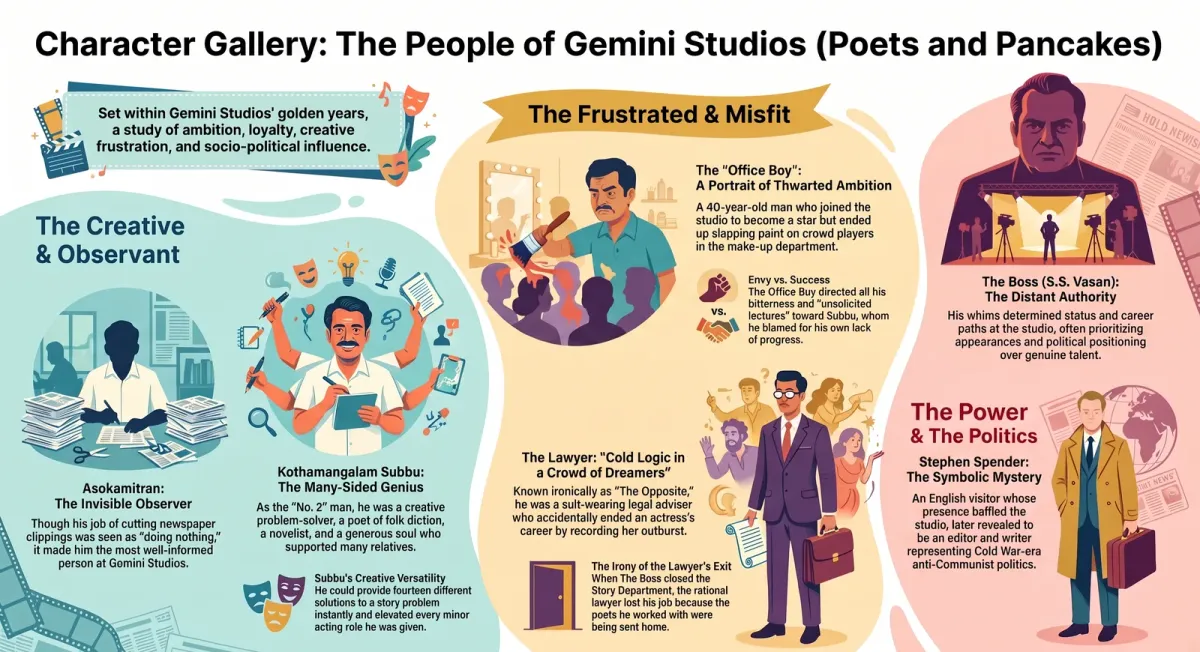
“Poets and Pancakes” by Asokamitran is built almost entirely out of character portraits rather than plot. Each figure at Gemini Studios represents a different response to ambition, loyalty, and disappointment. Understanding these characters closely is essential for CBSE Class 12 exams, since questions frequently ask students to describe individuals or compare their attitudes. Here is a complete character sketch of the key people in the chapter.
The Narrator — Asokamitran
The narrator is a quiet, observant employee whose actual job — cutting and filing newspaper clippings — looks like “doing next to nothing” to everyone, including The Boss. Yet this seemingly insignificant task makes him the most well-informed person at the studio, since he reads everything that passes through his hands. He is self-deprecating, gently ironic, and more interested in watching people than advancing his own career. His literary sensibility shows in how he treats even trivial studio gossip — make-up department politics, the poets’ visits — as material worth recording with care and humour. Crucially, he never mocks anyone cruelly; even his harshest portrait, of the resentful office boy, carries a trace of sympathy.
The “Office Boy” of the Make-Up Department
Despite the name, this man is in his early forties, not a boy at all. He had joined Gemini Studios years earlier with real ambitions — to become a star actor, a top screenwriter, a director, or a lyricist. Instead, he ended up at the bottom of the make-up department’s hierarchy, responsible only for slapping paint onto crowd players during large shoots. The narrator calls him “a bit of a poet,” a description that captures both his genuine sensitivity and the gap between his self-image and his actual position. Frustrated and bitter, he channels all his disappointment into unsolicited, long-winded lectures aimed at the narrator, whom he assumes is also wasting his talent. More tellingly, his anger fixes obsessively on Kothamangalam Subbu, whom he blames for every one of his own “woes, ignominy and neglect.” He is less a villain than a portrait of thwarted ambition and misdirected envy — someone who never had the good fortune, or perhaps the temperament, to turn his early aspirations into anything more.
Kothamangalam Subbu
Subbu is the chapter’s most fully drawn character and, in the narrator’s account, one of the true architects of Gemini Studios’ golden years. He began with no more advantages than the resentful office boy — no established film industry to join, no special formal education — except, the narrator notes pointedly, the “virtue” of being born a Brahmin, which gave him early exposure to more affluent circles. What made Subbu indispensable was his creative responsiveness: asked to solve an impossible story problem, he could produce four solutions in a minute and fourteen more if needed. He was also a genuine literary talent — a poet who wrote original “story poems” in folk diction, author of the novel Thillana Mohanambal, and a skilled actor who elevated every supporting role he played. Generous almost to a fault, his house was permanently full of relatives he supported without seeming to notice the burden. Yet his very closeness to The Boss earned him quiet enemies — a reminder that success in a hierarchical, personality-driven workplace rarely goes unresented.
The Lawyer (“The Legal Adviser”)
Officially part of the Story Department, the lawyer stands apart from everyone else — literally, since he wears pants, a tie, and a coat “like a coat of mail” while his khadi-clad colleagues dress alike. Nicknamed “the opposite” as an ironic joke on his formal title, he is a figure of “cold logic in a crowd of dreamers,” out of place among the poets and Gandhiites. His most memorable act — recording a distressed actress’s outburst and playing it back to her — is not malicious in intent but devastating in effect, ending her career by exposing her to her own vulnerability. He is also allowed to direct a film, like other Boss favourites, though little comes of it. His story closes on a sharp irony: when The Boss shuts down the Story Department, it is the lawyer, the most rational and least “poetic” member of the group, who loses his job — because the poets, not he, were the ones being sent home.
The Boss (S.S. Vasan)
Though he never appears in close focus, The Boss’s presence shapes every character’s behaviour. As the founder of Gemini Studios, his approval determines status, and his whims determine who is favoured, who is allowed to direct a film despite no evident talent, and who is worth an elaborate public reception. His speech welcoming the mysterious English visitor, filled with vague words like “freedom” and “democracy” despite his own evident ignorance of the guest, reveals a man more concerned with appearances and political positioning than genuine understanding — a trait the narrator only fully decodes years later.
Stephen Spender
Spender appears briefly as “a tall man, very English, very serious,” whose visit baffles the entire studio because nobody can place him. Years later, the narrator recognises him as the editor of The Encounter and, later still, as one of six writers in The God That Failed who publicly recanted their earlier sympathy for Communism. Spender’s real significance in the chapter is not personal but symbolic: he represents the Cold War politics quietly shaping even a small Tamil film studio’s hospitality, invisible to everyone at the time it happened.
Related Reading
-
Poets and Pancakes Summary and Analysis – CBSE Class 12 English Flamingo Chapter 6
-
Poets and Pancakes Themes Explained – CBSE Class 12 English Flamingo Chapter 6
-
Poets and Pancakes Literary Devices and Narrative Style – CBSE Class 12 Flamingo
-
Poets and Pancakes Exam Tips, Important Questions & Revision Checklist – CBSE Class 12 Flamingo
Start Learning with ChampionsPrep
Need clear, exam-ready character analysis for every Flamingo chapter? It is free to register & pay as you use — explore ChampionsPrep for structured CBSE Class 12 English notes built around exactly what your board exam expects.
Test Your Knowledge

Poets and Pancakes Character Sketch – Subbu, the Lawyer & More (CBSE Class 12 Flamingo)
Frequently Asked Questions
What kind of person is the "office boy" in the make-up department? +
He is a middle-aged man with unfulfilled literary and film ambitions who ended up doing crowd make-up, and who directs his bitterness at Kothamangalam Subbu's success.
Why is Kothamangalam Subbu considered a many-sided genius? +
He combined quick, on-demand creative problem-solving with real literary talent as a poet and novelist, plus acting skill and personal generosity.
Why was the legal adviser called "the opposite" by his colleagues? +
It was an ironic joke - "legal adviser" and "the opposite" play on each other, and the nickname stuck because of his sharp, dry manner.
How does the narrator himself come across as a character? +
As a quiet, self-deprecating observer whose insignificant job makes him unusually well-informed and gently perceptive about everyone around him.
What role does Stephen Spender play as a character in the chapter? +
He is the outwardly ordinary English visitor who later turns out to symbolise Cold War-era anti-Communist politics reaching even a Madras film studio.
AI-powered practice — free to start