
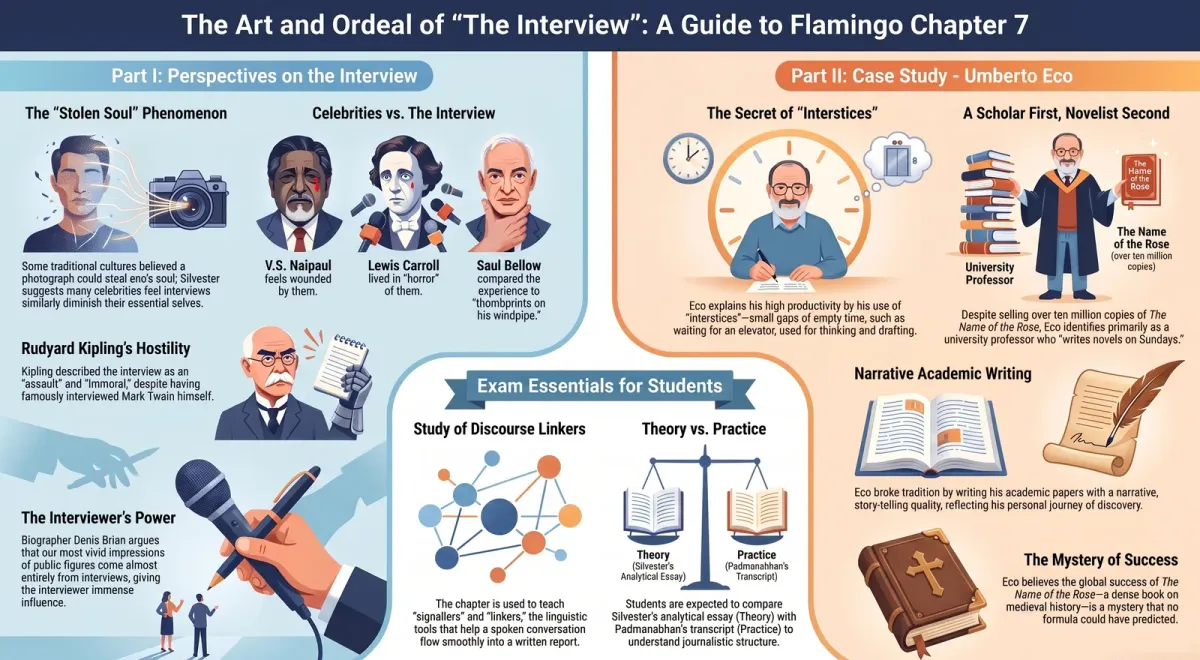
“The Interview” is Chapter 7 of the CBSE Class 12 English Flamingo textbook. Unlike most chapters in the book, it is not a short story or memoir — it is a two-part non-fiction piece examining interviewing as a form of communication. Part I is an essay-style excerpt from Christopher Silvester’s introduction to The Penguin Book of Interviews, and Part II is an actual transcript, an excerpt from Umberto Eco’s conversation with journalist Mukund Padmanabhan of The Hindu. Together, the two parts give students a rounded understanding of what an interview is, why it provokes such strong reactions, and how a skilled interviewee uses the format.
About the Author
Christopher Silvester studied history at Peterhouse, Cambridge, worked as a reporter for Private Eye for a decade, and later wrote for Vanity Fair. His long career studying journalism gives Part I its authority — he is not simply describing interviews from the outside, he has conducted and analysed hundreds of them.
Part I: A Balanced Look at the Interview as an Art Form
Silvester opens by noting that the interview, as a journalistic form, is barely over 130 years old, yet it has become one of the most common ways readers learn about public figures. He sets up the chapter’s central tension immediately: opinions about interviews vary enormously depending on who you ask.
On one side are people who treat the interview as close to art — a genuine method of arriving at truth about a person. On the other are celebrities and writers who experience interviews as an intrusion, even a kind of violation. Silvester draws a striking comparison here: in some traditional cultures, people believed that a photograph could steal a person’s soul. He suggests interview-averse celebrities feel something similar — as though the process takes something essential from them and leaves them diminished.
To illustrate this, Silvester brings in several literary figures. Nobel laureate V. S. Naipaul is cited as believing that certain people are genuinely hurt by interviews and lose a part of themselves. Lewis Carroll, creator of Alice in Wonderland, reportedly had such a horror of being interviewed that he refused every request throughout his life. Rudyard Kipling goes further, describing being interviewed in hostile terms — comparing it to an assault on his person — even though he himself had once interviewed Mark Twain. H. G. Wells once called interviews an “ordeal” but gave many anyway, including a later interview with Soviet leader Joseph Stalin. Novelist Saul Bellow contributes a memorable image, comparing the discomfort of being interviewed to thumbprints pressed against his windpipe.
Despite cataloguing this resistance, Silvester’s essay does not conclude that interviews are harmful. Instead, he pivots to their social value, citing biographer Denis Brian’s view that our clearest impressions of the people around us come almost entirely through interviews. Because so much of what we know about others reaches us through one person questioning another, the interviewer occupies a position of real influence over public perception.
Part II: Umberto Eco in Conversation
The second part shifts from commentary to demonstration. Instead of talking about interviews, students read one — a genuine excerpt from an interview with Italian scholar and novelist Umberto Eco, conducted by Mukund Padmanabhan for The Hindu.
Eco was already a towering academic figure — known for his work in semiotics, literary theory, and medieval studies — before he became a global bestselling novelist with The Name of the Rose in 1980, a book that eventually sold well over ten million copies. The interview explores how one person can be prolific across academic writing, children’s fiction, essays, journalism, and literary fiction. Eco’s answer is disarmingly simple: he insists he is always working on the same small cluster of ethical and philosophical interests, just expressed through different forms.
He also shares his theory of “interstices” — small pockets of otherwise wasted time, like waiting for an elevator, that he uses productively to think or draft an article. The interview touches on his self-image (he calls himself “a university professor who writes novels on Sundays”), the narrative, story-driven style of his academic writing, and his reflections on why a dense novel dealing with medieval history and semiotics achieved such mass popularity. Eco is candid that he sees this success as a mystery — not something a formula could have predicted.
Why This Chapter Matters for CBSE Class 12 Students
For exam purposes, this chapter blends comprehension with a study of communication skills. Part I trains students to read argumentative non-fiction and track a writer’s structure — how Silvester builds his case through examples before reaching his conclusion. Part II models how a well-conducted interview flows, supporting the chapter’s own writing task of converting a spoken interview into a written report. A dedicated section on discourse linkers and signallers makes this as much a lesson in conversation mechanics as journalism.
Key Takeaways
-
The interview has both passionate critics and passionate defenders among the celebrities who experience it.
-
Silvester argues that the interview remains an indispensable medium of modern communication.
-
Eco’s segment shows how a public figure can use an interview to project identity, humour, and intellectual depth at once.
-
The chapter pairs a persuasive essay (Part I) with a real transcript (Part II) so students can compare theory with practice.
Ready to Master Class 12 Flamingo?
Get chapter-wise summaries, NCERT solutions, and exam-focused practice for every Flamingo chapter on ChampionsPrep. It is free to register & pay as you use — no subscriptions, no bundles, just the help you need when you need it.
Test Your Knowledge
The Interview by Christopher Silvester: Summary and Analysis (CBSE Class 12 English)
Frequently Asked Questions
Who wrote 'The Interview' in CBSE Class 12 Flamingo? +
Part I is by Christopher Silvester, taken from his introduction to The Penguin Book of Interviews. Part II is an interview of Umberto Eco conducted by journalist Mukund Padmanabhan.
What is the main idea of Part I of 'The Interview'? +
Part I argues that although many celebrities and writers resent and fear being interviewed, the interview remains one of the most valuable and influential forms of communication in modern journalism.
Who is Umberto Eco in 'The Interview' chapter? +
Umberto Eco was an Italian professor known for his work on semiotics and medieval aesthetics, who later became a bestselling novelist after publishing The Name of the Rose.
Why do some celebrities dislike being interviewed, according to the chapter? +
The chapter says some celebrities feel interviews intrude on their privacy or diminish them, comparing this feeling to old beliefs that a photograph could steal a person's soul.
What does Umberto Eco mean by 'interstices'? +
Eco uses 'interstices' to describe small gaps of empty time in daily life, like waiting for an elevator, which he productively fills with thinking or writing.
AI-powered practice — free to start