
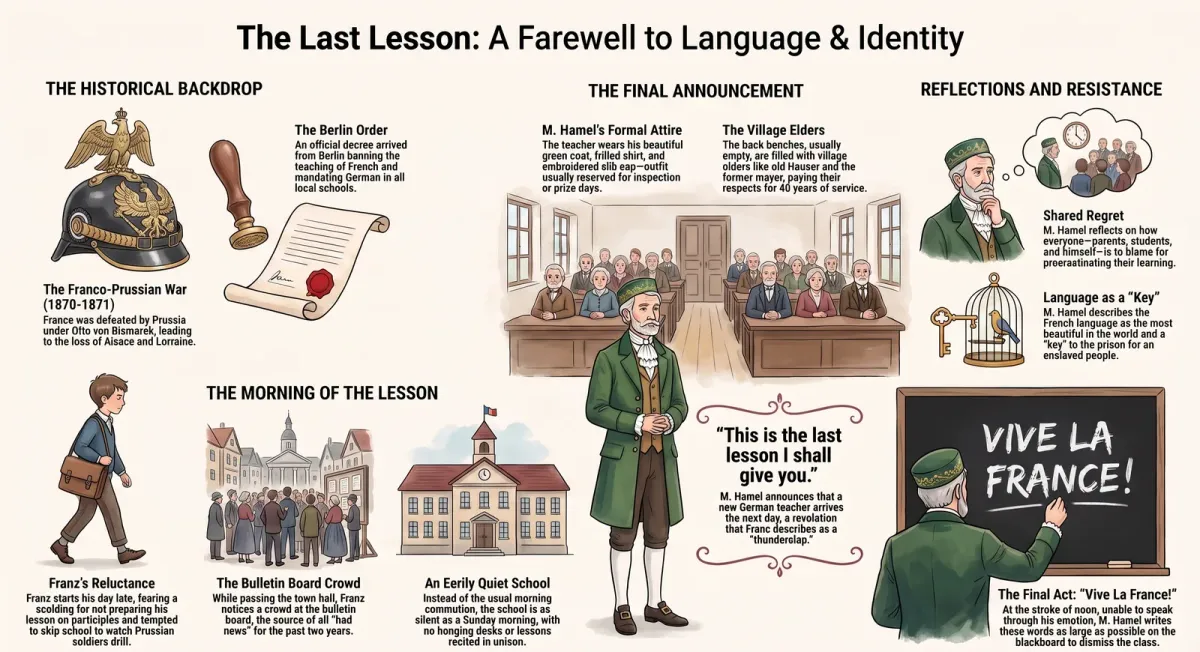
“The Last Lesson” by Alphonse Daudet is the opening story of the Flamingo prose section for CBSE Class 12 English, and it remains one of the most quietly powerful pieces in the syllabus. In a few pages, Daudet turns an ordinary school morning into a meditation on identity, freedom, and the value of what we take for granted. This post summarises the story and unpacks why it still resonates with students today.
About the Author and the Historical Background
Alphonse Daudet (1840-1897) was a French novelist and short-story writer known for weaving political history into intimate, human-scale narratives. The story is set during the Franco-Prussian War (1870-1871), in which France was defeated by Prussia under Otto von Bismarck. As part of the settlement, the French regions of Alsace and Lorraine passed into Prussian control. This is the historical hinge on which the story turns: an order arrives from Berlin that only German may now be taught in the schools of these two regions. Daudet does not narrate battles or treaties directly; instead, he shows what a political decision made far away actually feels like inside one small village classroom.
The Last Lesson: Story Summary
A Morning Like Any Other, Almost
The story is narrated by Franz, a schoolboy who sets out for school late one morning, dreading a grammar test on participles he has not prepared for. Tempted to skip school and spend the day outdoors amid the warm weather and drilling Prussian soldiers, he resists and hurries on, passing a crowd gathered at the town bulletin board, where bad news has been posted for two years running.
An Unusually Quiet Classroom
Franz expects the usual commotion of a school morning — banging desks, lessons recited loudly in unison, the teacher’s ruler rapping the table. Instead, he finds the school eerily still. Slipping in late, he braces for a scolding, but M. Hamel calmly tells him to take his seat, since the lesson is only just beginning. Franz then notices something odder: M. Hamel is dressed in his formal green coat and embroidered cap, usually reserved for inspection days, and the back benches — normally empty — are filled with village elders, including the former mayor and postmaster.
M. Hamel’s Announcement
M. Hamel climbs onto his chair and, gently and gravely, announces that this will be the last French lesson he will ever teach them. An order has arrived from Berlin: from tomorrow, only German will be taught in the schools of Alsace and Lorraine, and a new teacher takes over the next day. The news lands on Franz like a thunderclap. Suddenly, everything he had resented about school — his books, his lessons, even M. Hamel’s strict ruler — becomes precious, because he is about to lose access to all of it.
The Final Lessons of the Day
What follows is a school day transformed into a farewell. M. Hamel gently reflects that everyone — parents who valued farm work over schooling, and he himself, who sometimes let lessons slide for a fishing trip — shares some blame for not valuing their language while they still could. He praises French as the clearest and most beautiful language in the world and calls it a “key” that an enslaved people must hold onto. The class works through grammar, then a writing exercise using copybooks headed “France, Alsace,” then history, and finally the youngest children chanting their basic sounds, while old Hauser follows along in a battered primer at the back of the room.
The Closing Scene
At noon, the church bell and the Angelus sound together, and the trumpets of Prussian soldiers returning from drill echo outside. M. Hamel rises, visibly moved, tries to speak, and cannot finish his sentence. He turns to the blackboard and writes, as large as he can, “Vive La France!” — then gestures with his hand that the school is dismissed.
Analysis: What Makes This Story Powerful
Daudet’s choice to narrate through Franz is central to the story’s impact. Because Franz begins as a distracted, reluctant student, his transformation over one lesson mirrors the shift the reader is meant to undergo: from taking language and learning for granted to recognising them as forms of freedom.
Small details also carry outsized meaning: M. Hamel’s formal dress signals mourning and respect; the silent, dignified presence of the village elders shows a community honouring what it is losing; and the copybooks reading “France, Alsace” turn a simple writing exercise into quiet resistance. The story never depicts a battle, yet it conveys occupation and loss as vividly as a scene of combat might.
Why This Chapter Matters for CBSE Students
“The Last Lesson” is a frequent source of both short-answer and long-answer questions in CBSE Class 12 board exams, particularly around theme, character, and the significance of the closing scene. Building a clear mental timeline of the story makes it far easier to answer inference-based questions confidently.
Related Reading
-
The Last Lesson Character Sketch: Franz and M. Hamel (CBSE Class 12 English Flamingo)
-
The Last Lesson Themes: Language, Identity and Freedom (CBSE Class 12 English Flamingo)
-
The Last Lesson: Literary Devices and Narrative Style (CBSE Class 12 English Flamingo)
Take Your Exam Prep Further with ChampionsPrep
Reading the summary is only the first step — real exam readiness comes from practising questions and revising efficiently. ChampionsPrep’s AI-powered platform turns NCERT chapters like this one into structured practice sets built for CBSE and State Board students. It is free to register & pay as you use. Start practising on ChampionsPrep today .
Test Your Knowledge

The Last Lesson Summary and Analysis (CBSE Class 12 English, Flamingo Chapter 1)
Frequently Asked Questions
Who wrote "The Last Lesson" and what is it about? +
"The Last Lesson" was written by French author Alphonse Daudet. It is about a French schoolboy, Franz, who learns that his school in Alsace can no longer teach French after the region comes under Prussian control following the Franco-Prussian War.
Why does M. Hamel wear his formal clothes on the day of the last lesson? +
He wears his formal green coat and cap, usually kept for inspection or prize days, to honour the occasion of his final French lesson after forty years of teaching, treating it with the same solemnity as an important ceremonial day.
What does M. Hamel write on the blackboard at the end of the story? +
He writes "Vive La France!" as large as he can, since emotion prevents him from speaking any further words to his students.
Why are the village elders sitting in the classroom that day? +
Old Hauser, the former mayor, the former postmaster and others sit in the back benches to pay their respects to M. Hamel's forty years of service and to express regret for not valuing their own education and language earlier.
What is the central message of "The Last Lesson"? +
The story shows how people often realise the value of their language, culture and freedom only when these are about to be taken away, and it argues that holding onto one's own language is a form of holding onto one's identity and dignity.
Keep practising English
AI-powered feedback and structured revision for English — free to start, at your own pace.
AI-powered practice — free to start