
“The Adventure” is the fifth prose piece in the CBSE Class XI Hornbill textbook, written by astrophysicist Jayant Narlikar. Unlike other chapters, this is science fiction grounded in real research — a story that uses catastrophe theory and quantum theory to ask an old question in a new way: what if one moment in history had gone differently? Narlikar uses a historian protagonist to explore whether the unpredictability seen in tiny particles could, in some strange sense, apply to history’s great turning points too. This post walks through the plot and why it remains one of the most discussed chapters in the Hornbill syllabus.
The Man at the Centre: Professor Gaitonde’s Strange Awakening
The story opens mid-action, with a historian named Professor Gangadharpant Gaitonde travelling by train from Pune towards Bombay. He is on the Jijamata Express, and almost immediately the reader senses that something is not quite right with the India around him — the details are subtly different from the world we know, though the professor himself does not yet realise how different.
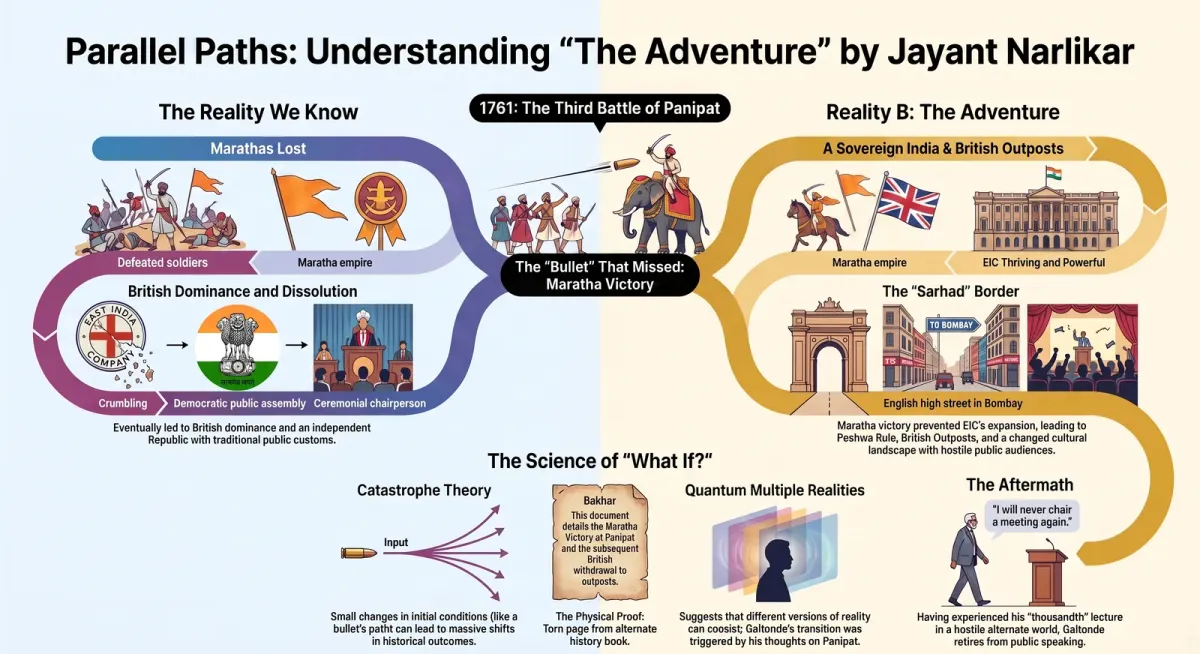
At a small station called Sarhad, an official checks travel permits and casually remarks that this is where “the British Raj begins.” For the professor, and the reader, this is the first real jolt: in the India we know, the Raj ended decades earlier. Gaitonde is travelling into an alternate version of his own country.
A Bombay That Time Forgot — Or Never Reached
As the train pulls into Victoria Terminus, Gaitonde steps into a city that looks familiar on the surface but is fundamentally different underneath. The station is neat and orderly, staffed largely by Anglo-Indians, Parsees, and British officers. Outside stands an enormous building: the headquarters of the East India Company, very much alive and thriving — a company that, in the history Gaitonde knows, was dissolved not long after 1857. Walking along Hornby Road, he finds British department stores and banks lining the street, exactly as in an English high street. Gaitonde’s instinct as a historian takes over: something enormous changed course in the past, and he needs to find out when.
He also attempts something personal — visiting Forbes Building to ask after his own son, Vinay Gaitonde. The receptionist has never heard of him, a quiet, unsettling moment: if the professor’s own life took a different path here, his son’s existence cannot be taken for granted either.
The Library, the Bakhar, and the Battle That Changed Everything
Gaitonde’s search leads him to the Town Hall library, home to the Asiatic Society’s collection, where he does something few people ever get to do: read his own multi-volume history book, written by a version of himself, and find that it disagrees with him. The first four volumes match everything he knows; the divergence appears in volume five, in the account of the Battle of Panipat.
In this alternate history, the Marathas won decisively, routing Ahmad Shah Abdali’s forces back to Kabul. That single reversed outcome cascades outward: the East India Company’s expansion stalls for generations, the Peshwas rise as India’s effective rulers, and the British are eventually confined to a small leased outpost around Bombay, due to expire in 2001. Digging into an old chronicle, the Bhausahebanchi Bakhar, Gaitonde finds the precise detail that tipped the outcome: a bullet that, in this world, missed a key Maratha commander by the narrowest possible margin.
The Empty Chair and the Sudden Return
That evening, drawn by old habit, Gaitonde wanders into a public lecture at Azad Maidan and is struck by an empty presidential chair on the platform. As a veteran of hundreds of public meetings in his own world, he cannot resist an unoccupied chair — he walks up and occupies it, only to discover that in this society the custom of a ceremonial chairperson has been abolished. The audience turns hostile, pelting him until he is swept off the stage — and vanishes from that world entirely, waking the next morning back in the Azad Maidan he actually knows, with one piece of physical evidence in his pocket: a torn page from the alternate world’s Bakhar.
Explaining the Impossible
The story’s final section shifts from adventure to explanation, as Gaitonde recounts everything to his physicist friend, Rajendra Deshpande. Rajendra offers a framework built on catastrophe theory and quantum theory’s idea of multiple coexisting realities, suggesting that a genuinely catastrophic moment — like a pivotal battle — can branch history into different, equally real outcomes, and that a rare interaction, perhaps triggered by Gaitonde’s own thoughts about Panipat at the moment of his accident, let him briefly experience the other branch.
Why the Story Works
What makes “The Adventure” memorable is not just its twist but its method: it treats history the way a scientist treats data. It closes on a personal note too — Gaitonde, shaken by having already “lived” his long-anticipated thousandth lecture in the other world, decides he will never chair a meeting again.
Related Reading
-
The Ailing Planet: The Green Movement’s Role — Summary and Analysis
-
The Ailing Planet — Important Questions and Answers for CBSE Class 11
Ready to Master Every Hornbill Chapter?
Studying “The Adventure” alongside other CBSE Commerce chapters gets easier with the right practice material. ChampionsPrep offers AI-powered question banks and exam-focused practice sets for Class XI and XII students — free to register, with pay-as-you-use pricing so you only pay for what you study. Visit ChampionsPrep to start practicing today.
Test Your Knowledge
The Adventure by Jayant Narlikar: Full Summary and Analysis
Frequently Asked Questions
What is the central idea of "The Adventure" by Jayant Narlikar? +
The story explores how one altered event — the Marathas winning the Battle of Panipat — could have reshaped Indian history, using catastrophe theory and quantum theory to explain how an alternate reality might be experienced.
Who is the protagonist of "The Adventure"? +
The protagonist is Professor Gangadharpant Gaitonde, a respected historian who unexpectedly experiences an alternate version of India after a road accident in Pune.
What historical event is central to the story's plot? +
The Third Battle of Panipat (1761) between the Marathas and Ahmad Shah Abdali is the pivotal event; the story imagines a version of history where the Marathas won decisively instead of losing.
What scientific theories does Rajendra Deshpande use to explain Gaitonde's experience? +
Rajendra combines catastrophe theory, which studies sudden shifts from small changes, with the quantum-theory idea of multiple possible realities, to argue that Gaitonde briefly crossed into an alternate branch of history.
Why does Gaitonde decide never to preside over a meeting again? +
Because he believes he already delivered his symbolic "thousandth" address in the alternate world, at the empty chair in Azad Maidan, before being forced off the stage — making a repeat in his own world feel unnecessary to him.
Keep practising English
AI-powered feedback and structured revision for English — free to start, at your own pace.
AI-powered practice — free to start