
The Portrait of a Lady: Summary, Themes and Analysis (CBSE Class 11 Hornbill Chapter 1)
Khushwant Singh’s “The Portrait of a Lady” opens the Class 11 Hornbill textbook, and for good reason — it is a warm, quietly moving memoir-style essay about a grandmother, told through the eyes of a grandson watching their bond change over two decades. For CBSE Class 11 students, this chapter is a favourite in both board exams and CUET-style comprehension questions because it blends narrative skill with rich, testable themes: ageing, faith, urbanisation, and the emotional distance that modern life can create between generations.
This guide breaks the essay into its key phases and major themes for exam-ready understanding.
Who Wrote The Portrait of a Lady?
Khushwant Singh, one of India’s best-known writers and journalists, was celebrated for his direct, conversational prose and his ability to find deep emotion in ordinary domestic scenes. “The Portrait of a Lady” is autobiographical in tone: a grandson’s tribute to his grandmother, structured as a series of remembered snapshots rather than a single continuous plot. This phase-based structure is itself worth noting for literary-device questions.
The Three Phases of the Relationship
CBSE examiners frequently ask students to identify the three stages of the narrator’s bond with his grandmother, so it helps to think of the essay in exactly these terms.
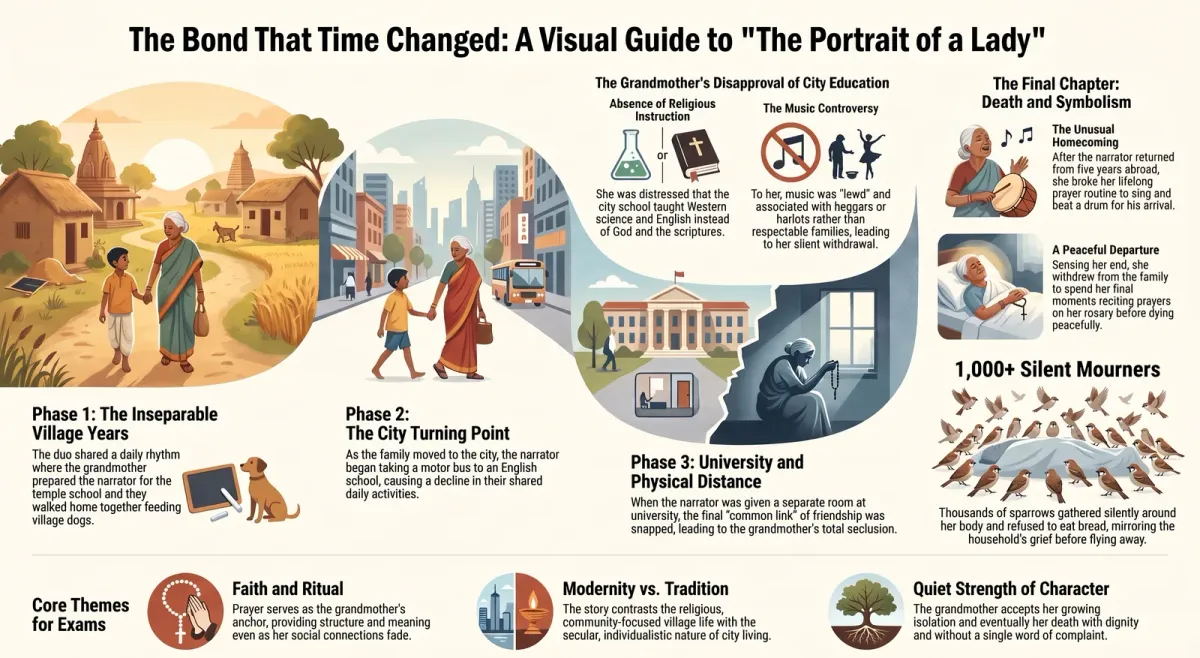
Phase One: The Village Years
In the village, the narrator and his grandmother are inseparable. She wakes him for school, prepares him each morning, and walks with him to the school attached to the temple, where she spends her time in prayer while he studies. Their days follow a shared, unhurried rhythm, and even the walk home — accompanied by the village dogs — becomes part of their closeness.
Phase Two: The Move to the City
When the family relocates to the city, something shifts. The grandmother no longer accompanies the narrator to his new English-medium school, and he begins travelling by motor bus instead. She turns her attention to feeding sparrows in the courtyard, a quiet substitute for the daily companionship she has lost. This is the point the text itself calls a turning point in their friendship — physical closeness continues, but shared activity fades.
Phase Three: University and Growing Distance
Once the narrator is given a room of his own at university, the two see even less of each other. The grandmother settles into a life centred on her spinning wheel and prayer, only pausing each afternoon to feed the sparrows that gather around her. She accepts this quieter, more solitary existence without complaint or bitterness — a detail examiners often ask students to reflect on when discussing her character.
Why the Grandmother Disapproves of Western Education
A recurring exam question asks students to list the reasons the grandmother is troubled by the narrator’s city schooling. Her discomfort comes from three sources: the shift from religious instruction to secular, science-based learning; her own inability to help with lessons she does not understand; and her disapproval when he mentions music lessons, since she associates music with a lifestyle unsuitable for her family. Her silence at this news is one of the essay’s most quietly powerful moments — disapproval expressed without a word of anger.
The Final Days: Devotion and Acceptance
The essay’s closing section is its emotional core. After the narrator returns from five years abroad, the grandmother — visibly unchanged and still absorbed in prayer — surprises everyone by breaking her routine one evening: she gathers the neighbourhood women, brings out an old drum, and sings songs celebrating the homecoming of warriors. It is the first time in the narrator’s life that he sees her skip her prayers. The very next morning, she falls ill, and she interprets this lapse as a sign that her life is ending. She quietly withdraws from conversation to spend her remaining hours in prayer, and dies peacefully, beads in hand.
The Sparrows: A Symbol Worth Remembering
The sparrows the grandmother feeds every afternoon are more than a charming habit — they symbolise her capacity for quiet companionship in solitude. Their behaviour on the day of her death, gathering silently around her body and later refusing the bread crumbs offered, mirrors the household’s grief. This detail is a favourite for “significance of a symbol” questions.
Key Themes in The Portrait of a Lady
-
Ageing and continuity: the grandmother is described as having always been old, suggesting a timeless, unchanging presence in the narrator’s life.
-
Faith and ritual: prayer structures her day and gives her life meaning as other companionship fades.
-
Modernity versus tradition: village schooling tied to religion contrasts with English-medium city education tied to science, capturing a real generational shift in early 20th-century India.
-
Quiet strength of character: she never protests her growing isolation, adapting instead with dignity.
-
Death as continuity, not tragedy: her peaceful death reinforces the essay’s calm, accepting tone.
Practice Smarter with ChampionsPrep
Reading a summary is a good start, but real exam readiness comes from practice. ChampionsPrep offers AI-powered question banks, chapter-wise practice sets, and instant explanations built specifically for CBSE and Maharashtra Board Class 11–12 Commerce students, along with CUET, IPMAT, NPAT, and SET aspirants. Registration is free, and you only pay for what you use — so there’s no reason to wait. Sign up today at app.championsprep.in and start practising The Portrait of a Lady and every other Hornbill chapter with confidence.
Test Your Knowledge

The Portrait of a Lady: Summary, Themes and Analysis
Frequently Asked Questions
Who is the narrator of The Portrait of a Lady? +
The narrator is Khushwant Singh's grandson persona, recalling memories of his grandmother from childhood in the village through his years at university and beyond.
What are the three phases of the narrator's relationship with his grandmother? +
The village years of daily companionship, the move to the city where shared routines fade, and the university years marked by growing physical and emotional distance.
Why was the grandmother against music lessons? +
She believed music was associated with a lifestyle unsuitable for respectable families, so she disapproved silently when the narrator mentioned taking music lessons at school.
What do the sparrows symbolise in the essay? +
They represent the grandmother's quiet companionship in her later, more solitary years, and their silent gathering after her death reflects the household's grief.
How does the grandmother react to her approaching death? +
She senses it calmly after missing her evening prayers for the first time, withdraws from conversation, and spends her final hours peacefully reciting her rosary.
Keep practising English
AI-powered feedback and structured revision for English — free to start, at your own pace.
AI-powered practice — free to start