
Important Questions and Answers: The Portrait of a Lady (CBSE Class 11)
“The Portrait of a Lady” is one of the most frequently tested chapters in CBSE Class 11 English. Its questions follow a predictable pattern: recall-based “mention” questions, reflective “talk about the text” questions, and application-based questions. This post organises the most important, exam-style questions into clear categories with model answers.
Short Answer Questions (2–3 Marks)
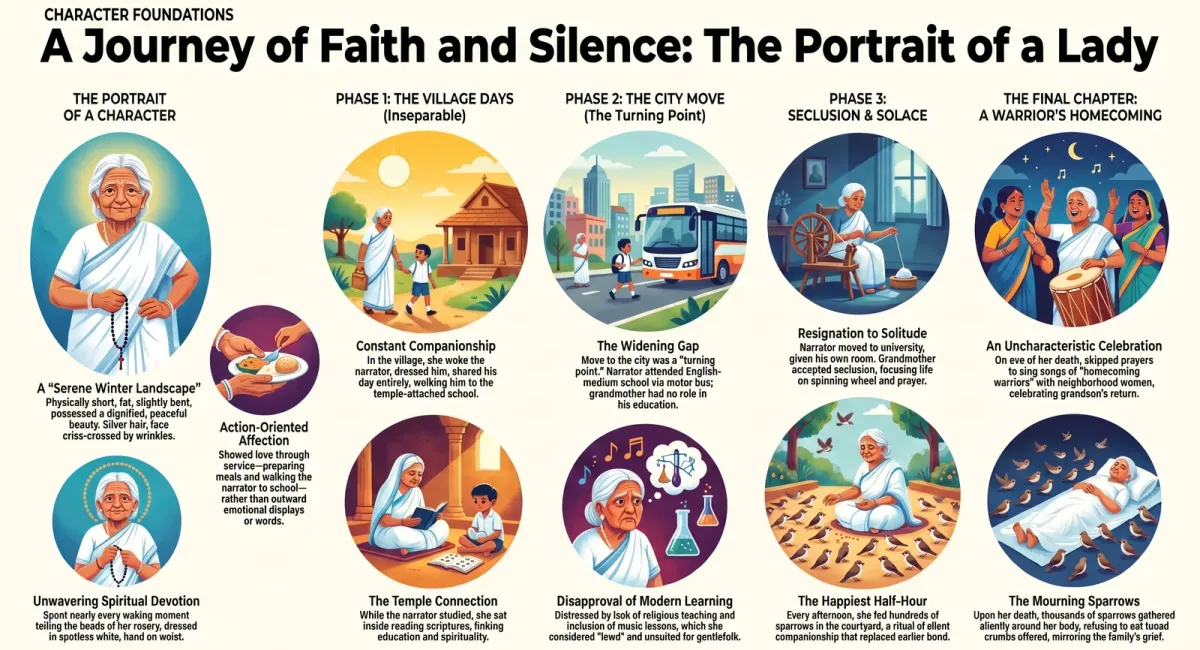
Q1. Describe the narrator’s grandmother’s physical appearance. The grandmother is short, fat, and slightly bent, with a face criss-crossed by wrinkles. Despite never having been conventionally pretty, she carries a serene, dignified beauty — compared in the text to a peaceful winter landscape. She dresses in spotless white and moves through the house with one hand resting on her waist for balance.
Q2. Why did the grandmother stop accompanying the narrator to school after the move to the city? In the city, the narrator attended an English-medium school reached by motor bus, unlike the village school attached to the temple where his grandmother used to sit and pray while he studied. The new school setup left no role for her to walk alongside him, marking what the text calls a turning point in their friendship.
Q3. What did the grandmother do every afternoon in her later years? She spent her afternoons feeding sparrows in the courtyard, breaking bread into small pieces for them. Hundreds of birds would gather around her, perching on her legs, shoulders, and even her head. This ritual is described as the happiest half-hour of her day.
Q4. How did the grandmother behave on the evening before she died? Uncharacteristically, she skipped her evening prayers. Instead, she gathered the neighbourhood women, brought out an old drum, and sang songs celebrating the homecoming of warriors for hours, until she had to be persuaded to stop.
Q5. Why did the grandmother consider her illness the sign of approaching death? She had missed her prayers for the first time in the narrator’s memory the night before falling ill, and she took this lapse as a sign that the final chapter of her life had arrived, choosing to spend her remaining hours in prayer rather than conversation.
Long Answer Questions (5–6 Marks)
Q6. Trace the three phases of the relationship between the narrator and his grandmother, and explain how each phase changed the nature of their bond. The relationship moves through three clear stages. In the village, grandmother and grandson are constant companions — she wakes him, prepares him for school, walks with him, and shares his day almost entirely. When the family moves to the city, this daily partnership breaks down: he attends an English school she cannot accompany him to, and she redirects her attention to feeding sparrows. By university, physical closeness itself fades, and she settles into a solitary but contented routine of spinning and prayer. Each phase marks a further step of separation, yet the essay presents her adaptation with quiet acceptance rather than sorrow, underlining her inner strength.
Q7. “My grandmother accepted her seclusion with resignation.” Discuss this statement with reference to the text. This line captures the grandmother’s defining trait: an unshakeable calm in the face of growing loneliness. Rather than resisting the narrator’s independence, she reorganises her life around prayer, her spinning wheel, and her sparrows, finding genuine contentment in small, self-sufficient rituals instead of seeking sympathy. This resignation is not passive defeat but quiet dignity, reflecting a personality shaped by deep religious faith and emotional self-reliance.
Q8. What impression do you form of the grandmother’s character based on the essay as a whole? The grandmother emerges as deeply religious, emotionally self-contained, and quietly resilient. She values ritual and routine, disapproves of modern influences such as music lessons, and shows affection through action rather than words — preparing meals, walking her grandson to school, and showing minimal outward emotion even at his departure abroad. Yet beneath this reserve lies deep attachment, visible in her silent kiss on his forehead and her final, uncharacteristic burst of song on the eve of her death.
Q9. Describe the significance of the sparrows in the narrator’s grandmother’s life and in the essay’s conclusion. The sparrows represent companionship that requires no words — an echo of the quiet intimacy the grandmother once shared with her grandson. As that bond fades with distance and growing up, the birds become her chief source of daily joy. Their presence at the essay’s close, gathering silently around her body and refusing the bread offered afterward, mirrors the household’s grief and gives the ending a symbolic quality.
Value-Based / Reflective Questions
Q10. Have you known someone like the narrator’s grandmother? What does this essay teach us about intergenerational relationships? This is a personal-response question with no fixed answer, but strong responses typically discuss how the essay highlights the value of small daily rituals in sustaining relationships, and how physical distance between generations does not have to mean emotional distance, provided both sides make space for connection.
Practice Every Question Pattern with ChampionsPrep
Model answers are useful, but timed practice with instant feedback is what builds real exam confidence. ChampionsPrep’s AI-powered question banks cover every pattern CBSE Class 11 examiners use — short answer, long answer, and value-based — with detailed explanations for each response. Registration is completely free, and you pay only as you use the platform. Start practising The Portrait of a Lady and the rest of your Hornbill syllabus today at app.championsprep.in .
Test Your Knowledge
Important Questions and Answers: The Portrait of a Lady
Frequently Asked Questions
What type of questions are most commonly asked from this chapter? +
Mention-based recall questions on the three relationship phases, reasons for the grandmother's disapproval of city schooling, and long-answer character analysis questions are the most frequently tested.
Is this chapter asked as a value-based question in CBSE exams? +
Yes, examiners often include a reflective question asking students to relate the essay's themes of ageing, loss, and companionship to their own family experiences.
How should I structure a 5-6 mark answer for this chapter? +
Begin with a one-line thesis, follow with 3–4 supporting points drawn from different parts of the essay, and close with a brief concluding observation about theme or character.
What is the most important theme to revise for this chapter? +
The changing nature of companionship across the three phases of the relationship, and the grandmother's quiet acceptance of solitude, are the two most exam-relevant themes.
Should I memorise exact lines from the text for exams? +
Understanding events and their significance matters more than memorising exact wording; CBSE evaluators reward clear, well-organised answers in the student's own words.
Keep practising English
AI-powered feedback and structured revision for English — free to start, at your own pace.
AI-powered practice — free to start