
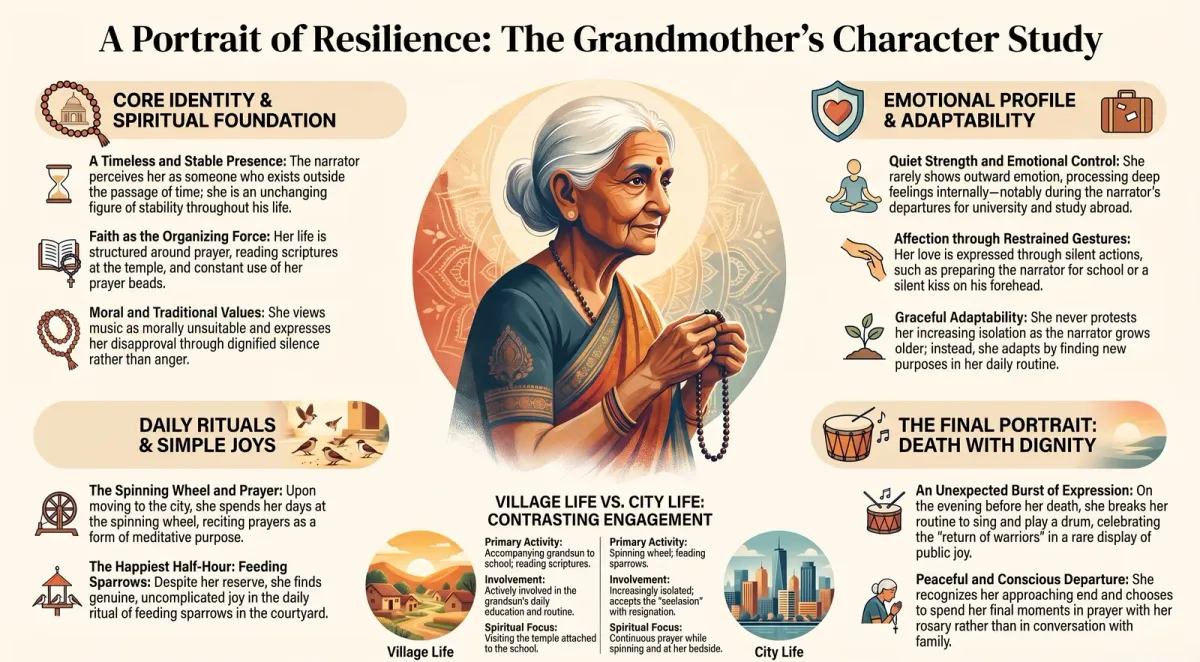
Character sketch questions are a guaranteed feature of the CBSE Class 11 English exam, and few characters in the Hornbill syllabus offer as much material as the grandmother in Khushwant Singh’s “The Portrait of a Lady.” Never named, she emerges as one of the most fully realised figures in the textbook — dignified, devout, and quietly resilient. This post breaks down her character trait by trait, with textual support for exam answers.
A Timeless, Unchanging Presence
One of the essay’s most distinctive choices is how it describes the grandmother as having always been old — the narrator cannot picture her as young, despite knowing she was once a girl herself. This detail establishes her as a figure of stability and continuity in the narrator’s life, someone who exists outside the usual passage of time even as everything around her changes. It is a subtle but important characterisation technique worth mentioning in analytical answers.
Deep and Unwavering Religious Faith
Faith is the organising force of the grandmother’s entire life. She recites her morning prayers each day, spends her time at the village school reading scripture while her grandson studies the alphabet, and later structures her days around prayer and her spinning wheel once the family moves to the city. Her disapproval of music lessons stems directly from this faith — she associates music with a lifestyle she considers morally unsuitable, and her silence in response is a controlled, dignified expression of disagreement rather than an angry outburst. Even in her final hours, she chooses prayer over conversation, believing it more important to make peace with her approaching death than to spend her remaining time talking to her family.
Quiet Strength and Emotional Self-Control
The grandmother rarely displays outward emotion, even at moments that would seem to call for it. When the narrator leaves for university and again when he departs for five years of study abroad, she shows almost no visible sentiment — no tears, no dramatic farewell. Instead, her feelings surface in small, restrained gestures: a silent kiss on his forehead, fingers moving through her prayer beads. This emotional reserve is not coldness; it reflects a personality that processes deep feeling internally rather than performing it outwardly, a trait many CBSE answers describe as “quiet strength of character.”
Adaptability Without Complaint
As the narrator grows older and drifts further from her — first through his city schooling, then through university, then through years abroad — the grandmother never protests or expresses resentment about her increasing isolation. Instead, she adapts each time, finding new sources of companionship and purpose: feeding sparrows in the city courtyard, spending long hours at her spinning wheel, immersing herself more deeply in prayer. This capacity to accept change with dignity, rather than clinging to what has been lost, is arguably her most admirable trait, and examiners frequently ask students to discuss it directly.
A Capacity for Simple, Genuine Joy
Despite her general reserve, the grandmother is shown experiencing clear, uncomplicated happiness in small rituals — most memorably, her afternoons spent feeding sparrows, described as the happiest half-hour of her day. This detail humanises her and shows that her calm exterior does not mean an absence of joy; rather, she finds contentment in modest, repeatable pleasures rather than dramatic events. It is a useful counterpoint for students who might otherwise describe her only as stern or distant.
An Unexpected Burst of Expression Before Death
The grandmother’s character takes a striking turn on the evening before she falls ill for the final time. Breaking from her usual restraint, she gathers the neighbourhood women, brings out an old drum, and sings for hours in celebration of returning warriors — the only time in the narrator’s memory that she skips her prayers. This moment reveals a more expressive, even joyful side of her personality that had been present all along but rarely shown, making her final days feel like a culmination of her character rather than a simple decline.
Facing Death with Calm Acceptance
True to her character throughout the essay, the grandmother meets her death with the same composure she has shown in every other transition of her life. She recognises the signs, quietly withdraws from ordinary conversation, and spends her final hours in prayer, dying peacefully with her rosary in hand. This ending reinforces the essay’s central impression of her: a woman whose inner strength and faith allowed her to face every change in life, including its end, without fear or complaint.
Summary of Key Traits
-
Timeless and stable presence in the narrator’s life
-
Deeply religious, using prayer and ritual to structure her days
-
Emotionally reserved but capable of deep, quiet affection
-
Adaptable, meeting change and isolation with acceptance rather than protest
-
Capable of simple joy, especially through her daily ritual with the sparrows
-
Composed and dignified in facing her own death
Master Character-Based Answers with ChampionsPrep
Character sketch questions carry significant weight in CBSE exams, and strong answers need specific textual detail, not vague generalisations. ChampionsPrep’s AI-powered question banks for CBSE Class 11 English include targeted character analysis practice with model answers and instant feedback, helping you build exam-ready responses efficiently. Registration is free, and you only pay as you use the platform. Start practising today at https://app.championsprep.in .
Test Your Knowledge

Grandmother in The Portrait of a Lady: A Character Study
Frequently Asked Questions
What are the grandmother's main character traits in The Portrait of a Lady? +
She is deeply religious, emotionally reserved yet affectionate, adaptable in the face of change, and calm and dignified, especially when confronting isolation and death.
How does the grandmother show her love for her grandson? +
She expresses love through actions rather than words — preparing him for school, walking him to the temple school, and showing small physical gestures like a silent kiss before his departure abroad.
Why does the grandmother disapprove of music lessons? +
She associates music with a lifestyle she considers unsuitable for respectable families, and her disapproval is expressed through silence rather than direct confrontation.
What does the grandmother's behaviour on the night before her death reveal about her character? +
It reveals a more expressive, joyful side of her personality, showing that her usual restraint coexisted with deep emotion that occasionally found direct expression.
Is the grandmother a static or dynamic character? +
She is largely a static character in terms of core values, but the essay shows her adapting her daily routines and sources of companionship as her circumstances change over time.
AI-powered practice — free to start