
CBSE Class 11 English exams don’t only test comprehension — they also assess vocabulary, word usage, and grammar directly through the “Working with Words” and “Noticing Form” exercises attached to each Hornbill chapter. Chapter 1, built around “The Portrait of a Lady,” is particularly rich in this respect, covering multi-sense words, manner-of-walking vocabulary, and the past perfect tense. This guide organises these language concepts into a clear, revision-friendly format.
Words and Phrases to Know
Before diving into the exercises, it helps to be comfortable with some of the essay’s more descriptive expressions, since CBSE often tests inferred meaning from context rather than dictionary definitions alone.
-
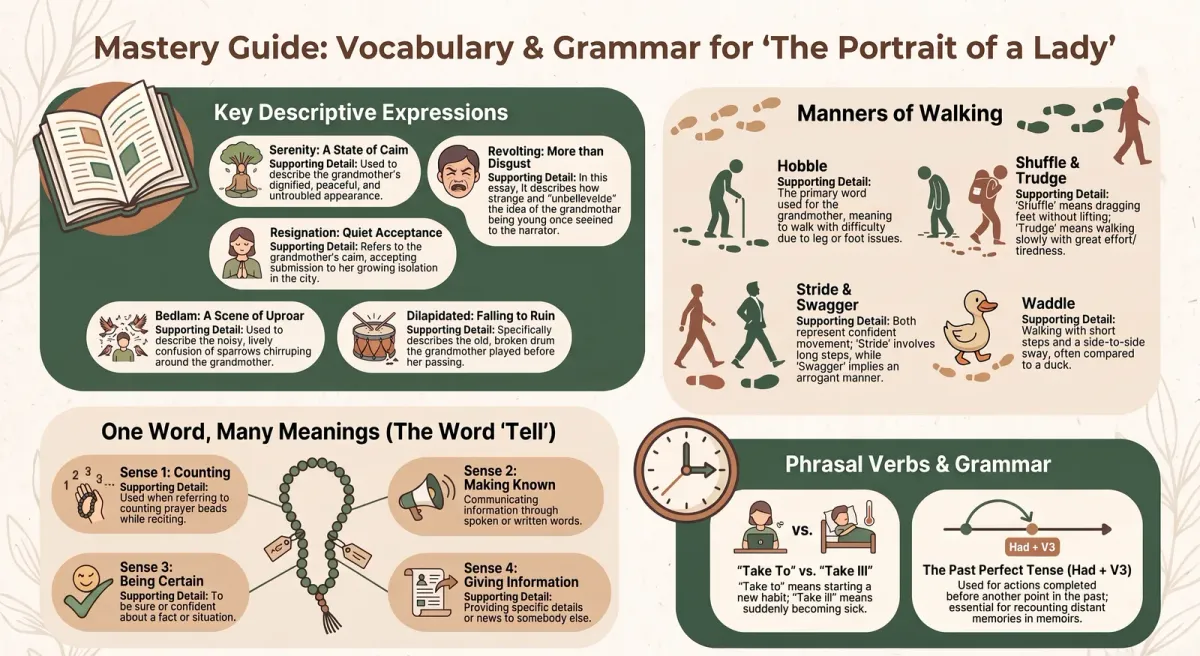
Revolting: causing strong distaste or disgust; used in the essay to describe how strange the idea of the grandmother once being young seemed to the narrator.
-
Serenity: a state of being calm, peaceful, and untroubled; used to describe the grandmother’s dignified appearance.
-
Turning-point: a moment at which a decisive change occurs; used to mark the shift in the narrator’s relationship with his grandmother after the family’s move to the city.
-
Resignation: calm, accepting submission to something inevitable or unwelcome; used to describe how the grandmother accepted her growing isolation.
-
Bedlam: a scene of uproar and confusion; used to describe the lively chirruping of sparrows gathered around the grandmother.
-
Frivolous: not serious or sensible; carefree in a light-hearted way; used to describe the grandmother’s playful scolding of her sparrows.
-
Dilapidated: falling into disrepair or ruin; used to describe the old drum the grandmother plays on the night before her death.
Understanding how each of these words functions in context — not just their dictionary meaning — is exactly what CBSE’s “infer meaning from context” exercises are designed to test.
Multiple Senses of the Word “Tell”
One of the chapter’s key vocabulary exercises asks students to distinguish between different senses of the word “tell” as it appears across the essay. The four senses tested are: to count while reciting (as in counting prayer beads), to make something known through spoken or written words, to be certain or sure about something, and to give information to somebody. Recognising which sense applies in a given sentence depends entirely on context — the same word can carry very different meanings depending on how it’s used, which is precisely the skill CBSE aims to build with this exercise.
The Phrasal Verb “Take”
The chapter also highlights two specific senses of “take” that appear in the text: “to take to” something, meaning to begin doing it as a new habit, and “to take ill,” meaning to suddenly become sick. Both are useful additions to a student’s active vocabulary, since phrasal and idiomatic verb forms like these appear frequently in CBSE’s grammar and usage sections, not just in this chapter.
Words for Manner of Walking
The essay describes the grandmother’s distinctive way of moving through the house using the word “hobble,” meaning to walk with difficulty due to problems with the legs or feet. The textbook exercise then asks students to identify other words describing specific manners of walking from a mixed list. Words genuinely describing a manner of walking include shuffle (dragging the feet without lifting them fully), stride (walking with long, confident steps), waddle (walking with short steps and a side-to-side sway, like a duck), swagger (walking in a confident, arrogant manner), and trudge (walking slowly and with effort, often when tired). Words like haggle, ride, paddle, and slog are not manner-of-walking verbs in the same sense, and distinguishing them is the point of the exercise.
Grammar Focus: The Past Perfect Tense
“Noticing Form,” the chapter’s grammar-focused section, draws attention to the frequent use of the past perfect tense throughout the essay — verb forms like “had been,” “had known,” and “had finished.” This tense is used specifically to describe an action or state that was completed before another point in the past, which makes it the natural choice for a memoir-style essay recounting distant memories. When practising this tense, it helps to build your own example sentences using a similar structure: a past perfect action that took place before a simple past action, such as recalling something that had already happened by the time a specific past event occurred.
Why Vocabulary Practice Matters for This Chapter
CBSE’s language-based questions from Hornbill chapters are often treated as “easy marks” by students who focus only on comprehension, which means they’re also easy marks to lose through carelessness. Practising word-in-context questions, multi-sense vocabulary, and grammar forms specific to each chapter is one of the most efficient ways to secure consistent scores across your English paper.
Build Strong Vocabulary Skills with ChampionsPrep
Vocabulary and grammar questions reward consistent, chapter-wise practice rather than last-minute cramming. ChampionsPrep’s AI-powered question banks for CBSE Class 11 English include dedicated vocabulary and word-usage questions for every Hornbill chapter, complete with clear explanations. Registration is free, and you only pay as you use the platform, so you can start building strong language skills right away. Visit https://app.championsprep.in to begin.
Test Your Knowledge
Vocabulary and Word Usage from Hornbill Chapter 1: The Portrait of a Lady
Frequently Asked Questions
What are some important vocabulary words from The Portrait of a Lady? +
Key words include revolting, serenity, turning-point, resignation, bedlam, frivolous, and dilapidated, each carrying specific contextual meaning within the essay.
What are the four senses of "tell" tested in this chapter? +
To count while reciting, to make something known through speech or writing, to be certain about something, and to give information to somebody.
What does "hobble" mean, and how is it used in the essay? +
"Hobble" means to walk with difficulty due to problems with the legs or feet, and it is used to describe how the grandmother moved through the house.
Which words in the textbook's list genuinely describe a manner of walking? +
Shuffle, stride, waddle, swagger, and trudge are genuine manner-of-walking words, unlike haggle, ride, paddle, and slog.
Why does this chapter use the past perfect tense so often? +
Because the essay recounts distant memories, the past perfect tense is used to show actions or states that were completed before another point in the past being described.
AI-powered practice — free to start