
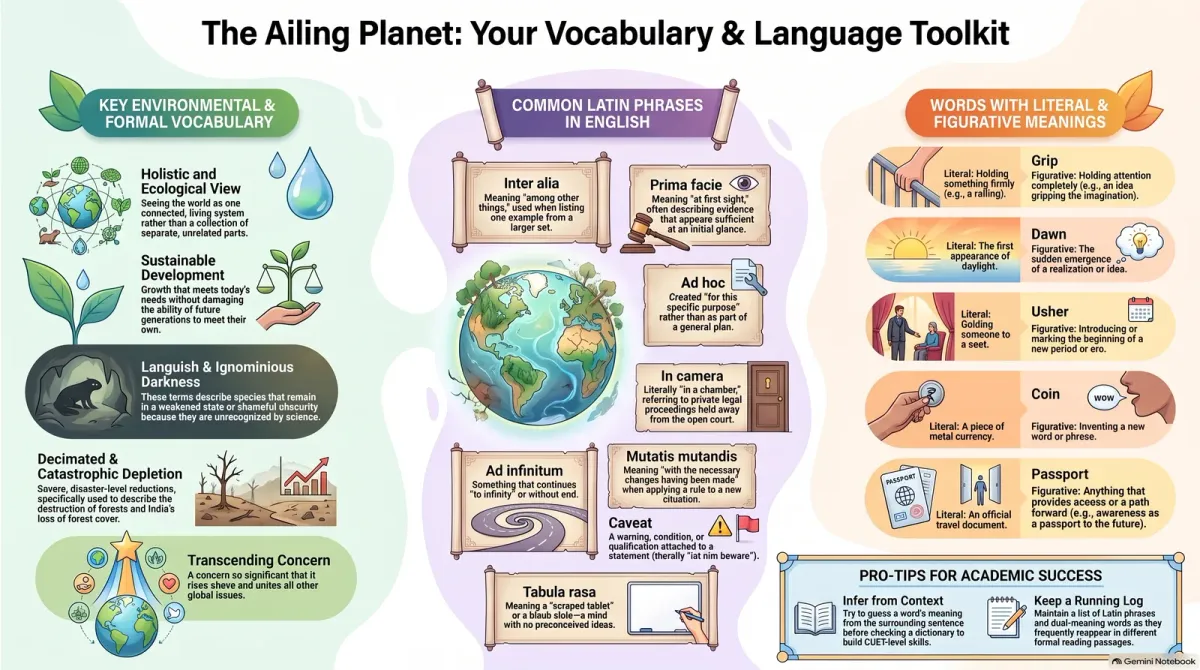
CBSE Class 11 Hornbill Chapter 4, “The Ailing Planet: the Green Movement’s Role,” is rich in formal vocabulary, borrowed Latin expressions and words that carry both literal and figurative meanings. Strengthening your grasp of this language is not just useful for the chapter’s “Working with Words” and “Thinking about Language” exercises, it also builds the kind of vocabulary that pays off across every reading comprehension and writing task in your exam.
Key Vocabulary from the Chapter
Before reading the essay, students are asked to notice several expressions and infer their meaning from context. Here is what each one means and how it functions in the essay.
A holistic and ecological view refers to seeing the world as one connected, living system rather than as a collection of separate, unrelated parts.
Sustainable development means growth and progress that meets today’s needs without damaging the ability of future generations to meet their own needs.
Languish means to remain in a weakened, neglected or forgotten state, used in the essay to describe undiscovered species.
Ignominious darkness describes a state of shameful obscurity or neglect, in this case, species that remain unnamed and unrecognised by science.
Inter alia is a Latin phrase meaning “among other things,” used when listing one example from a larger set.
Decimated means severely reduced in number or destroyed, used in the essay to describe the destruction of forests for firewood.
Catastrophic depletion refers to an extremely severe, disaster-level reduction, describing the loss of India’s forest cover.
Transcending concern describes a concern so significant that it rises above and unites all other concerns, here, the shared global concern for the planet’s survival.
Common Latin Phrases Used in English
The chapter’s “Thinking about Language” section introduces “inter alia” as one of many Latin phrases that have become part of everyday English usage, particularly in legal, academic and formal writing. Here are several more worth knowing.
Prima facie means “at first sight” or “on first appearance,” often used to describe evidence that appears sufficient at an initial glance.
Ad hoc means “for this specific purpose,” describing something created or done for a particular situation rather than as part of a general plan.
In camera literally means “in a chamber,” and is used to describe proceedings, especially legal ones, conducted privately rather than in open court.
Ad infinitum means “to infinity” or “without end,” used to describe something that continues indefinitely.
Mutatis mutandis means “with the necessary changes having been made,” used when applying a rule or comparison to a new situation with appropriate adjustments.
Caveat means “let him beware,” commonly used in English to mean a warning, condition or qualification attached to a statement.
Tabula rasa literally means “scraped tablet” and is used to describe a mind or situation with no preconceived ideas, as if starting from a blank slate.
Legal, business and academic writing in English borrows heavily from Latin, and recognising these phrases will help you read a wide range of formal texts, from newspaper editorials to CUET comprehension passages, with greater confidence.
Words with Literal and Figurative Meanings
The chapter also draws attention to words that carry both a literal, physical sense and a figurative, extended sense. Understanding both uses sharpens your ability to interpret tone and meaning in formal writing.
Grip, in its literal sense, means to hold something firmly, as in gripping a railing. Figuratively, it means to hold someone’s attention completely, as in a movement that grips the imagination of a nation.
Dawn, literally, refers to the first appearance of daylight. Figuratively, it describes the sudden emergence of an idea or realisation in someone’s mind, as when an awareness dawns upon a person.
Usher, literally, means to guide someone into a place, as an usher does at a wedding or theatre. Figuratively, it means to introduce or mark the beginning of a new period, as in ushering in a new era.
Coin, literally, refers to a piece of metal currency. Figuratively, it can mean to invent a new word or phrase that becomes widely used, or to describe a phrase that has passed into common usage.
Passport, literally, is an official travel document. Figuratively, it refers to anything that provides access or a path forward, as when the essay describes environmental awareness as a passport for the future.
Tips for Building This Kind of Academic Vocabulary
When you encounter an unfamiliar word or phrase in a formal essay, try to infer its meaning from the surrounding sentence before checking a dictionary. This mirrors exactly what the chapter’s pre-reading exercise asks you to do, and it is also the skill CUET and other comprehension-based exams test directly. Keep a running list of Latin expressions and dual-meaning words as you encounter them across chapters, since these tend to reappear in unrelated reading passages throughout the year.
Related Reading
-
The Ailing Planet: The Green Movement’s Role — Summary and Analysis
-
The Ailing Planet — Important Questions and Answers for CBSE Class 11
Study Smarter with ChampionsPrep
Want structured vocabulary practice alongside every CBSE Class 11 English chapter? ChampionsPrep is free to register, and you pay only as you use the platform — no subscriptions, no hidden costs. Sign up today and make vocabulary-building part of your daily exam prep.
Test Your Knowledge

Vocabulary and Language Skills in The Ailing Planet
Frequently Asked Questions
What does "sustainable development" mean in The Ailing Planet? +
It means development that meets present-day needs without compromising the ability of future generations to meet their own needs.
What does the Latin phrase "inter alia" mean? +
It means "among other things," used to introduce one example from a larger group without listing everything.
What is the figurative meaning of "dawned upon" as used in the essay? +
Figuratively, it means an idea or realisation suddenly became clear to someone, rather than describing an actual sunrise.
Why does the chapter ask students to study Latin phrases like "prima facie" and "ad hoc"? +
Because these phrases are widely used in formal, legal and academic English, and recognising them improves comprehension of similar texts in exams.
What does "catastrophic depletion" refer to in the essay? +
It refers to the severe, disaster-level loss of India's forest cover described in the essay's discussion of deforestation.
Keep practising English
AI-powered feedback and structured revision for English — free to start, at your own pace.
AI-powered practice — free to start