
Paired with Nani Palkhivala’s essay in CBSE Class 11 Hornbill Chapter 4 is a short, reflective poem titled “Childhood” by Markus Natten. Where the essay examines the health of the planet, the poem turns inward, examining the quiet, almost unnoticed moment when childhood itself disappears. This post walks through the poem stanza by stanza and unpacks its central ideas without reproducing its exact lines, so that you understand the poem well enough to write confident, original exam answers.
About the Poem
“Childhood” is structured as a series of questions the speaker asks himself, each one probing a different possible moment when his childhood ended. Rather than answering definitively, the poem circles the question from several angles, intellectual, moral and psychological, before arriving at a wistful, inconclusive close. This questioning structure is itself part of the poem’s meaning: growing up is not a single event but a gradual, hard-to-pinpoint process.
Stanza-Wise Analysis
Stanza One: Losing Childhood Certainties
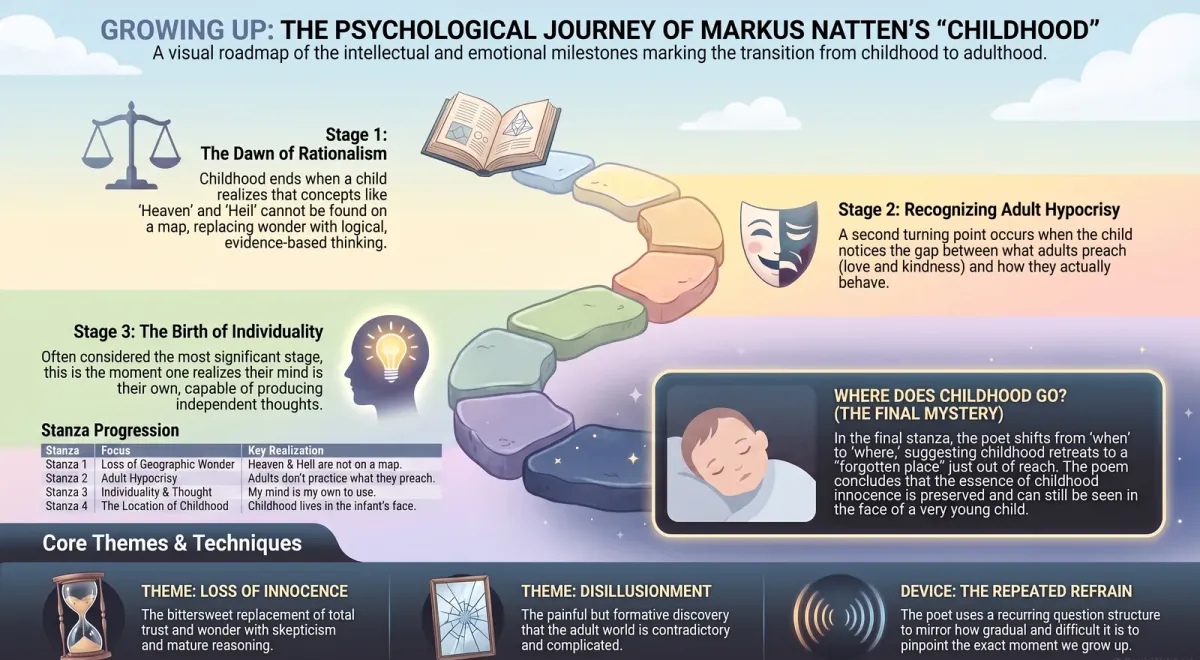
The poem opens with the speaker asking when his childhood went. He raises two possibilities: that it ended on the day he stopped being eleven, or when he realised that heaven and hell could not be found in geography, that they could not be located anywhere in the physical world he was learning about in school. This stanza captures the moment a child’s imaginative, literal belief in fantastical ideas gives way to a more rational, evidence-based way of thinking. It represents the first stage of growing up: the replacement of childhood wonder with logical understanding.
Stanza Two: Discovering Adult Hypocrisy
In the second stanza, the speaker recalls realising that grown-ups did not always practise what they preached. Adults spoke often of love and claimed to value it, yet their actions did not always match their words. This disillusionment, seeing the gap between what adults say and what they do, marks a second possible ending point for childhood. It reflects a child’s dawning awareness that the adult world is more complicated, and sometimes more contradictory, than it first appears.
Stanza Three: Discovering an Independent Mind
The third stanza shifts from disappointment to a kind of quiet empowerment. The speaker recalls the moment he realised his mind belonged entirely to him, free to be used however he chose, capable of producing thoughts that were genuinely his own rather than borrowed from others. This marks the emergence of individuality and independent thought, the ability to reason, judge and believe for oneself rather than simply absorbing what one is told. Many readers consider this the poem’s most significant turning point, since it captures the birth of a distinct, self-aware identity.
Stanza Four: Where Does Childhood Go?
The final, shorter stanza shifts from “when” to “where.” The speaker no longer asks which moment ended his childhood but wonders where it has actually gone. His answer is deliberately vague and gentle: it has retreated to some forgotten place, one that can still be glimpsed in the face of a very young child. The poem closes without certainty, suggesting that childhood is never entirely lost, only hidden, preserved somewhere just out of reach.
Themes of the Poem
The Loss of Innocence
At its heart, the poem explores how belief, trust and wonder are gradually replaced by scepticism and reasoning as a person matures, a loss that is bittersweet rather than purely negative.
Disillusionment with the Adult World
The gap between what adults say and how they behave is presented as a formative, if painful, discovery for every growing person.
The Birth of Individuality
Perhaps the most hopeful theme in the poem is the emergence of independent thought, the moment a person begins to think for themselves rather than simply repeating what they have been taught.
The Repeated Question
Structurally, each of the first three stanzas opens with the same question about when childhood went, and each closes by asking whether that was the day it ended. This repetition reinforces the poem’s central uncertainty. The speaker keeps proposing possible endings to childhood without ever settling on one, mirroring how gradual and hard to pin down the process of growing up really is.
Poetic Devices Worth Noting
The poem relies on rhetorical questions throughout, which invite the reader to reflect on their own experience of growing up rather than simply absorbing the speaker’s conclusions. Its simple, conversational language stands in contrast to the weighty ideas it explores, making the poem accessible while still emotionally resonant. The shift in the final stanza, from asking when childhood ended to asking where it went, is a subtle but important structural device, moving the poem from a search through time to a search through space.
Related Reading
Study Smarter with ChampionsPrep
Looking for more poem-by-poem breakdowns and practice questions for CBSE Class 11 English? ChampionsPrep is free to register, and you pay only as you use the platform — no subscriptions, no hidden fees. Sign up today on ChampionsPrep to build exam-ready confidence, one chapter at a time.
Test Your Knowledge
Childhood by Markus Natten — Summary and Analysis
Frequently Asked Questions
Who wrote the poem "Childhood" in CBSE Class 11 Hornbill? +
The poem was written by Markus Natten and appears alongside Nani Palkhivala's essay in Hornbill Chapter 4.
What are the three main stages of growing up described in the poem? +
The poem describes losing childhood beliefs about the world, discovering that adults do not always act on what they preach, and realising one's mind is independent and capable of original thought.
What does the final stanza suggest about where childhood goes? +
It suggests childhood retreats to a forgotten place that can still be glimpsed, faintly, in the face of a young child, leaving the question ultimately unresolved.
Which stanza in the poem deals with individuality? +
The third stanza deals with individuality, describing the moment the speaker realises his mind and his thoughts belong entirely to him.
What poetic technique does the poet use to structure the poem? +
The poet uses a repeated question-and-refrain structure across the stanzas, which reinforces the poem's central theme that growing up cannot be traced to one single, definite moment.
Keep practising English
AI-powered feedback and structured revision for English — free to start, at your own pace.
AI-powered practice — free to start