
On the surface, “Deep Water” tells a simple story — a boy nearly drowns, grows afraid of water, and later learns to swim properly. But the essay’s enduring popularity in the CBSE Class 12 English Flamingo syllabus comes from the layered themes William O. Douglas weaves through this personal experience. Board exams frequently test these themes directly, so understanding them in depth — rather than just remembering the plot — is essential for scoring well in long-answer questions.
The Nature and Power of Fear
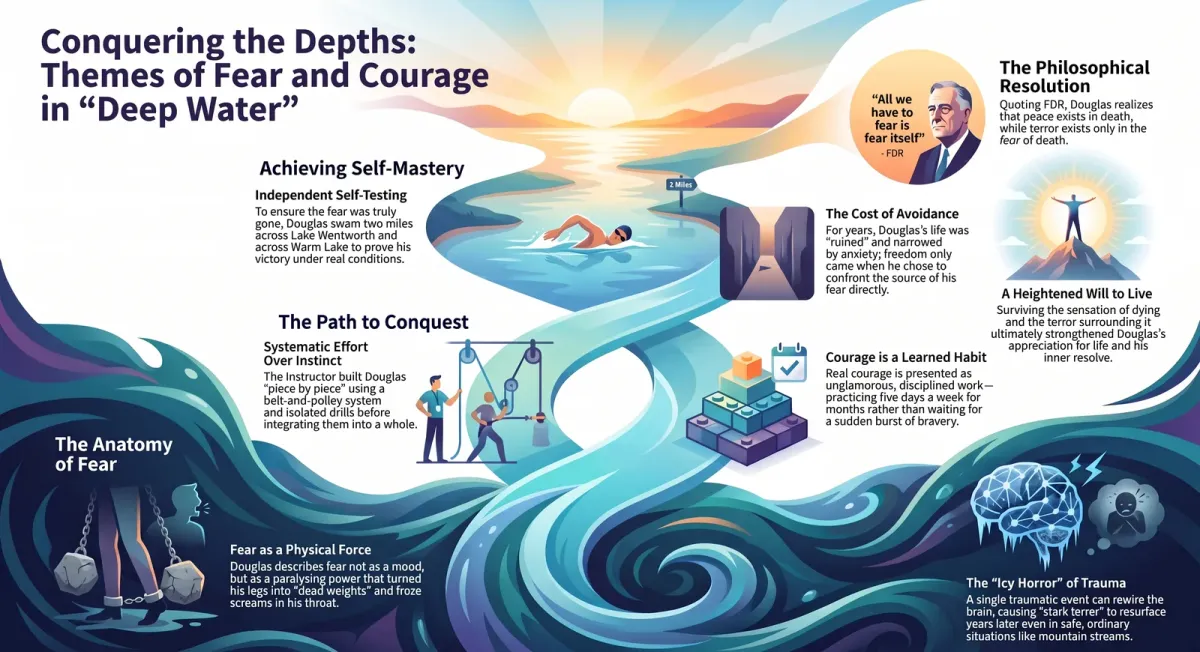
The most obvious theme in “Deep Water” is fear itself — not just an emotion, but a physical, almost paralysing force. Douglas describes his legs turning into “dead weights, paralysed and rigid” and his screams “frozen” in his throat even as he tries to call for help. This is not ordinary nervousness; it is what he calls “sheer, stark terror… that knows no understanding, terror that knows no control.” By dwelling on these physical details, Douglas shows that fear is not simply “in the mind” — it can override the body’s own instincts for self-preservation. The theme resurfaces years later, when even a mountain stream can trigger the same paralysis and “icy horror,” showing how deeply a single traumatic event can rewire a person’s response to an ordinary situation.
Courage as a Deliberate, Learned Process
Just as important is Douglas’s portrayal of courage — and crucially, he does not present it as a sudden burst of bravery. Real courage here looks almost unglamorous: hiring an instructor, showing up five days a week for months, practising the same breathing and kicking drills over and over. His eventual triumph is not a single heroic act but the sum of many small, disciplined choices. This is an important distinction for students: the chapter suggests courage is less about the absence of fear and more about a willingness to face a feared situation again and again, in carefully managed steps, until it loses its power.
Willpower and Self-Discipline
Closely tied to courage is the theme of willpower. Even after his formal lessons end and the instructor declares him able to swim, Douglas is not satisfied — he still wonders whether he would panic again if left alone. Rather than accepting the instructor’s word, he designs his own escalating tests: swimming alone in the pool, then two miles across Lake Wentworth using every stroke he knows, and finally a complete swim across Warm Lake high in the Cascades. This self-imposed testing shows a mind unwilling to settle for partial victory — true self-mastery requires proving to oneself, repeatedly and under real conditions, that the old fear no longer holds power.
Facing the Past Instead of Avoiding It
A subtler theme is the cost of avoidance versus the value of confrontation. For years, Douglas simply avoided water wherever possible, and the essay is honest about what this took from him — the joy of canoeing, boating, swimming, and fishing trips “ruined” by anxiety. Only when Douglas actively chooses to confront the source of his fear, rather than continuing to work around it, is he finally freed. This carries an implicit lesson: unresolved fear does not simply fade with time; it quietly narrows a person’s life until it is deliberately addressed.
The Larger Meaning of Fear and Death
Douglas closes the essay by connecting his personal ordeal to a much larger idea, quoting Franklin D. Roosevelt’s famous words, “All we have to fear is fear itself.” He reflects that in death there is peace, and that terror exists only in the fear of death — a fear he had now experienced and survived. This turns the essay from a simple childhood memory into a philosophical reflection: because Douglas had felt both the sensation of dying and the terror surrounding it, his will to live grew stronger, not weaker, afterward. This theme elevates “Deep Water” beyond an ordinary survival story into a meditation on how confronting our deepest fears, rather than avoiding them, can ultimately strengthen our appreciation of life itself.
Systematic Effort Over Instinct
Finally, the essay quietly celebrates method over instinct. The instructor’s approach — belt and pulley, controlled breathing, isolated kicking drills, and only then full swimming — reflects a broader idea: complex problems, including deeply irrational fears, respond best to patient, structured effort rather than a single dramatic gesture. Douglas notes that the instructor built him as a swimmer “piece by piece” before integrating those pieces into a whole. This theme has practical relevance well beyond swimming: it models how any seemingly impossible challenge can be broken into manageable stages and mastered gradually.
Why These Themes Matter for CBSE Exams
CBSE Class 12 board papers regularly ask students to discuss the theme of “conquering fear” with reference to specific incidents, or to explain how Douglas’s struggle mirrors a universal human experience. Answers that only summarise the plot tend to score lower than those connecting textual details — the paralysed legs, the belt-and-pulley training, the Lake Wentworth test, the Roosevelt quotation — to these underlying themes.
Related Reading
-
Deep Water Summary and Analysis – CBSE Class 12 English Flamingo Chapter 3
-
Deep Water Character Sketch: William Douglas, His Parents, and the Swimming Instructor
Start Learning Smarter with ChampionsPrep
Struggling to connect textual details to themes for full marks? ChampionsPrep gives CBSE Class 11 and 12 Commerce students structured, theme-wise study material for every Flamingo chapter. It is free to register & pay as you use — so you only pay for what you actually need. Register free at ChampionsPrep and turn theme analysis into exam-ready answers.
Test Your Knowledge

Themes in Deep Water: Fear, Courage, and Self-Conquest
Frequently Asked Questions
What is the central theme of Deep Water? +
The central theme is the conquest of fear — specifically, how a childhood trauma created a lasting fear of water, and how deliberate, disciplined effort was needed to overcome it.
How does Douglas show that fear is a physical force, not just a feeling? +
He describes his legs becoming paralysed and rigid and his screams freezing in his throat, showing that fear physically overrides the body's normal responses.
Why is courage in Deep Water shown as gradual rather than sudden? +
Douglas overcomes his fear through months of structured swimming lessons and repeated self-testing, showing that courage in the essay is built through sustained effort, not a single brave moment.
What does the Roosevelt quotation add to the essay's themes? +
It connects Douglas's personal battle with fear to a universal idea — that the real danger is not the feared thing itself but the fear surrounding it, and that facing this fear strengthens the will to live.
Why is testing himself at Lake Wentworth and Warm Lake important to the theme of self-conquest? +
These self-imposed tests show that true victory over fear requires proving the fear is gone under real, independent conditions, not simply completing formal lessons.
Keep practising English
AI-powered feedback and structured revision for English — free to start, at your own pace.
AI-powered practice — free to start