
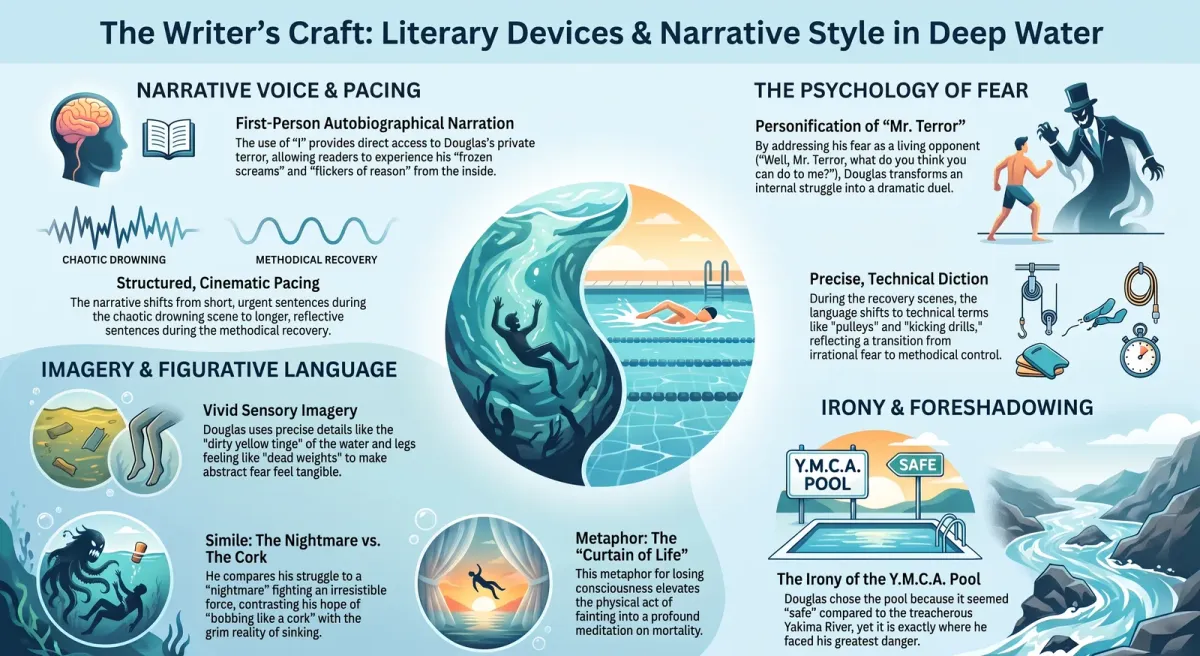
Part of what makes “Deep Water” so memorable is not just what happens in the essay, but how William O. Douglas tells it. The near-drowning scene is written with a control and intensity that turns a personal memory into gripping prose. Examining the literary devices and narrative choices Douglas uses helps students both appreciate the writing and answer figure-of-speech style questions that regularly appear in exams.
First-Person Autobiographical Narration
The essay is written entirely in the first person, drawing directly from Douglas’s own memory as an adult looking back on a childhood trauma. This narrative choice matters: it allows readers direct access to his private terror in a way a third-person account never could. When he describes his screams freezing in his throat or the “touch of reason” that flickers through his panic, the reader is placed inside his experience rather than observing it from outside. This intimacy is part of why the essay reads less like a factual report and more like a psychological account of survival.
Vivid Sensory Imagery
Douglas relies heavily on sensory detail to recreate the physical experience of near-drowning. He does not simply say the water was murky — he specifies its “dirty yellow tinge.” He does not just say he was scared — he describes his legs as “dead weights, paralysed and rigid.” This precision of imagery is what allows readers to feel the scene rather than merely follow it. The same technique appears later in his description of the recurring fear in the mountains, where “icy horror” grabbing his heart makes an abstract emotion feel almost tangible.
Simile and Metaphor
Douglas uses figurative language at the most intense moments of the narrative to capture experiences that plain description cannot fully convey. His struggle underwater is compared to “one in a nightmare [who] fights an irresistible force” — a simile that captures both the physical futility of his effort and its dreamlike, disorienting quality. Elsewhere, he had originally imagined he would “bob to the surface like a cork,” a simile that ironically sets up how badly reality would differ from his expectation. The recurring image of “the curtain of life” falling is a metaphor for approaching unconsciousness and, symbolically, approaching death — a phrase that elevates a physical event into something closer to a meditation on mortality.
Personification of Fear
One of the essay’s most striking stylistic choices is the way Douglas treats his fear almost as a living opponent. During his recovery, he addresses “the old terror” directly, telling it, “Trying to scare me, eh? Well, here’s to you! Look!” Later, in the middle of Lake Wentworth, he calls his fear “Mr Terror” and challenges it aloud: “Well, Mr Terror, what do you think you can do to me?” This personification transforms an internal psychological struggle into something closer to a dialogue or a duel, giving the essay’s climax — the final conquest of fear — a satisfying, almost dramatic shape.
Structured, Almost Cinematic Pacing
Douglas’s narrative unfolds in clearly defined phases: the calm build-up at the pool, the sudden violence of being thrown in, the extended and increasingly desperate underwater struggle, the aftermath and years of avoidance, the disciplined training, and finally the escalating tests of courage. This structure mirrors a classic narrative arc of crisis, decline, and recovery, but what makes it effective is Douglas’s pacing — short, urgent sentences during the drowning scene (“I opened my eyes and saw nothing but water”) contrasted with longer, more reflective sentences once he begins describing his methodical recovery. This shift in sentence rhythm subtly reinforces the shift from chaos to control.
Precise, Technical Diction During the Recovery Sections
While the drowning scene is emotionally charged, Douglas’s description of his swimming lessons is notably calm and almost technical — belts, pulleys, breathing sequences, kicking drills, the crawl stroke. This deliberate shift in vocabulary, from the chaotic imagery of the drowning to the precise, procedural language of training, reflects the essay’s larger theme: fear is chaotic and irrational, but recovery is methodical and deliberate. The contrast in diction is itself a literary technique that reinforces meaning.
Foreshadowing and Irony
There is a quiet irony built into the essay’s structure: Douglas chooses the Y.M.C.A. pool specifically because it seems safer than the treacherous Yakima River his mother warned him about — yet it is in this “safe” pool that he nearly drowns. This early detail, easy to overlook on a first reading, becomes ironic in hindsight and adds a layer of tension for readers who notice it, reinforcing the idea that danger cannot always be avoided simply by choosing what appears to be the safer option.
Why Style Matters for Exam Answers
CBSE board papers frequently ask students to identify or explain the effect of specific expressions from “Deep Water,” or comment on how the writer builds tension in the drowning scene. Strong answers go beyond naming a device — they explain what effect it creates and why Douglas might have chosen it at that moment.
Related Reading
-
Deep Water Summary and Analysis – CBSE Class 12 English Flamingo Chapter 3
-
Deep Water Character Sketch: William Douglas, His Parents, and the Swimming Instructor
Start Learning Smarter with ChampionsPrep
Want to master figure-of-speech and style-based questions across every Flamingo chapter? ChampionsPrep offers AI-powered, exam-mapped notes built for CBSE Class 11 and 12 Commerce students. It is free to register & pay as you use — so you only pay for what you actually need. Register free at ChampionsPrep and sharpen your literary analysis skills.
Test Your Knowledge

Literary Devices and Narrative Style in Deep Water
Frequently Asked Questions
What narrative point of view does Douglas use in Deep Water? +
Douglas writes in the first person, recounting his own childhood experience as an adult looking back, which creates intimacy and immediacy for the reader.
What is an example of simile in Deep Water? +
Douglas compares his underwater struggle to "one in a nightmare [who] fights an irresistible force," capturing both the physical futility and dreamlike terror of the moment.
How does Douglas use personification in the essay? +
He addresses his fear directly as 'the old terror' and later as 'Mr Terror,' turning an internal psychological struggle into something like a dialogue or confrontation with a living opponent.
Why does the language change between the drowning scene and the training scenes? +
The drowning scene uses urgent, sensory, chaotic language, while the training scenes use calm, precise, technical language, reflecting the shift from irrational fear to disciplined recovery.
What irony is present in Douglas's choice of the Y.M.C.A. pool? +
Douglas chooses the pool because it seems safer than the treacherous river, yet it is in this supposedly safe pool that he nearly drowns, creating a quiet irony in the essay's structure.
Keep practising English
AI-powered feedback and structured revision for English — free to start, at your own pace.
AI-powered practice — free to start