
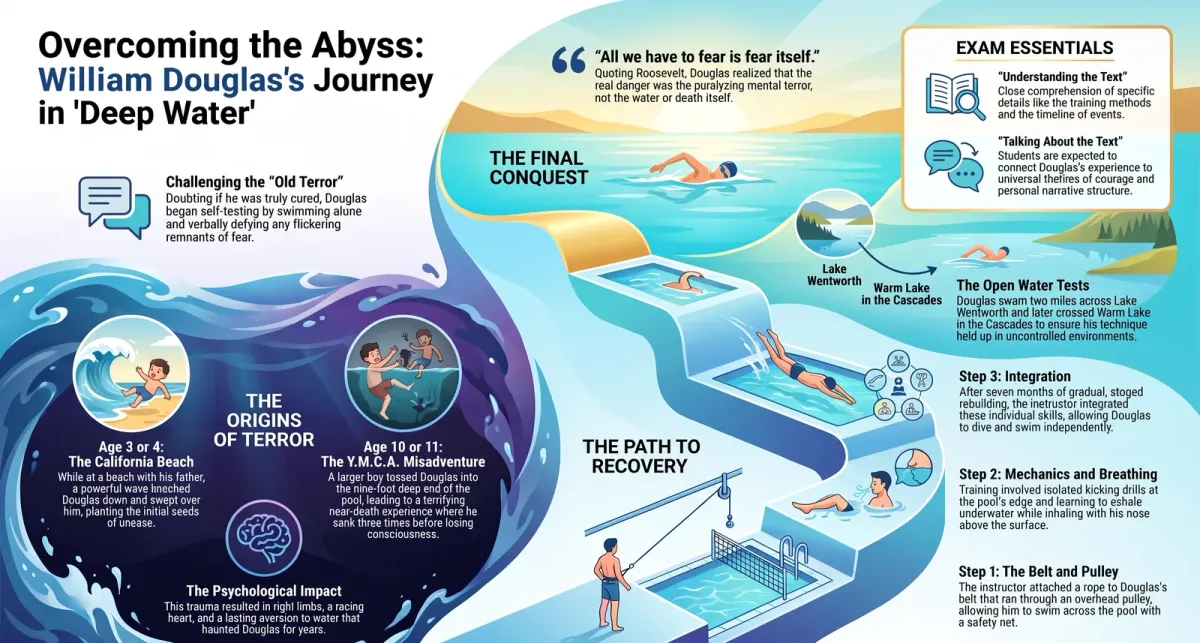
The end-of-chapter exercises in “Deep Water” fall into two sections — Understanding the Text, checking close comprehension, and Talking About the Text, connecting themes to personal experience. This guide walks through both with clear, exam-ready explanations in original wording, so CBSE Class 12 students can build strong written answers rather than memorised lines.
Understanding the Text
1. How did Douglas’s fear of water begin, and how did it deepen?
Douglas’s aversion to water traces back to when he was three or four, at a beach in California, where a wave knocked him down and swept over him — worse in memory because his father laughed while he felt real terror. This early unease hardened into full trauma years later, around age ten or eleven, when an older boy at the Y.M.C.A. pool threw him into the deep end without warning. Sinking repeatedly, feeling his legs go rigid, and nearly losing consciousness cemented water as a source of genuine terror rather than simple childhood caution.
2. Describe the “misadventure” that gave Douglas his fear of water.
The misadventure happened on a quiet day when few people were at the pool. An older, bigger boy called out “Hi, Skinny! How’d you like to be ducked?” and threw Douglas into the nine-foot end without warning. Douglas sank to the bottom, formed a plan to jump up and paddle to safety, but a powerful force pulled him back under each time he tried to rise. He sank three times, experiencing uncontrollable terror and a strange, comforting vision of arms like his mother’s just before he blacked out. He was pulled out vomiting beside the pool, while the boy responsible dismissed it by saying he “was only fooling.”
3. How did the instructor’s training help Douglas overcome his fear?
The instructor used an entirely different approach from the sudden, careless throw that caused the original trauma. Training took place five days a week for an hour, and was deliberately slow: a belt attached to a rope through an overhead pulley let Douglas be guided safely across the pool; this was followed by breathing practice — face underwater to exhale, nose raised to inhale — and then kicking drills at the pool’s edge. Only after months of this staged rebuilding did the instructor allow him to dive off and swim independently, using the crawl stroke. The method worked because it replaced sudden shock with gradual, controlled exposure.
4. How did Douglas make sure he had truly conquered his old terror?
Formal lessons alone did not satisfy Douglas, because he still doubted whether he would panic if left completely alone in the water. So he devised his own escalating tests: swimming by himself and talking back to any flicker of the old fear; travelling to Lake Wentworth, New Hampshire, and swimming two miles across open water using every stroke he had learned; and finally swimming across Warm Lake in the Cascade Mountains, just as a confident local swimmer once had. Only after this final swim, shouting with joy as the mountain returned his echo, did he feel certain the fear was genuinely gone.
5. Why does Douglas quote Roosevelt’s words, “All we have to fear is fear itself,” and what does this mean here?
Douglas uses this quotation to summarise the essay’s central insight: the true danger was never the water, but the paralysing terror it produced in his mind. He extends the idea further, reflecting that in death itself there is a kind of peace, and that real terror lies only in the fear of death. Because he had experienced both the sensation of dying and the terror surrounding it, and survived both, his will to live afterward grew stronger. The quotation elevates his childhood story into a broader statement about facing one’s deepest fears.
Talking About the Text
1. Discuss a personal experience of fear that you later overcame.
This is a personal, discussion-based question with no single “correct” answer. A strong response follows the same structure Douglas uses: describe how the fear began through a specific incident, explain its effect on daily life, and describe the concrete steps taken to overcome it. Examiners look for a clear narrative arc and honest reflection over a dramatic story.
2. Was it a good idea for Douglas to test himself repeatedly even after his formal lessons ended?
Most well-reasoned answers agree this was wise, because formal instruction only proves a skill can be performed under supervised conditions — it does not prove the underlying fear has disappeared. By seeking harder, independent situations, Douglas tested not just his technique but his psychological state, ensuring the “old terror” would not resurface later. Genuine mastery of any fear usually requires testing it under real conditions, not just controlled ones.
A Note on These Answers
These solutions use original explanatory language, best treated as a model for structuring your own answers — combining specific textual details with clear, connected reasoning, which is exactly what CBSE examiners reward.
Related Reading
-
Deep Water Summary and Analysis – CBSE Class 12 English Flamingo Chapter 3
-
Deep Water Character Sketch: William Douglas, His Parents, and the Swimming Instructor
Start Learning Smarter with ChampionsPrep
Want fully worked, exam-ready NCERT solutions for every Flamingo chapter, not just Deep Water? ChampionsPrep gives CBSE Class 11 and 12 Commerce students AI-powered study material mapped directly to the syllabus. It is free to register & pay as you use — so you only pay for what you actually need. Register free at ChampionsPrep and get every chapter’s solutions in one place.
Test Your Knowledge

Deep Water NCERT Solutions – Understanding the Text and Talking About the Text
Frequently Asked Questions
How many main sections are there in the Deep Water NCERT exercises? +
The exercises are divided mainly into Understanding the Text, which tests comprehension of the essay, and Talking About the Text, which connects the essay's themes to personal experience and discussion.
What is the best way to answer Understanding the Text questions for Deep Water? +
Combine specific details from the essay — such as the belt-and-pulley training method or the Lake Wentworth swim — with clear explanations in your own words, rather than simply repeating the plot.
Is there a single correct answer for the Talking About the Text questions? +
No, these questions are personal and discussion-based, so examiners look for a clear, honestly structured response rather than one fixed 'correct' answer.
Why is the Roosevelt quotation important in the NCERT solutions for this chapter? +
It ties Douglas's personal ordeal to a universal idea about fear and death, and examiners often expect students to explain its meaning rather than just identify it as a quotation.
Should NCERT answers for Deep Water be memorised word for word? +
No — examiners generally reward genuine understanding and original phrasing over mechanically memorised answers, which often fail to address the specific wording of a question.
Keep practising English
AI-powered feedback and structured revision for English — free to start, at your own pace.
AI-powered practice — free to start