
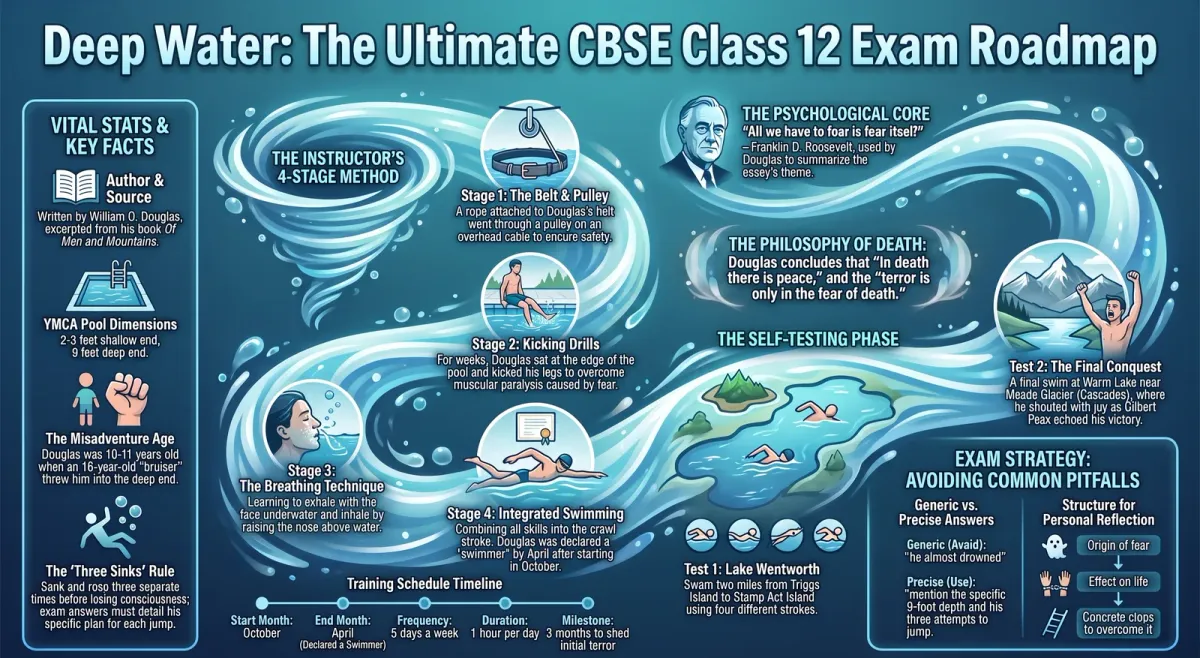
“Deep Water” is a short chapter, but it packs in enough plot detail, thematic depth, and quotable lines that students often lose marks by writing vague, generic answers instead of precise, textually grounded ones. This final post pulls together the most exam-relevant angles on the chapter — the question types CBSE typically asks, the details worth memorising, and a quick checklist for last-minute revision.
How CBSE Typically Tests This Chapter
Board papers on “Deep Water” fall into a few recurring patterns. Short-answer questions (2–3 marks) test direct comprehension: what happened at the pool, how deep it was, what the instructor did first, or what Douglas said during his final swim. Long-answer questions (5–6 marks) ask students to trace a process in detail — how the instructor “built a swimmer,” how Douglas made sure he had truly conquered his fear, or how the essay’s imagery makes the drowning scene vivid. A smaller but recurring category asks for personal reflection, connecting Douglas’s experience to the student’s own life, such as describing a time they overcame a fear themselves.
Important Questions Worth Preparing in Detail
The following categories cover the questions most likely to appear on a CBSE Class 12 English paper for this chapter:
On the misadventure itself: Be ready to narrate the incident in your own words, including the exact plan Douglas made on his way down, the three separate times he sank, and the comforting image he saw before losing consciousness. Vague summaries (“he almost drowned”) lose marks — specific sequence and sensory detail earn them.
On the instructor’s method: Examiners frequently ask students to trace the stages of training step by step. List, in order: the belt-and-pulley system for crossing the pool safely, the breathing technique (face underwater to exhale, nose raised to inhale), kicking drills at the edge, and independent swimming with the crawl stroke. Remember the timeframes too — five days a week for an hour, three months before real progress, and April as the month he was declared able to swim.
On self-testing after training: Questions often ask what tests Douglas set for himself once his formal lessons ended. Be ready to describe at least two: the two-mile swim across Lake Wentworth using four different strokes, and the final complete swim at Warm Lake in the Cascade Mountains.
On the psychological dimension: Be prepared to explain quotations like “In death there is peace. There is terror only in the fear of death,” and to discuss how the essay portrays fear as something that must be faced deliberately, not simply endured.
On personal reflection questions: If asked to describe your own experience of overcoming a fear, structure your answer the way Douglas structures his — a specific origin for the fear, its real effect on your daily life, and the concrete steps you took to face it.
Key Facts to Have Ready for Short-Answer Questions
A quick list of details that frequently show up in short-answer and fill-in-style questions:
-
Author: William O. Douglas; source: Of Men and Mountains
-
Y.M.C.A. pool depth: two or three feet at the shallow end, nine feet at the deep end
-
Age at the time of the misadventure: ten or eleven years old
-
The boy who threw him in: about eighteen years old
-
Number of times Douglas sank before losing consciousness: three
-
Month training began: October; month declared able to swim: April
-
Training schedule: five days a week, an hour each day
-
Location of the two-mile swim: Lake Wentworth, New Hampshire (Triggs Island to Stamp Act Island)
-
Location of the final test: Warm Lake in the Cascade Mountains
-
Famous quotation at the close of the essay: Franklin D. Roosevelt’s “All we have to fear is fear itself”
Common Mistakes Students Make
Many students confuse the sequence of events — mixing up the belt-and-pulley stage and the breathing drills, or forgetting that Douglas tested himself independently even after being declared able to swim. Another common error is treating the essay purely as an adventure story and missing its reflective, philosophical close on fear and death. In personal-reflection answers, students often write only a couple of generic lines instead of following a clear beginning-middle-end structure — examiners consistently reward answers with real narrative shape over vague generalisations.
Quick Revision Checklist
Use this checklist before your exam:
-
[ ] Can you summarise the pool misadventure in under 100 words, in the correct sequence?
-
[ ] Can you name all four stages of the instructor’s training method in order?
-
[ ] Can you describe at least two of Douglas’s self-imposed tests after formal training ended?
-
[ ] Can you explain the meaning of “All we have to fear is fear itself” in the context of the essay?
-
[ ] Can you identify at least two literary devices (simile, personification, imagery) with a specific textual example each?
-
[ ] Can you write a five- or six-mark answer connecting a specific incident to the theme of “conquering fear”?
-
[ ] Can you draft a short personal-reflection answer with a clear beginning, middle, and end?
Related Reading
-
Deep Water Summary and Analysis – CBSE Class 12 English Flamingo Chapter 3
-
Deep Water Character Sketch: William Douglas, His Parents, and the Swimming Instructor
-
Deep Water NCERT Solutions – Understanding the Text and Talking About the Text
Start Learning Smarter with ChampionsPrep
Want a personalised revision plan and practice questions for every Flamingo chapter before your exam? ChampionsPrep gives CBSE Class 11 and 12 Commerce students AI-powered, syllabus-mapped revision tools. It is free to register & pay as you use — so you only pay for what you actually need. Register free at ChampionsPrep and walk into your exam fully prepared.
Test Your Knowledge
Deep Water Exam Tips, Important Questions and Revision Checklist
Frequently Asked Questions
What type of questions does CBSE usually ask from Deep Water? +
CBSE typically asks short comprehension questions, long-answer questions tracing a process (like the instructor's training method), and personal-reflection questions connecting the theme to the student's own experience.
What details about the training process are most important to memorise? +
The order of stages — belt-and-pulley crossings, breathing technique, kicking drills, independent swimming — along with the timeframes: five days a week for months, October to April.
What is the most common mistake students make while answering questions on this chapter? +
Students often lose marks by summarising vaguely instead of using specific detail, or by ignoring the essay's reflective ending on fear and death.
How should personal-reflection questions on Deep Water be answered? +
Follow a clear structure similar to Douglas's own account: how the fear began, how it affected daily life, and the specific steps taken to overcome it.
Which quotation from Deep Water is most important to remember for exams? +
Franklin D. Roosevelt's line, 'All we have to fear is fear itself,' is the most referenced quotation and central to the essay's larger meaning.
Keep practising English
AI-powered feedback and structured revision for English — free to start, at your own pace.
AI-powered practice — free to start