
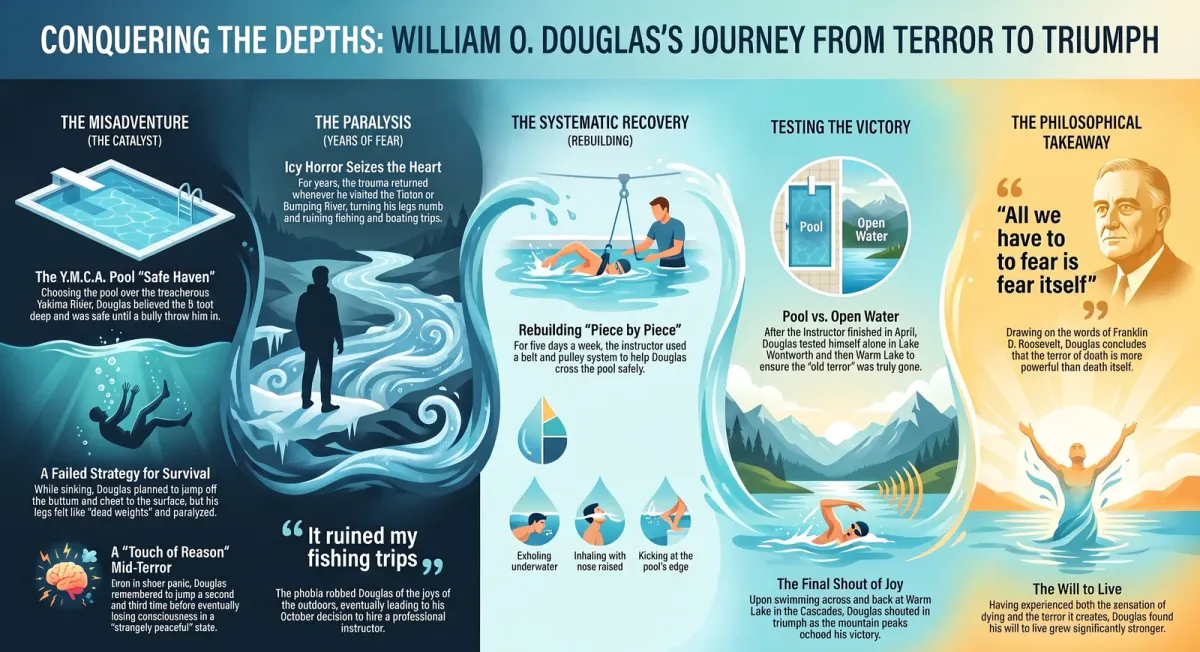
“Deep Water” is one of the most quietly powerful chapters in the CBSE Class 12 English Flamingo textbook. Written by William O. Douglas and drawn from his autobiography Of Men and Mountains, it is the intimate account of a ten- or eleven-year-old boy’s near-drowning, the decades-long fear that followed, and the deliberate, almost scientific process by which he defeated it — making it a favourite source for both short-answer and long-answer board questions.
About the Author: William O. Douglas
William O. Douglas was born in 1898 in Maine, Minnesota, and earned a Bachelor of Arts in English and Economics. Before turning to law, he spent two years teaching high school in Yakima, Washington. It was at Yale that he met Franklin D. Roosevelt, later a close friend whose words on fear Douglas quotes at the essay’s close. Douglas served as a U.S. Supreme Court Justice for thirty-six years — the longest term in the court’s history — before retiring in 1975. “Deep Water” is taken from Of Men and Mountains, reflecting his lifelong love of the outdoors and mountains of the American West.
The Setting: The Yakima River and the Y.M.C.A. Pool
Douglas grew up near the Yakima River in eastern Washington, a tributary of the Columbia River. He describes it as treacherous, and his mother often warned him about people who had drowned there. Because the river felt so dangerous, Douglas chose instead to learn swimming at the local Y.M.C.A. pool — two or three feet deep at one end, deepening to nine feet at the other. The pool he believed safe is where his trauma began, adding irony to the essay’s opening.
The Misadventure at the Pool
Before the incident, Douglas had been building confidence slowly — paddling with a pair of water wings and watching the other boys to learn by imitation. He was self-conscious about his thin legs, but had “subdued his pride” enough to keep returning to the pool. One quiet day, a boy of about eighteen — much older and bigger — came bounding in, called out “Hi, Skinny! How’d you like to be ducked?”, and threw him into the deep end.
What follows is the emotional centre of the essay. Douglas landed sitting down, swallowed water, and sank to the bottom. On the way down, he formed a plan: jump hard off the bottom, shoot to the surface, lie flat, and paddle to the edge. But the plan collapsed — he saw only water with a dirty yellow tinge, and a great force pulled him back under, leaving his legs “paralysed and rigid,” hanging like dead weights. He compares his struggle to a man in a nightmare fighting an unbeatable force, describing the terror as “sheer, stark terror” so total that even his screams froze in his throat.
A brief “touch of reason” returned to him: he remembered he must jump again when he touched the bottom. He did — but it made no difference; the water stayed still around him. He sank a third time, and just before losing consciousness, a strangely peaceful image passed through his mind: tender arms, like his mother’s, holding him. When he came to, he was lying on his stomach beside the pool, vomiting, while the boy who had thrown him in muttered that he “was only fooling.” He was carried to the locker room, and hours later walked home alone, weak and trembling — never returning to that pool again.
Years of Fear
The trauma did not stay in the pool. Years later, in mountain waters he loved — the Tieton, the Bumping River, Warm Lake in the Cascades — the old terror returned without warning, his legs going numb and “icy horror” seizing his heart, ruining fishing trips and robbing him of the joy of canoeing, boating, and swimming.
The Decision to Conquer Fear
One October, Douglas hired a swimming instructor. Five days a week, an hour a day, the instructor rebuilt him “piece by piece” — a belt and overhead pulley for safe crossings, then breathing technique (face underwater to exhale, nose raised to inhale), then kicking drills at the side of the pool. It took three months before the tension began to loosen. In April, the instructor declared him able to swim, and had him dive off and swim the pool’s length using the crawl stroke.
Testing the Victory
Even after formal training, doubt lingered — would he still panic if left alone? Douglas set himself harder tests: swimming alone and talking back to “the old terror,” then two miles across Lake Wentworth, New Hampshire, using every stroke he knew (a flicker of fear returned mid-lake, but he laughed it off). His final test came at Warm Lake near Meade Glacier in the Cascades, where he swam across and back just as Doug Corpron used to do. He shouted with joy, and the nearby peak echoed back — he had conquered his fear of water.
The Larger Meaning
Douglas closes by connecting his private battle to Franklin D. Roosevelt’s famous words: “All we have to fear is fear itself.” In death there is peace, he reflects — real terror lies only in the fear of death. Having experienced both the sensation of dying and the terror around it, his will to live grew stronger than before.
Related Reading
Start Learning Smarter with ChampionsPrep
Want chapter-wise summaries and exam-ready notes for every Flamingo chapter in one place? ChampionsPrep gives CBSE Class 11 and 12 Commerce students AI-powered study tools built around your syllabus. It is free to register & pay as you use. Register free at ChampionsPrep and start preparing smarter today.
Test Your Knowledge

Deep Water Summary and Analysis – CBSE Class 12 English Flamingo Chapter 3
Frequently Asked Questions
Who wrote Deep Water and where is it taken from? +
William O. Douglas wrote it; it is an excerpt from his autobiography, Of Men and Mountains.
What is the central incident in Deep Water? +
As a boy of ten or eleven, Douglas was thrown into the deep end of a Y.M.C.A. pool by an older boy and nearly drowned, leaving him with a lasting fear of water.
How did Douglas overcome his fear of water? +
He hired a swimming instructor, trained systematically for months, then tested himself through increasingly difficult swims in open lakes until certain the fear was gone.
Why does Douglas quote Franklin D. Roosevelt at the end? +
He uses Roosevelt's line 'All we have to fear is fear itself' to show the real enemy was never water but the paralysing fear of it.
Why is Deep Water an important chapter for CBSE Class 12 exams? +
It combines a vivid personal narrative with universal themes of fear, willpower, and self-conquest, making it a frequent source for board questions.
Keep practising English
AI-powered feedback and structured revision for English — free to start, at your own pace.
AI-powered practice — free to start