
Paired with “The Portrait of a Lady” in the CBSE Class 11 Hornbill textbook, Shirley Toulson’s short poem “A Photograph” tackles a similar emotional territory — memory, loss, and the passage of time — but through a completely different lens: an old family snapshot. In just three compact stanzas, the poem moves from a joyful beach holiday captured on film to quiet grief at the speaker’s mother’s death. This guide walks through the poem’s structure, meaning, and literary techniques in a way that’s ready for CBSE exam answers, without reproducing the poem’s original lines.
Background: Who Was Shirley Toulson?
Shirley Toulson was a British poet and writer known for reflective, personal verse. “A Photograph” reads as deeply autobiographical, built around a real family photograph of the poet’s mother as a young girl on a beach holiday with two cousins. The poem is a meditation on how a single image can hold multiple layers of time within it.
Stanza-Wise Summary
Stanza One: The Photograph Itself
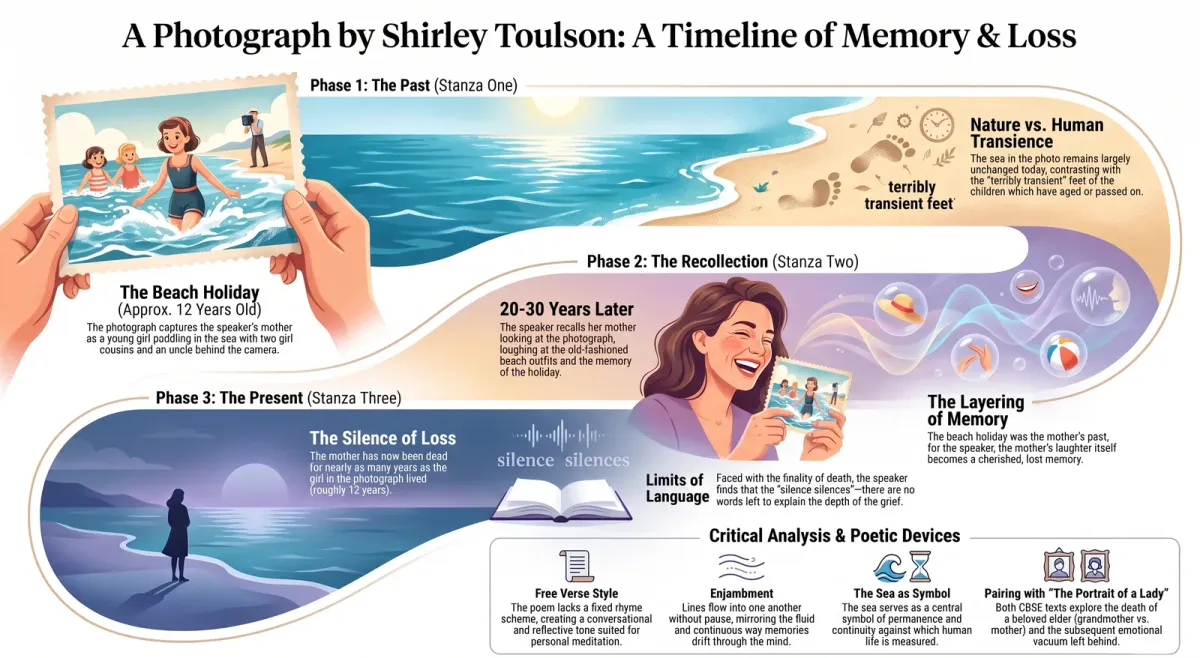
The poem opens with the speaker looking at an old photograph showing her mother as a young girl of about twelve, paddling in the sea on holiday with two girl cousins, all three holding hands. An uncle stands behind the camera taking the picture. The speaker notes that the sea in the photograph looks much the same as it does now, even though the children’s feet — and by extension, their fleeting childhood — have long since moved on. This contrast between the permanence of nature and the transience of human life is the stanza’s central idea.
Stanza Two: The Mother’s Memory of That Day
Years later, the speaker recalls her mother looking back at this same photograph and laughing about the old-fashioned beach outfits she and her cousins wore. For the mother, the photograph represented a fondly remembered past; for the speaker, listening as a child, that same moment becomes a memory of her mother’s laughter rather than of the beach holiday itself. The stanza captures how memory passes between generations — one person’s lived past becomes another person’s secondhand memory.
Stanza Three: The Present, After the Mother’s Death
The final and shortest stanza shifts abruptly to the present, where the speaker reveals that her mother has now been dead for almost as many years as the girl in the photograph had been alive at the time it was taken. Faced with this stark fact, the speaker finds she has nothing more to say — the silence surrounding the loss simply exists on its own terms, needing no further explanation or comment.
Key Themes in A Photograph
-
The passage of time: the poem’s three stanzas mark three distinct time periods — the photograph’s original moment, the mother’s later recollection of it, and the speaker’s present-day grief — showing how time reshapes the meaning of the same image.
-
Memory and inheritance: the poem explores how memories are passed down, changed, and eventually lost between generations, as the speaker’s memory of her mother’s laughter outlives the mother herself.
-
Loss and the limits of language: the poem’s closing lines suggest that some forms of grief are beyond words, and that silence can be more honest than explanation.
-
Nature versus human transience: the unchanging sea in the first stanza is a quiet contrast to the fleeting, ever-changing nature of human life and relationships.
Poetic Devices and Style
Toulson’s poem is written in free verse, without a fixed rhyme scheme, giving it a conversational, reflective tone that suits its subject matter. The poem relies heavily on enjambment — lines that flow into the next without a pause — which mirrors the way memory itself drifts and continues without clean breaks. The image of the sea functions as a symbol of permanence against which the transience of childhood and life is measured. The poem’s final lines are notable for their compression: very few words are used to convey a large emotional weight, reflecting the idea that profound loss often resists elaborate description.
Why This Poem Pairs Well with The Portrait of a Lady
CBSE often tests students on why “A Photograph” is placed immediately after “The Portrait of a Lady” in the textbook. Both texts explore the relationship between memory, ageing, and loss, and both end with the death of a beloved family figure — a grandmother in one case, a mother in the other. Comparing the two helps students appreciate how the same emotional theme can be expressed differently in prose and in poetry.
Strengthen Your Poetry Analysis with ChampionsPrep
Poetry questions often trip up students who focus only on literal meaning and miss the deeper themes and devices examiners look for. ChampionsPrep’s AI-powered practice sets for CBSE Class 11 English include targeted questions on poems like “A Photograph,” complete with detailed explanations that build real analytical skill. Registration is free, and you only pay as you use the platform — so there’s nothing stopping you from starting today. Visit https://app.championsprep.in to practice this poem and the rest of your Hornbill syllabus.
Test Your Knowledge
A Photograph by Shirley Toulson: Summary, Analysis and Poetic Devices
Frequently Asked Questions
What is the central theme of the poem A Photograph? +
The poem explores the passage of time, the nature of memory across generations, and the quiet, wordless grief that follows the loss of a parent.
What does the photograph in the poem show? +
It shows the speaker's mother as a young girl of about twelve, paddling at the beach with two girl cousins, taken by an uncle with a camera.
What does the poem's final image of silence suggest about the speaker's grief? +
It suggests that the depth of the speaker's grief cannot be expressed in words, and that the silence surrounding her mother's death is total and self-contained, leaving nothing more to say.
What is the significance of the sea in the poem? +
The sea represents permanence and continuity, standing in contrast to the fleeting, transient nature of human childhood, memory, and life itself.
What poetic form does Shirley Toulson use in A Photograph? +
The poem is written in free verse with no fixed rhyme scheme, using enjambment to create a natural, reflective, conversational tone.
AI-powered practice — free to start