
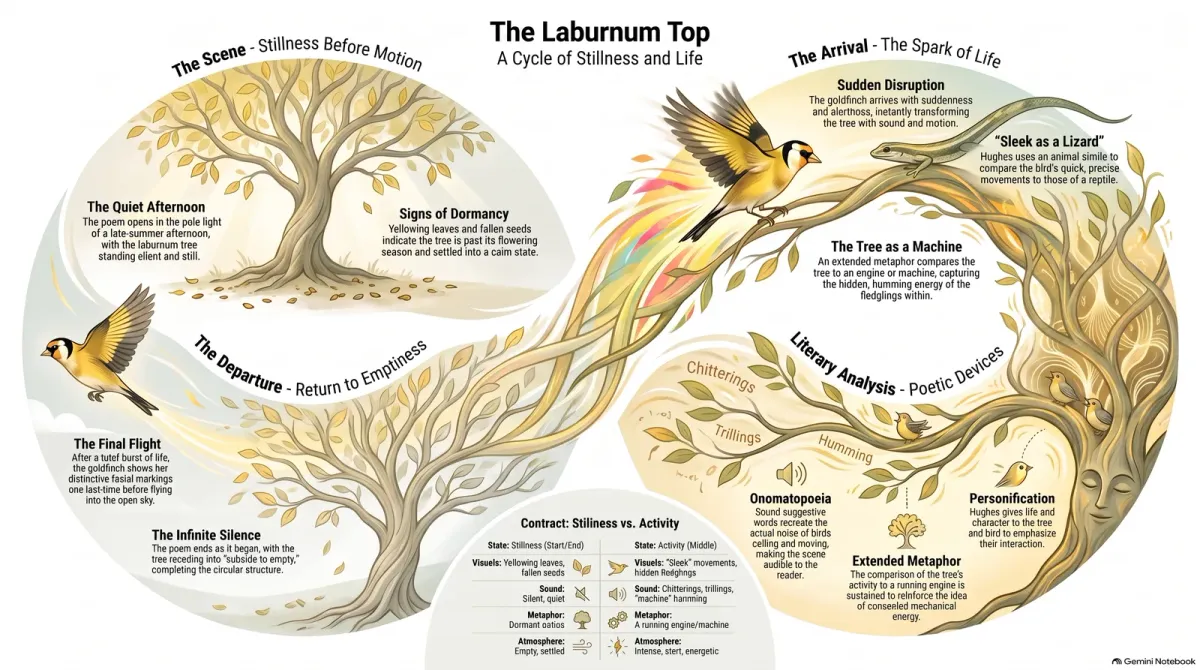
Tucked into Hornbill Chapter 3 right after the story of Tutankhamun’s CT scan is a short but densely packed nature poem: “The Laburnum Top” by British poet Ted Hughes. Where “Discovering Tut” deals with human history and scientific investigation, this poem turns attention to a single, quiet moment in nature — a goldfinch visiting a laburnum tree. This post explains the poem’s structure, its central imagery, and the poetic devices CBSE Class 11 students are expected to identify.
About the Poet and the Poem’s Placement
Ted Hughes was known for nature poetry that captures animals and plants with startling, almost scientific precision, often finding hidden energy or tension in ordinary scenes. The NCERT editors placed “The Laburnum Top” immediately after “Discovering Tut” because both texts, despite their very different subjects, share a thematic thread involving names of plants and living things — the funeral garlands of willow, olive, and lotus in the Tut chapter find a quieter echo in this poem’s focus on a single laburnum tree.
Setting the Scene: Stillness Before Motion
The poem opens by establishing a scene of near-total stillness. A laburnum tree stands quiet in the pale light of a late-summer afternoon, its leaves beginning to yellow and its seeds already fallen — small details that signal the tree is past its flowering season, settled into a kind of dormant calm. This opening stillness is essential to the poem’s structure, because everything that follows depends on disrupting it.
The Arrival of the Goldfinch
The poem’s central event is deceptively small: a goldfinch lands on the tree. Yet Hughes describes this arrival with remarkable intensity, using words that suggest sudden movement, alertness, and barely contained energy. The bird’s presence transforms the tree almost instantly, filling it with sound and motion where there had been none.
The Tree as a Machine: A Central Metaphor
One of the poem’s most striking choices is its comparison of the tree, once the goldfinch and her hidden family become active inside it, to a kind of engine or machine. This is an unusual metaphor for a piece of natural imagery — trees are rarely described in mechanical terms — but it works precisely because it captures something true about hidden, humming activity that isn’t visible from the outside. The comparison suggests barely restrained energy, a system running at full capacity just beneath a calm exterior, much like the fledglings and family life concealed within the tree’s foliage.
The Goldfinch’s Departure and the Tree’s Return to Emptiness
Just as suddenly as she arrived, the goldfinch leaves, offering one last glimpse of her distinctive facial markings before flying off into the open sky. With her departure, the tree loses its brief burst of life and sound, and the poem ends by describing it as returning to emptiness — a deliberate echo of the stillness that opened the poem, creating a circular structure.
Key Poetic Devices to Remember
CBSE Class 11 students are frequently asked to identify literary devices in this poem, and several stand out clearly:
-
Onomatopoeia: Hughes uses sound-suggestive words throughout the poem to recreate the actual noise of birds moving and calling within the tree, making the scene audible as well as visual.
-
Personification and animal simile: The goldfinch’s movements are compared to those of a quick, alert reptile, emphasising her speed and precision.
-
Extended metaphor: The comparison of the tree’s sudden activity to a running engine is sustained across several lines, reinforcing the idea of concealed, mechanical energy.
-
Circular structure: The poem begins and ends with the tree in a state of stillness, framing the goldfinch’s visit as a brief, self-contained burst of life within an otherwise quiet setting.
Why the Poem’s Structure Matters
Students are often asked what they notice about the beginning and ending of the poem. The answer lies in this circular pattern: the tree’s stillness at the start and its return to emptiness at the end frame the entire poem, suggesting that the goldfinch’s visit — however vivid and energetic — is a temporary, fleeting interruption rather than a lasting change. This structural choice reinforces one of the poem’s underlying ideas: that intense bursts of life and energy exist alongside, and eventually return to, quiet and stillness.
Related Reading
Master Poetry Analysis With ChampionsPrep
Poetry questions reward precise identification of devices and structure, not just general appreciation. ChampionsPrep offers targeted practice questions and model answers for every poem in the CBSE Class 11 English Hornbill syllabus, including “The Laburnum Top.” Registration is free, and you only pay as you use the platform, so you can start strengthening your poetry analysis skills today.
Test Your Knowledge
The Laburnum Top by Ted Hughes — Summary, Analysis and Poetic Devices
Frequently Asked Questions
Who wrote "The Laburnum Top" and where does it appear in the CBSE syllabus? +
The poem was written by Ted Hughes and appears in Chapter 3 of the CBSE Class 11 English Hornbill textbook, immediately following the prose piece "Discovering Tut: the Saga Continues."
What is a laburnum, and why does it matter to the poem? +
A laburnum is a small tree with hanging branches, yellow flowers, and poisonous seeds; its quiet, still form at the start of the poem sets up the contrast with the sudden burst of activity that follows.
What central metaphor does the poem use to describe the tree's activity? +
The poem compares the tree, once filled with bird activity, to a machine or engine, suggesting hidden, humming energy beneath a calm exterior.
What is significant about the poem's beginning and ending? +
Both the opening and closing lines describe the tree in stillness, creating a circular structure that frames the goldfinch's visit as a brief, temporary disruption.
Why might this poem have been placed after "Discovering Tut" in the textbook? +
The two texts are thematically linked through references to plants and natural imagery, allowing the anthology to move from a human historical narrative to a quieter, nature-focused poem.
Keep practising English
AI-powered feedback and structured revision for English — free to start, at your own pace.
AI-powered practice — free to start