
“The Ailing Planet: the Green Movement’s Role” is the fourth chapter of the CBSE Class 11 Hornbill textbook. Written by the eminent jurist and economist Nani Palkhivala, this essay was first published in The Indian Express on 24 November 1994. More than three decades later, its warning about the earth’s declining health remains strikingly relevant, which is exactly why it continues to appear in the CBSE syllabus and in competitive exam reading lists.
About the Essay and Its Author
Nani Palkhivala was better known as one of India’s finest legal minds and constitutional experts, but he wrote widely on public affairs, economics and, in this case, the environment. In “The Ailing Planet,” he steps outside strictly legal territory to examine how humanity’s relationship with the earth has changed since the birth of the modern environmental movement. He traces this change back to 1972, when the world’s first nationwide Green party was founded in New Zealand, and argues that no other movement in history has captured global attention so quickly. The essay blends hard data on species, forests and population with philosophical reflection on humanity’s ethical duty toward the planet.
How the Essay Unfolds
Palkhivala structures his argument as a journey: from a changed worldview, through mounting evidence of ecological damage, to a call for collective responsibility.
From a Mechanistic to a Holistic Worldview
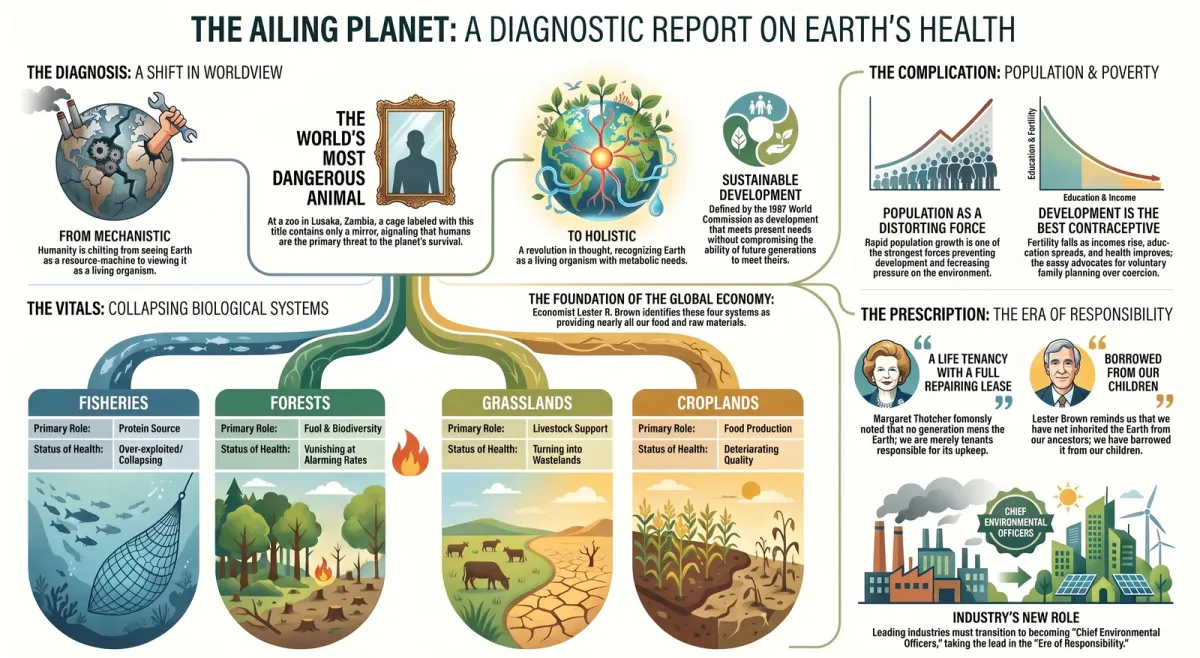
The essay opens by describing a fundamental shift in human perception — from viewing the earth as a machine to be exploited, to seeing it as a living organism with its own needs and processes. Palkhivala compares this shift to the revolution Copernicus caused when he showed that the earth revolves around the sun rather than the other way round. Just as that discovery changed humanity’s place in the universe, the ecological worldview changes humanity’s relationship with its home planet.
The Zoo at Lusaka: A Powerful Parable
One of the essay’s most memorable moments is its description of a cage at a zoo in Zambia labelled “the world’s most dangerous animal.” Inside, visitors find no beast — only a mirror. This simple exhibit captures the essay’s central message: human beings themselves are the greatest threat to the planet, and real change begins with self-recognition. Palkhivala uses this parable to argue that awareness is finally shifting society from a mindset of domination over nature to one of partnership with it.
The Erosion of Earth’s Biological Systems
The essay then turns to evidence. Citing economist Lester R. Brown, Palkhivala explains that fisheries, forests, grasslands and croplands form the foundation of the global economy, supplying food and nearly all industrial raw materials besides minerals and petroleum products. He documents how human demand is pushing these systems past sustainable limits — fisheries are over-exploited, forests are vanishing at an alarming rate worldwide, and India in particular is losing forest cover many times faster than official statistics suggest. He backs these claims with figures from the World Bank, the United Nations, and India’s own Parliamentary Estimates Committee.
The Population Explosion
A large section of the essay is devoted to population growth, which Palkhivala calls one of the strongest forces reshaping human society. He traces how long it took the world to add its first billion people compared to how quickly later billions were added, and connects population pressure directly to poverty, unemployment and environmental strain. He is careful to reject coercive measures like compulsory sterilisation, instead advocating voluntary family planning and pointing out that rising incomes, education and healthcare naturally reduce fertility.
Towards an Era of Responsibility
The essay closes on a note of cautious hope. Palkhivala argues that for the first time in history, humanity shares a “transcending concern” for the survival of the planet itself, not just its people. He calls on industry to lead this shift, citing a DuPont chairman who named himself the company’s “Chief Environmental Officer.” The essay ends with two often-quoted lines — Margaret Thatcher’s remark that no generation owns the earth outright, only a life tenancy with a full repairing lease, and Lester Brown’s observation that we have borrowed the earth from our children rather than inherited it from our ancestors.
Key Themes in The Ailing Planet
Environmental Stewardship
The essay repeatedly frames humans as trustees rather than owners of the earth, responsible for preserving it for future generations rather than extracting maximum short-term value from it.
Sustainable Development
Palkhivala explains the concept as popularised by the 1987 World Commission on Environment and Development — meeting present needs without compromising the ability of future generations to meet theirs. This single idea threads through every section of the essay.
The Role of Industry and Individuals
Rather than treating environmental damage as someone else’s problem, the essay insists that industry, governments and ordinary citizens all share responsibility, and that meaningful change requires all three working together.
Why This 1994 Essay Still Feels Urgent Today
Read today, “The Ailing Planet” feels less like a historical document and more like a preview of ongoing debates around climate change, deforestation and sustainable growth. Palkhivala’s warnings about forest loss and population pressure anticipated concerns that dominate environmental policy discussions decades later, which is exactly why CBSE continues to set this essay for close study — it trains students to read persuasive, evidence-based non-fiction while engaging with issues that remain unresolved.
Related Reading
-
The Ailing Planet — Important Questions and Answers for CBSE Class 11
-
From Innocence to Awareness: Comparing The Ailing Planet and Childhood
Study Smarter with ChampionsPrep
Want chapter-wise question banks, mock tests and detailed explanations for CBSE Class 11 English and all your Commerce subjects? Registration on ChampionsPrep is completely free, and you only pay as you use the platform — no subscriptions, no hidden charges. Sign up today and turn every chapter, including “The Ailing Planet,” into exam-ready confidence.
Test Your Knowledge
The Ailing Planet: The Green Movement's Role — Summary and Analysis
Frequently Asked Questions
Who wrote "The Ailing Planet: the Green Movement's Role" and when was it published? +
The essay was written by Nani Palkhivala and published in The Indian Express on 24 November 1994.
What does the "world's most dangerous animal" at the Lusaka zoo symbolise? +
It symbolises that human beings themselves, through their exploitation of nature, are the greatest threat to the planet's health.
What is sustainable development according to the essay? +
It is development that meets the needs of the present without compromising the ability of future generations to meet their own needs, as defined by the 1987 World Commission on Environment and Development.
How does the essay link population growth to environmental damage? +
Palkhivala argues that rapid population growth increases pressure on forests, fisheries and croplands while deepening poverty, making environmental and demographic problems inseparable.
What is the central message of The Ailing Planet? +
That humanity must shift from viewing the earth as a resource to dominate to seeing it as a living system to be protected, sharing responsibility across individuals, industry and governments.
Keep practising English
AI-powered feedback and structured revision for English — free to start, at your own pace.
AI-powered practice — free to start