
Preparing for your CBSE Class 11 English exam means going beyond a simple reading of “The Ailing Planet: the Green Movement’s Role.” This post works through the essay’s most exam-relevant questions in the style you are likely to face, with model answers that show how to structure a strong response.
Understanding the Text: Key Questions
1. Which lines support the title “The Ailing Planet”?
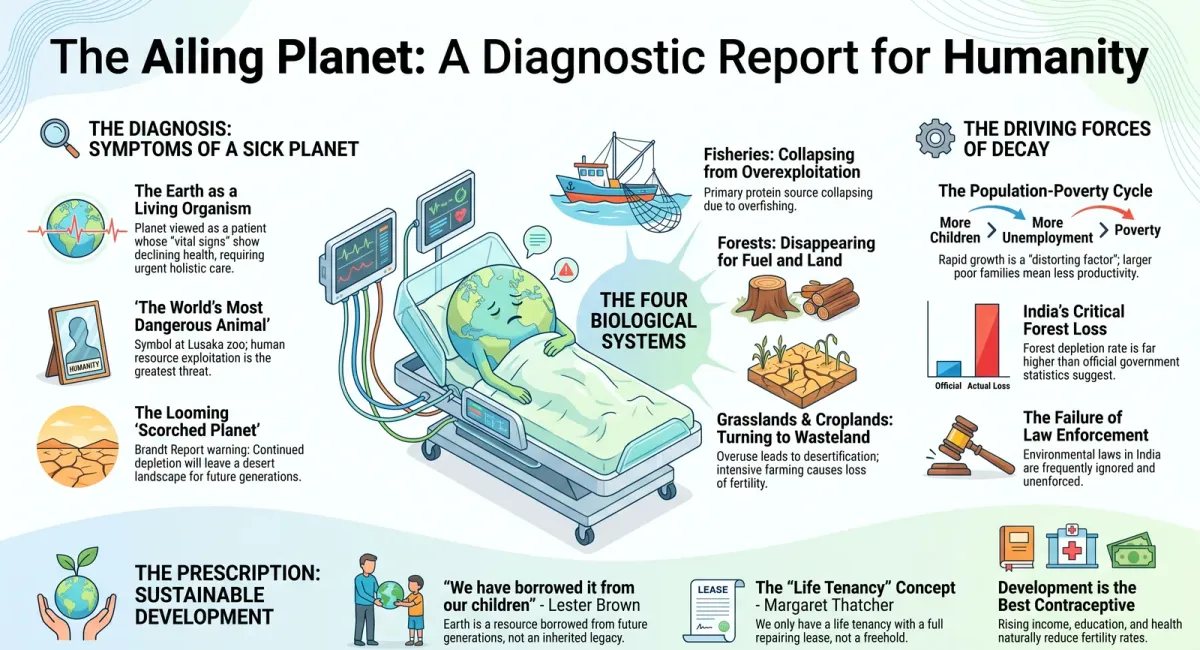
The title reflects the essay’s central metaphor — the earth as a patient in declining health. Palkhivala builds this picture through the description of the earth as a living organism with its own metabolic needs, through evidence of catastrophic forest depletion, and through the argument that its vital signs reveal a patient in declining health. Every major example in the essay, from vanishing forests to overfished seas, adds another symptom to this diagnosis, justifying the title.
2. What does the notice “The world’s most dangerous animal” at the Lusaka zoo signify?
This is one of the most frequently asked questions from the chapter. The cage contains no animal, only a mirror, so that every visitor sees themselves as the answer. The parable signifies that human beings, through their careless exploitation of natural resources, have become the greatest threat to the planet. A strong exam answer should also mention the second half of the point Palkhivala makes: that awareness of this truth is itself driving a shift from a system of domination over nature to one of partnership with it.
3. How are the earth’s principal biological systems being depleted?
Palkhivala, drawing on Lester R. Brown’s writing, identifies fisheries, forests, grasslands and croplands as the four biological systems that form the foundation of the global economy. He explains that human demand on these systems is exceeding sustainable limits in large parts of the world. As a result, fisheries collapse from overfishing, forests are cut down faster than they can regenerate, especially for firewood in poorer countries, grasslands turn into wasteland through overuse, and croplands lose their fertility. A complete answer should mention specific figures the essay provides, such as the accelerating rate of tropical forest loss and India’s disproportionately high rate of forest depletion compared to official statistics.
4. Why does the author say population growth is one of the strongest factors distorting the future of human society?
The essay presents population growth as tightly linked to poverty and unemployment. Palkhivala argues that more children in poor households does not translate into more productive workers but simply into more people without work, deepening the cycle of poverty. At the same time, rising population increases pressure on already-strained biological systems. He balances this concern by rejecting coercive population control and instead calling for voluntary family planning supported by rising incomes, education and healthcare, which naturally reduce fertility over time.
Talking About the Text: Discussion-Based Questions
These questions typically appear as short-answer or discussion prompts and test your ability to connect the essay’s ideas to real-world understanding.
On the enforcement of environmental laws in India
The essay notes that Article 48A of the Constitution directs the state to protect the environment and safeguard forests and wildlife, yet Palkhivala points out that laws in India are frequently not respected or enforced. A good answer draws the parallel he makes with other unenforced constitutional provisions, such as the abolition of untouchability and bonded labour, to show a broader pattern of gaps between law and practice.
On the Brandt Report’s question about a “scorched planet”
The First Brandt Report’s question, whether future generations will inherit a scorched planet of deserts and impoverished landscapes, sets up the essay’s central anxiety. Students should connect this to Palkhivala’s later data on deforestation and species loss as evidence that this concern is not hypothetical but already unfolding.
On “we have not inherited this earth… we have borrowed it from our children”
This closing quotation from Lester Brown, paired with Margaret Thatcher’s remark about a life tenancy, sums up the essay’s argument about intergenerational responsibility. A strong response explains that both quotations reject the idea of ownership in favour of temporary custodianship, reinforcing the essay’s sustainable development theme.
On overpopulation’s everyday impact
Students are encouraged to connect population pressure to visible, local issues such as competition for resources, unemployment and strain on public services, rather than treating it as an abstract statistic.
Exam Tips for Answering These Questions
When answering questions on this chapter, always support your points with the specific facts Palkhivala provides, such as figures, quotations and named sources like Lester Brown, the Brandt Commission and the World Bank, rather than general statements about the environment. Examiners reward answers that show close engagement with the text itself.
Related Reading
Study Smarter with ChampionsPrep
Want a complete question bank with model answers for The Ailing Planet and every other CBSE Class 11 English chapter? ChampionsPrep is free to register, and you pay only as you use the platform — no subscriptions, no hidden costs. Start practising today and walk into your exam prepared.
Test Your Knowledge
The Ailing Planet — Important Questions and Answers for CBSE Class 11
Frequently Asked Questions
What is the most important theme to focus on for exams in this chapter? +
The shift from a mechanistic to a holistic, ecological worldview, along with the linked ideas of sustainable development and shared responsibility, is the theme most frequently tested.
Should I memorise the exact statistics mentioned in the essay? +
It helps to remember a few key figures, such as India's forest depletion rate and world population milestones, since examiners often reward answers that cite specific evidence from the text.
How long should answers to "Understanding the Text" questions be? +
These are typically short-answer questions, so aim for focused, well-organised answers of around 60 to 100 words unless your school specifies otherwise.
Are the closing quotations by Margaret Thatcher and Lester Brown important for exams? +
Yes, these two quotations are frequently asked about because they summarise the essay's core message on intergenerational responsibility.
What approach works best for "Talking about the Text" discussion questions? +
Connect the essay's specific examples to broader real-world contexts, and where relevant, bring in your own reasoned opinion supported by evidence from the text.
Keep practising English
AI-powered feedback and structured revision for English — free to start, at your own pace.
AI-powered practice — free to start