
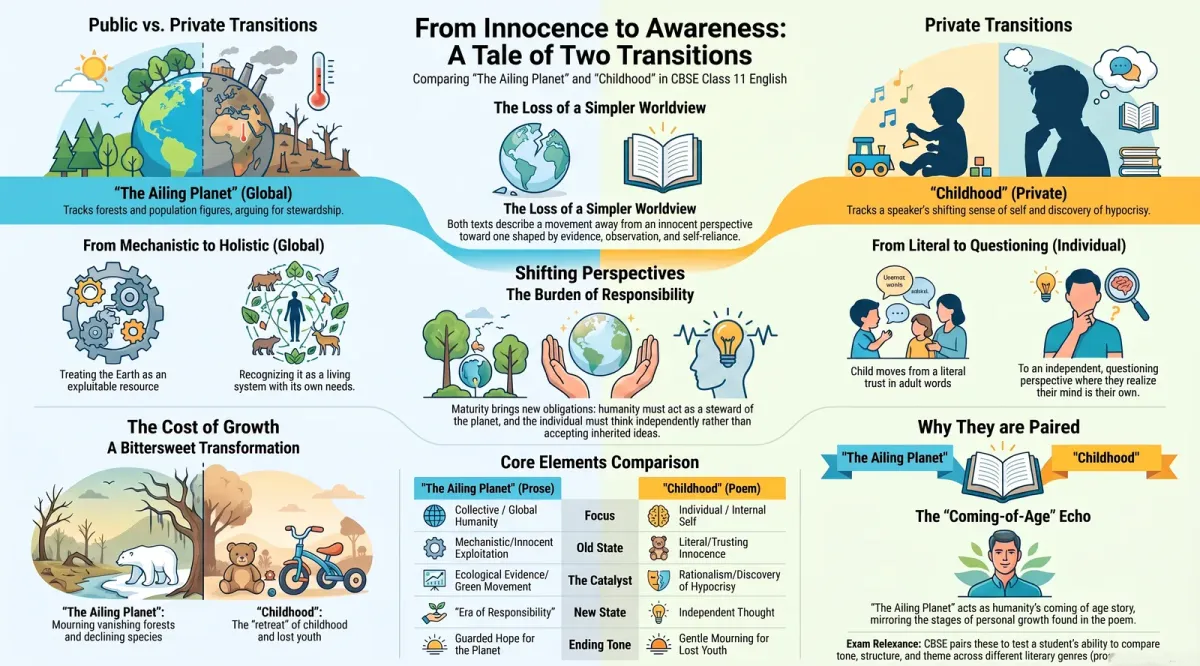
CBSE Class 11 Hornbill Chapter 4 pairs two texts that, on the surface, seem to belong to entirely different worlds: Nani Palkhivala’s essay “The Ailing Planet: the Green Movement’s Role,” a data-driven argument about global environmental decline, and Markus Natten’s poem “Childhood,” a quiet, personal reflection on growing up. Yet CBSE consistently groups prose and poetry together within the same chapter for a reason, and this pairing rewards a closer look. Both texts, in very different registers, trace a journey from unexamined innocence to hard-won awareness.
Two Different Texts, One Chapter
At first glance, the connection between an environmental essay and a poem about personal growth might seem thin. One is public and global, tracking forests, population figures and international commissions. The other is private and internal, tracking a single speaker’s shifting sense of self. But both texts are, at their core, about a loss of an earlier, simpler way of seeing the world, followed by the emergence of a more complex, responsible kind of understanding.
The Theme of Change and Awareness
In “The Ailing Planet,” the change described is collective: humanity moving from a mechanistic view of the earth, treating it as a resource to exploit without limit, to a holistic, ecological view that recognises the planet as a living system with needs of its own. Palkhivala frames this shift as revolutionary, comparable to the Copernican discovery that reordered humanity’s understanding of its place in the universe.
In “Childhood,” the change is individual rather than collective. The speaker moves from a child’s literal, trusting understanding of the world, where heaven and hell might be found on a map, where adults’ words can be taken at face value, to an adult’s more questioning, independent perspective. Both texts, then, describe a movement away from an earlier, more innocent worldview toward one shaped by evidence, observation and self-reliance.
Loss, Discovery and Responsibility
Both texts also share a bittersweet quality: the change they describe is not purely a gain. “The Ailing Planet” acknowledges real losses, vanishing forests, declining species, mounting pressure from population growth, even as it insists that growing awareness offers hope for the future. Similarly, “Childhood” treats the end of childhood not as a triumphant achievement but as something gently mourned, symbolised by the poem’s closing image of childhood retreating to some forgotten place. In both cases, the essay’s call for environmental responsibility and the poem’s arrival at independent thought are framed as necessary but not entirely painless transitions.
Responsibility is the thread that ties the two texts together most tightly. Palkhivala calls for humanity to accept its role as steward of the planet rather than its owner. Natten’s speaker, in discovering that his mind is truly his own, takes on a different but related kind of responsibility, the responsibility of thinking independently rather than simply accepting inherited ideas. Both texts suggest that maturity, whether of a species or an individual, comes with new obligations that cannot be avoided once they are recognised.
How Both Texts Address “Growing Up” — of a Person, and of Humanity
It is possible to read “The Ailing Planet” as humanity’s own coming-of-age story, told on a planetary scale. Just as the poem’s speaker moves through stages, losing childhood beliefs, discovering adult hypocrisy, and finally claiming an independent mind, Palkhivala describes humanity moving through its own stages of environmental awareness, from unconcerned exploitation to a transcending concern for the planet’s survival. Both texts end on notes of guarded hope rather than certainty. The poem does not know exactly where childhood has gone, only that it lingers somewhere; the essay does not claim the environmental crisis is solved, only that an Era of Responsibility has begun.
This structural echo, private growth mirroring public awakening, is likely why CBSE placed these two very different texts side by side. Studying them together sharpens your ability to compare tone, structure and theme across genres, a skill tested directly in the “Talking about the Text” and comparative discussion questions common to school exams.
Why ChampionsPrep Pairs Prose and Poetry Together for Exam Prep
Comparative questions that ask you to connect a chapter’s prose and poetry sections are common in CBSE Class 11 English papers, and students often lose marks by treating the two texts as unrelated. Practising cross-text questions specifically, not just prose questions and poem questions separately, is one of the most effective ways to prepare for this question type.
Related Reading
-
The Ailing Planet: The Green Movement’s Role — Summary and Analysis
-
The Ailing Planet — Important Questions and Answers for CBSE Class 11
Study Smarter with ChampionsPrep
Want more comparative and synthesis-style practice questions across every CBSE Class 11 English chapter? ChampionsPrep is free to register, and you pay only as you use the platform — no subscriptions, no hidden costs. Sign up today and prepare for every kind of exam question, not just the obvious ones.
Test Your Knowledge
From Innocence to Awareness: Comparing The Ailing Planet and Childhood
Frequently Asked Questions
What do The Ailing Planet and Childhood have in common thematically? +
Both texts describe a movement from an earlier, simpler way of understanding the world to a more complex, aware and responsible perspective, one on a planetary scale, the other on a personal scale.
How does the essay's idea of a "holistic view" relate to the poem? +
Just as the essay describes humanity shifting to a more connected, ecological understanding of the world, the poem's speaker shifts to a more independent, self-aware understanding of his own mind.
Do both texts end on a hopeful note? +
Both end with guarded hope rather than certainty. The essay points to an emerging Era of Responsibility, while the poem suggests childhood is not entirely lost, only hidden.
Why does CBSE pair an environmental essay with a personal poem in the same chapter? +
The pairing highlights a shared underlying theme of moving from innocence to awareness, encouraging students to compare tone, structure and theme across different genres.
What kind of exam question typically tests this comparison? +
Comparative or synthesis-style questions in the "Talking about the Text" section, which ask students to connect ideas across the chapter's prose and poetry sections.
Keep practising English
AI-powered feedback and structured revision for English — free to start, at your own pace.
AI-powered practice — free to start